

Imagine standing in your parent’s garden in Poole, watching them enjoy the view they’ve loved for thirty years, while knowing their diagnosis means they can no longer live safely without support. It’s a heavy, emotional crossroad where the security of a care home feels like the only choice, yet you dread the thought of them losing their identity in an unfamiliar place. We understand that you want the best of both worlds: professional medical safety and the warmth of home. Finding reliable live-in dementia care Poole services is about more than just logistics; it’s about protecting the sanctuary your loved one has built over a lifetime.
In this guide, you’ll discover how specialist support provides a clinical-grade environment at home, preserving your loved one’s dignity and daily rhythm. We’ll explore how to coordinate medical needs within the Dorset healthcare system and the ways one-to-one assistance alleviates caregiver burnout. By the end, you’ll have a clear path toward expert support that prioritizes your family’s peace of mind and your loved one’s comfort. You don’t have to navigate this transition alone, and your loved one doesn’t have to leave the home they cherish to receive the excellence in care they deserve.
Key Takeaways
- Understand how staying in a familiar environment preserves identity and reduces the distress often caused by the move to a care home.
- Learn why specialist live-in dementia care Poole offers a safer, more attentive alternative to residential facilities through dedicated one-to-one support.
- Compare the clinical and emotional benefits of 24/7 home-based assistance against the shared staff ratios of local care homes.
- Get a step-by-step guide to coordinating with BCP Council and local healthcare providers to establish a seamless care pathway.
- Discover the Bloomfield philosophy of dignity and how expert training ensures your loved one’s routine remains uninterrupted.
What is Specialist Live-in Dementia Care in Poole?
Specialist live-in dementia care Poole is a dedicated form of 24/7 assistance where a trained professional moves into your loved one’s private residence. Unlike visiting care, where help arrives in short, timed bursts, a live-in carer provides constant, one-to-one attention. This model ensures someone is always present to manage the complex shifts in mood and memory that define cognitive decline. While general elder care often focuses on physical tasks like mobility or housework, condition-led dementia support prioritizes psychological safety and neurological well-being.
Families across Poole are increasingly moving away from residential care homes because they want to avoid the institutional feel of a large facility. In a traditional care home, staff ratios often mean one person is looking after ten residents at once. With live-in support, that ratio is strictly one-to-one. This level of focus is essential for Dementia caregiving, as it allows for a deeply person-centred approach that respects the individual’s unique history and personality. It’s about more than just safety; it’s about helping someone live a life that still feels like their own.
The Core Pillars of Dementia Support at Home
The foundation of successful care lies in the sanctuary of home. For someone living with dementia, familiar surroundings act as vital sensory anchors. Keeping the same morning routine or sitting in a favourite armchair reduces the confusion and anxiety that often lead to “sundowning,” a period of increased agitation in the late afternoon. Expert carers are trained to recognize these subtle triggers. They use gentle redirection and calming techniques to manage wandering or distress, ensuring the home remains a place of peace. Cognitive stimulation is also a priority. This might include gentle walks along Sandbanks or looking through old photos of Poole Harbour to spark meaningful memories and maintain mental engagement.
Who Makes Up the Local Care Team?
Your live-in carer is the heart of the support system, but they don’t work in isolation. They act as the primary point of contact, observing daily changes that a visiting professional might miss. This role involves close collaboration with Poole-based GPs and local district nursing teams to ensure medical needs are met seamlessly. A dedicated care manager serves as the bridge between these medical professionals and your family. They oversee the care plan and provide a steady hand, which gives you the freedom to step back from the exhausting role of a care coordinator and return to being a daughter, son, or spouse.
The Benefits of the “Sanctuary of Home” for Dementia Patients
For someone living with dementia, the environment is far more than just a backdrop; it’s a vital part of their memory and sense of self. When we talk about the “sanctuary of home,” we’re referring to the profound psychological security found in familiar sensory triggers. The gentle hum of a personal kettle, the specific way the light hits the living room in the afternoon, or the scent of a garden they’ve tended for decades provide a sense of place that a clinical facility cannot replicate. Choosing live-in dementia care Poole allows these anchors to remain in place, protecting the individual from the disorientation often caused by a sudden move into unfamiliar surroundings.
Relocation stress can significantly accelerate cognitive decline, often leading to increased confusion and a loss of personal history. Staying at home preserves a sense of identity because every photograph on the wall and every book on the shelf tells a story that reinforces who they are. Families opting for live-in dementia care Poole also discover that the absence of rigid visiting hours transforms the experience. There’s no need to sign in or check the clock; friends, grandchildren, and even beloved pets can come and go as they always have, maintaining the social fabric that is so crucial for mental well-being.
Preserving Dignity and Autonomy
A key part of this model is the ability to customise daily life around lifelong habits rather than a facility’s timetable. If your father has always enjoyed a late breakfast while listening to the radio, he should continue to do so. Our approach to companionship care ensures that these small but significant choices are respected. It maintains self-esteem by allowing for autonomy, where the carer adapts to the person, not the other way around. Safety is paramount, of course, but adaptations like grab rails or sensor mats are integrated discreetly so the home never feels like a hospital ward.
Emotional Continuity for Poole Families
The shift from being a family member to a full-time carer is often a source of immense emotional exhaustion. By introducing professional support, the dynamic in the household changes for the better. You’re able to return to being a daughter or a son, spending quality time with your parent rather than managing medication schedules or personal care. Accessing official dementia support services is a vital step in this journey, ensuring you have the right guidance. A live-in carer provides a steady, reassuring presence during times of change, offering stability for the whole family. If you’re feeling overwhelmed, exploring how personalized home support can help might be the first step toward reclaiming your family connection.
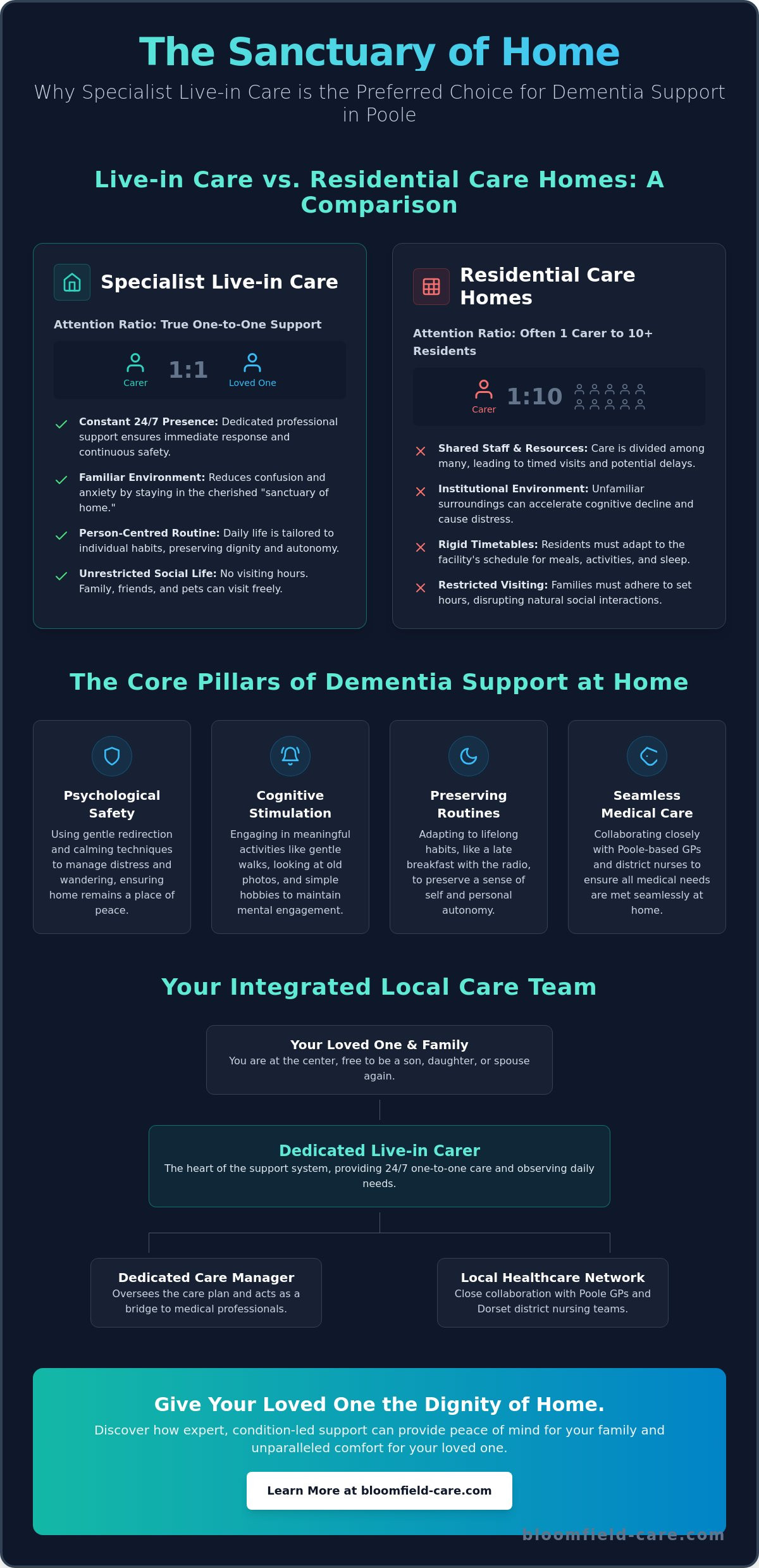
Live-in Care vs. Poole Dementia Care Homes: A Comparison
Choosing between residential care and home-based support is a pivotal moment for any family. While Poole’s care homes provide a communal setting, they often rely on shared staffing models. In these environments, one professional may be responsible for multiple residents simultaneously. Opting for live-in dementia care Poole changes this dynamic entirely by providing a dedicated one-to-one relationship. This ensures your loved one is the sole focus of their carer, allowing for a level of personalized attention that institutional settings simply cannot match.
Many families assume that a residential facility is safer because of its clinical appearance. However, safety in dementia care often stems from consistency and the carer’s ability to spot minute changes in health or mood. A live-in professional identifies these shifts immediately, often preventing falls or infections before they require hospital intervention. This proactive approach aligns with the National Dementia Strategy, which emphasizes high-quality, community-based support. Staying at home also means remaining part of the local community, keeping up with visits to familiar spots like Poole Park or local social groups.
One-to-One Attention vs. Institutional Staffing
Managing complex behaviours requires a deep, trusting bond that is hard to build when staff rotate through shifts. Having the same friendly face every day provides the stability a person with dementia needs to feel secure. This consistency allows the carer to learn the subtle nuances of your loved one’s communication. For a more detailed look at these two paths, our Bloomfield Care Home or Care at Home? guide offers a detailed comparison for families in Dorset.
Clinical Safety in a Private Residence
Professional safety at home integrates seamlessly with a domestic lifestyle. Medication management is handled with clinical precision, and we use discreet assistive technologies to monitor well-being without invading privacy. This model remains effective even as needs become more intensive. By utilizing specialist palliative care at home, we ensure that your loved one receives high-level medical and emotional support without ever having to leave the sanctuary of their own residence.
Navigating Dementia Support Services in Poole and Dorset
Setting up support in Poole requires more than just hiring help; it involves connecting with a network of local professionals who understand the Dorset healthcare landscape. The first step for most families is requesting a Care Needs Assessment from BCP Council. This official review determines the level of support required and whether the local authority provides financial assistance. Next, you’ll need to coordinate closely with your local Poole GP and the Memory Clinic. These medical experts provide the formal diagnosis and ongoing clinical oversight necessary for high-quality live-in dementia care Poole.
It’s also vital to create an Advance Care Plan (ACP). This document ensures your loved one’s future wishes regarding their health and lifestyle are documented and respected, even if their ability to communicate them changes. Finally, don’t overlook local Poole charities and support groups. Organizations like Prama or local memory cafés offer supplementary aid and emotional support that can be invaluable for families. They provide a sense of community that reminds you that you aren’t alone in this process.
Working with Local Healthcare Professionals
A successful care plan relies on seamless communication between the home and the wider medical community. Your live-in carer acts as a vital link, coordinating with district nurses and local pharmacies in Poole to manage prescriptions and clinical needs. If your loved one is currently in Poole Hospital, the transition back to a home setting is a critical moment. Professional live-in support ensures that discharge plans are followed accurately, reducing the risk of readmission. This multi-disciplinary approach is particularly important as you move through the different dementia stages, ensuring support evolves alongside the condition.
Understanding Funding and Costs in Poole
Navigating the financial side of care can feel daunting, but several avenues exist to help manage the investment. If dementia symptoms are particularly advanced, your loved one might be eligible for Continuing Healthcare (CHC) funding, which is fully funded by the NHS. For others, Attendance Allowance provides a non-means-tested weekly payment to help with the costs of care. Local authority support in Dorset is also an option for those who meet specific financial thresholds. For a detailed breakdown of what to expect, you can view our guide on the cost of home care in Oxfordshire and Dorset.
If you’re ready to discuss how we can help you navigate these steps, contact our Poole care team today for a gentle, no-obligation conversation about your family’s needs.
Dignified Dementia Support with Bloomfield Care
At Bloomfield Care, we believe that a diagnosis should never be the end of a person’s story. Our philosophy is rooted in a commitment to dignity, respect, and profound reassurance. We don’t just provide a service; we build relationships that honour the individual’s history. Our specialist live-in dementia care Poole team is trained to see the person behind the symptoms, ensuring that life remains rich with meaning and familiar comforts. We understand that inviting someone into your home is a significant decision, which is why we approach every partnership with the heart of a family-oriented support system.
Excellence in support starts with our specialist training programmes. Every carer undergoes rigorous preparation for dementia and Alzheimer’s care, focusing on the nuances of cognitive decline. However, clinical skill is only one part of the equation. We take great pride in our matching process, pairing carers with clients based on shared interests, personality traits, and lifestyle choices. Whether it’s a shared love for the Dorset coastline or a specific way of preparing a Sunday roast, these small connections form the foundation of trust. Our approach to care planning is intentionally unhurried, allowing us to listen more than we speak and conduct regular reviews that keep your family’s needs at the centre of everything we do.
Our Person-Centred Care Planning
We focus on building a bespoke care team that feels like a natural extension of your family. As dementia progresses, your loved one’s needs will inevitably change. We provide continuous monitoring and adaptation, shifting our approach to maintain safety while prioritizing mental well-being. This isn’t just about managing a condition; it’s about comprehensive wellness. We ensure that every aspect of daily life, from nutrition to social engagement, is handled with excellence, empowering the individual to maintain their autonomy within the sanctuary of their own home.
Next Steps for Poole Families
Taking the first step often feels like the hardest part of the journey, but we’re here to guide you with grace and clarity. You can book a compassionate care assessment in Poole or surrounding Dorset areas by reaching out to our local team. During our first meeting in your home, we’ll sit down together to discuss your specific situation. We’ll answer your questions and begin shaping a plan that offers your family true peace of mind. You don’t have to navigate this transition alone. We’re ready to walk alongside you, providing the professional safety and domestic warmth your loved one deserves.
Protecting Your Loved One’s Sanctuary in Poole
Choosing the right path for a family member living with cognitive decline is a deeply personal and often emotional journey. We’ve explored how staying at home preserves a vital sense of identity and how one-to-one support provides a level of safety and continuity that shared residential facilities simply cannot replicate. By coordinating with local healthcare pathways and focusing on a person-centred approach, you can ensure your loved one remains in the environment where they feel most secure. Specialists in live-in dementia care Poole are here to help you bridge the gap between clinical necessity and the warmth of a domestic environment.
As a CQC registered and inspected provider with specialist dementia and palliative training, our locally managed Poole and Dorset team is dedicated to providing profound reassurance. If you’re ready to explore how we can support your family, please Request a Compassionate Dementia Care Assessment in Poole. You don’t have to navigate these complex decisions alone. We’re here to help you rediscover your role as a daughter, son, or spouse, while we provide the expert, unhurried care your loved one deserves.
Frequently Asked Questions
How quickly can live-in dementia care be arranged in Poole?
We can often arrange support within 48 to 72 hours, depending on the urgency and the specific needs of your loved one. This process involves a thorough assessment to ensure we match the right professional to your home. We act quickly. While we provide relief for families, we never rush the matching process. Building a foundation of trust is essential for long-term stability and peace of mind.
What is the difference between dementia care and standard elderly care?
Specialist dementia care prioritizes neurological well-being and psychological safety, while standard elderly care focuses more on physical tasks. It involves specific techniques to manage memory loss, confusion, and mood shifts. Our carers are trained to recognize subtle triggers and use gentle redirection. This ensures that the support provided is tailored to the unique cognitive challenges of the condition rather than just addressing physical frailty or mobility issues.
Can live-in care manage late-stage dementia and wandering?
Yes, specialist live-in dementia care Poole professionals are specifically trained to manage advanced symptoms like wandering and “sundowning.” Having a dedicated person in the home 24/7 means someone is always there to provide a calming presence. Safety is our priority. We use discreet monitoring and gentle engagement to prevent distress. This allows your loved one to remain in their familiar sanctuary even as their needs become more complex.
Is live-in care more expensive than a Poole nursing home?
Live-in care is often comparable in cost to high-end nursing homes in Poole, and it’s frequently more cost-effective for couples who wish to stay together. Unlike residential facilities where you pay for a room and shared staff, live-in support provides dedicated one-to-one attention. You’re investing in a personalized service that focuses entirely on your loved one’s dignity, routine, and specific healthcare requirements within their own private residence.
Do we need to make major house renovations for a live-in carer?
You don’t need to undertake major renovations, but you will need to provide a private, furnished bedroom for the carer. This room should offer a comfortable space for them to rest during their off-duty hours. We might suggest minor safety adaptations like grab rails or sensor mats to enhance security. However, the goal is always to maintain the domestic warmth of the home rather than creating a clinical or hospital-like environment. For families residing in managed blocks or estates in the South West, ensuring the wider property is equally well-maintained can be handled by specialists like Winfields Block Management, allowing you to focus entirely on the quality of care within the home.
What happens if our needs change or the condition progresses rapidly?
Our care plans are designed to be flexible and evolve alongside the individual. We conduct regular reviews to ensure the level of support remains appropriate as the condition progresses. If needs change rapidly, we coordinate with your local Poole healthcare team to adjust the plan. This ensures that the transition to more intensive support is handled with the same unhurried compassion and professional expertise you have come to expect.
How do you ensure the carer is the right fit for my loved one?
We use a detailed matching process that considers personality, hobbies, and lifelong habits alongside clinical requirements. We believe that live-in dementia care Poole is most successful when there is a genuine human connection. By pairing your loved one with someone who shares their interests, we create a partnership rooted in friendship. This approach significantly improves the quality of life and emotional well-being for everyone involved.
Does BCP Council provide funding for live-in dementia care?
BCP Council may provide funding if your loved one meets the eligibility criteria following a Care Needs Assessment. This support is typically means-tested, looking at savings and assets. You may still qualify for other help. Even if you don’t qualify for full council funding, you might still be eligible for non-means-tested benefits like Attendance Allowance. We recommend contacting the council’s adult social care team for guidance.