

Imagine your father sitting in his favourite armchair, the one by the window where he’s watched the garden grow for thirty years, sipping tea from his own mug. For many families, the thought of replacing this familiar sanctuary with a clinical room in a residential facility feels like a quiet betrayal of a loved one’s independence. You want them to be safe, but you also want them to remain themselves. Choosing live-in care Dorset ensures that your relative doesn’t have to sacrifice their autonomy or their home for the sake of professional support.
We understand the heavy weight of this decision. You’re likely feeling a mix of guilt that you can’t provide the care yourself and confusion about how to handle the 2026 funding rules. This guide provides a clear roadmap to help you move forward with grace. We’ll explore how a dedicated carer integrates into your family’s daily rhythm, how to verify safety through the latest CQC standards, and what to expect regarding the £23,250 local authority capital limit. You’ll discover how to transition from a place of worry to a future defined by peace of mind and compassionate, person-centred support.
Key Takeaways
- Learn how live-in care preserves your loved one’s independence by providing 24/7 professional support within the sanctuary of their own home.
- Understand why live-in care Dorset offers a superior alternative to residential facilities through personalised one-to-one attention and the preservation of local community ties.
- Discover how specialised support for dementia and Alzheimer’s utilises familiar surroundings and routines to provide stability and comfort.
- Gain clarity on care funding and how live-in support can be a more cost-effective solution for couples compared to separate care home placements.
- Find peace of mind with a roadmap for starting person-centred care that prioritises dignity, safety, and the unique needs of your family.
What is Live-in Care in Dorset and How Does it Work?
At its heart, live-in care is a 24-hour professional support system that allows your loved one to remain in the comfort of their own home. Unlike traditional visiting care, where help arrives in short bursts, a dedicated carer resides within the property. This ensures that assistance is always at hand, whether it’s help with a morning routine or a reassuring presence during the night. For many families, understanding What is a live-in caregiver? is the first step in exploring alternatives to residential facilities.
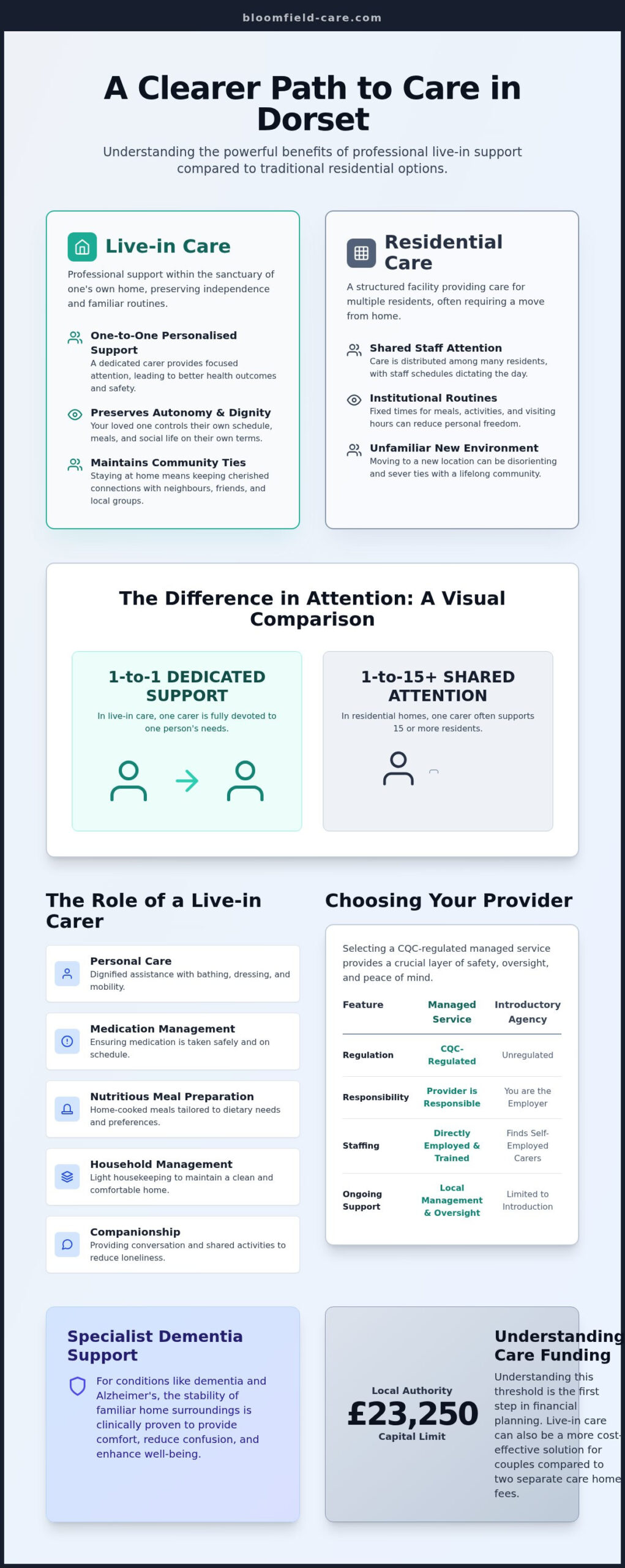
The core philosophy of live-in care Dorset is rooted in the belief that the home is a sanctuary. Whether your family is based in the coastal beauty of Weymouth or the quiet lanes of Christchurch, staying in familiar surroundings is vital for mental well-being. Traditional care homes often require residents to adapt to rigid institutional schedules and shared staff. In fact, while a care home might have a staff-to-resident ratio of 1:15, live-in support provides a dedicated 1:1 relationship. If your mother prefers breakfast at 10 am or enjoys a specific walk along the Dorset coast, her carer is there to facilitate that lifestyle, not restrict it.
The Role of a Live-in Carer
A carer’s duties are as varied as the people they support. They provide essential help with personal care, such as bathing and dressing, and ensure medication is taken safely and on time. Beyond these clinical needs, they manage the domestic rhythm of the house. This includes preparing nutritious, home-cooked meals and keeping on top of light housework. However, the most profound benefit is often the companionship. Having someone to share a conversation with or watch a favourite programme alongside can significantly reduce the loneliness that often accompanies aging. It’s about enhancing quality of life, not just managing daily tasks.
Managed Care vs. Introductory Agencies
When researching your options, you’ll encounter two main models: managed services and introductory agencies. Choosing a CQC-regulated managed provider like Bloomfield Care offers a level of security that agencies simply cannot match. With a managed service, we take full responsibility for the quality of care. We employ, train, and supervise our staff directly. You won’t have to worry about the logistics of employer liability or finding a replacement if a carer falls ill. We have local Dorset-based managers who provide regular oversight, ensuring that the care plan remains perfectly aligned with your loved one’s evolving needs. This partnership-driven approach provides the stability and calm families need during sensitive times.
The Benefits of Choosing Care at Home Over a Care Home
Choosing live-in care Dorset represents more than just a logistical shift in how assistance is delivered. It’s a fundamental choice to protect the emotional and psychological well-being of a loved one. When someone moves into a residential facility, they often leave behind the community they’ve spent decades building. By staying at home in towns like Weymouth or Christchurch, they maintain their local connections. They can still wave to the same neighbours, visit their regular shops, and feel the sea breeze on familiar coastal paths. This continuity provides a sense of security that no care home can replicate.
From a clinical perspective, the advantages are equally compelling. In a traditional care home, staff are often stretched thin, sometimes managing a 1:15 ratio. This means care is scheduled around the facility’s needs, not the individual’s. With a dedicated carer, the support is entirely one-to-one. This leads to better medication management, fewer falls, and more attentive monitoring of health changes. While Understanding care funding is a vital part of the process, the value of this personalised attention is often the deciding factor for families seeking excellence in service.
Protecting Independence and Dignity
Institutional life naturally tends toward a “one size fits all” approach. Meals are served at set times, and visiting hours are often restricted. Choosing to stay at home empowers your loved one to remain the master of their own domain. They decide when to wake up, what to eat, and who comes through the front door. This autonomy is essential for maintaining dignity. It prevents that “institutionalised” feeling where individuals start to lose their sense of self-sufficiency. With professional backing, they can continue to live life on their own terms, feeling supported rather than managed.
Safe and Familiar Surroundings
Your home is your sanctuary. It’s filled with personal belongings, family photos, and decades of memories that provide comfort during difficult times. Moving an elderly person can trigger “relocation stress syndrome,” a condition that can lead to confusion and a decline in physical health. Staying in a familiar environment acts as a buffer against this distress. You can explore the nuances of this decision in our Bloomfield Care home or care at home? guide. If you’re ready to see how a tailored plan could work for your family, our team is here to provide a compassionate consultation to help you find the right path forward.
Specialist Live-in Support: Dementia and Complex Care
Cognitive decline often brings a world of confusion and sensory overload. For someone living with dementia, the layout of their own hallway or the specific view of the Dorset coast from their window isn’t just scenery; it’s a vital anchor to reality. Live-in care Dorset provides the stability needed to navigate these challenges without the profound distress of a new environment. By remaining in a home they know, individuals can rely on muscle memory and familiar landmarks to maintain a sense of peace that a busy residential ward often cannot provide.
Professional carers in this specialist field undergo rigorous training to understand the nuances of Alzheimer’s and other forms of dementia. They don’t just manage symptoms. They learn the individual’s life history, their quiet preferences, and their specific triggers. This high level of expertise is monitored by the Care Quality Commission (CQC), ensuring that every aspect of the support meets strict safety and quality standards. We also collaborate closely with local Dorset healthcare teams, including district nurses and GPs, to provide a joined-up approach that addresses both physical health and emotional wellness.
Dementia Care at Home
Confusion and agitation often stem from a lack of familiar cues. Our person-centred techniques focus on validation and creating a calm, unhurried atmosphere. Having the same carer every day is transformative. They recognise the small, subtle signs of distress before they escalate, providing a level of continuity that is impossible in high-turnover environments. For a deeper look at how needs evolve over time, you can read our guide on understanding dementia stages.
Palliative and Respite Options
Families facing end-of-life care need a partner who understands the sanctity of these final moments. Live-in support allows for a dignified, peaceful experience at home, surrounded by loved ones and personal comforts. We also offer short-term respite for family members in Dorset who may be feeling the strain of full-time caregiving. Taking a break is not a sign of failure; it’s a necessary step to ensure you can continue to support your relative with patience and love. Our compassionate guide to palliative care at home offers more detail on how we support families through these sensitive transitions with grace and professional safety.
Understanding the Costs and Funding of Care in Dorset
Discussing the financial aspects of care is often the most stressful part of the journey for families. It’s a topic that requires both transparency and a gentle touch. When comparing options, many families are surprised to find that live-in care Dorset is often comparable to, or even more affordable than, a high-quality residential care home. While a standard residential placement in the UK for 2026 typically ranges between £1,200 and £1,800 per week, live-in support offers a dedicated one-to-one service that residential facilities cannot match at a similar price point.
For couples, the financial benefits are even more pronounced. In a care home setting, a couple would usually be charged for two separate beds, effectively doubling the cost. With live-in support, a single carer can often assist both individuals for a modest additional fee. This allows partners to stay together in their own home, surrounded by their shared history, while significantly reducing the total weekly spend. Beyond the immediate fees, staying at home helps preserve the value of the family residence, avoiding the immediate pressure to sell the property to fund residential fees.
Navigating Funding Options
The path to securing financial support starts with a conversation with Dorset Council. They conduct care assessments and means-testing to determine eligibility for local authority funding. For the 2026 financial year, the upper capital limit remains £23,250; if your loved one’s assets are above this, they’ll likely be expected to self-fund. However, non-means-tested support like Attendance Allowance is available to many. In cases of primary health needs, NHS Continuing Healthcare (CHC) may cover the full cost of care. For a detailed breakdown of these variables, see our 2026 guide to the cost of home care.
The Assessment Process
We believe that every care plan should begin with a listening ear rather than a checklist. Our free care needs assessment is designed to be unhurried and supportive, giving your family the space to express concerns and preferences. We look at the level of dependency, specialist requirements like dementia support, and the daily rhythm of the home to ensure the right fit. This thorough planning ensures that the investment you make provides not just professional safety, but genuine emotional reassurance for everyone involved. If you’re ready to explore how this could work for your family, you can book a free care assessment with our Dorset team today.
Why Choose Bloomfield Care for Live-in Support in Dorset?
Trust isn’t built overnight. Since our founding in 2014, we’ve focused on creating a care environment that feels less like a clinical service and more like a warm, supportive extension of your own family. Choosing live-in care Dorset through Bloomfield Care means partnering with a team that values human connection above all else. We maintain a strong local presence across Poole, Christchurch, and Weymouth; this ensures our care managers are always close by to provide oversight and reassurance.
Our approach to matching carers with clients goes far beyond a simple checklist of clinical skills. We believe that for a carer to truly enhance a person’s life, there must be a genuine personality match. If your loved one has a passion for local history, gardening, or simply enjoys a specific style of home cooking, we look for a professional who shares those interests. This focus on compatibility transforms the care experience from a managed routine into a meaningful partnership that respects the sanctity of the individual’s lifestyle.
A Trusted Advisor for Your Family
We understand that the path to arranging care is often paved with anxiety and difficult questions. Our role is to act as a trusted advisor, guiding you through every sensitive topic with grace and clarity. We don’t rush the decision-making process. Instead, we listen deeply to your concerns, providing an unhurried space where your family’s needs are heard and respected. Our goal isn’t just to manage daily tasks; it’s to empower your loved one to maintain their self-sufficiency and joy within their own sanctuary.
Getting Started with Bloomfield Care
Starting the journey toward professional support is a straightforward, supportive process. It begins with a simple phone call or message to our Dorset team to arrange an initial consultation. During this first meeting, our care managers visit the home to understand the unique rhythm of your loved one’s life. We discuss everything from medical requirements to morning routines, ensuring the final care plan is truly person-centred. For families who may not require 24/7 support yet, we also offer bespoke domiciliary care in Weymouth and the surrounding areas. Whether you need intensive live-in support or occasional companionship, our commitment to dignity, integrity, and excellence remains the same. We are here to help you find the right path forward, providing the professional safety and domestic warmth your family deserves.
Protecting the Sanctity of Home and Independence
Choosing the right support for a loved one is a journey that begins with a single, compassionate step. You’ve discovered how staying at home protects the sanctuary of familiar surroundings while providing the dedicated one-to-one attention that residential facilities often can’t match. From navigating the 2026 funding rules to finding a specialist who understands the nuances of dementia, live-in care Dorset provides a safe, dignified alternative that keeps families together. It’s about more than just managing daily tasks; it’s about enhancing life quality in the place where your relative feels most secure.
We are here to act as your trusted advisor, offering the professional safety of a CQC regulated provider combined with the heart of a local, family-oriented team. With our specialist dementia support and local Dorset-based care managers, you can move forward with confidence and peace of mind. Your family deserves a care plan that is as unique as the person receiving it. When you’re ready to explore the possibilities, we’re ready to listen and support you through every sensitive decision.
Request a Compassionate Care Assessment in Dorset Today
Frequently Asked Questions
How much does live-in care in Dorset cost compared to a care home?
Live-in care is often comparable to or more cost-effective than a high-quality residential home, particularly when you consider the level of dedicated support provided. While residential fees cover a shared environment and a high staff-to-resident ratio, live-in fees secure a 1:1 relationship in your own home. For couples, the saving is even more significant as they don’t have to pay for two separate rooms in a facility.
Does the live-in carer need their own room?
Yes, a live-in carer requires a private, furnished bedroom to ensure they have a space to rest and maintain their own well-being. This room should include a bed and storage for their belongings, as well as access to bathroom facilities. Providing a comfortable environment for the carer helps foster a positive, long-term relationship, which is essential for the stability and quality of the support provided.
Can a live-in carer help with dementia or Alzheimer’s?
Specialist carers are specifically trained to support individuals living with various forms of cognitive decline. By maintaining a familiar routine in a known environment, live-in care Dorset helps reduce the confusion and distress that often accompanies a move to a new setting. Carers use person-centred techniques to manage symptoms like agitation or “sundowning,” focusing on validation and emotional comfort rather than just clinical tasks.
What happens if my live-in carer is unwell or takes a holiday?
As a managed care provider, we take full responsibility for arranging holiday and sickness cover so your loved one is never without support. We manage a team of professional carers and will introduce a suitable replacement who’s been briefed on the specific needs and routines of the household. This seamless transition ensures continuity of care, giving families peace of mind that the daily rhythm of the home won’t be disrupted.
Is live-in care in Dorset regulated by the CQC?
All reputable providers of personal care must be registered and regulated by the Care Quality Commission (CQC). This regulation ensures that the services provided are safe, effective, caring, responsive, and well-led. As the CQC transitions to new assessment frameworks toward the end of 2026, we remain committed to meeting and exceeding these rigorous standards to ensure the highest quality of service for every family we support.
Can live-in care support couples staying together at home?
Live-in support is an ideal solution for couples who wish to stay together but have differing care needs. It prevents the heartbreaking separation that often occurs when one partner requires residential support while the other doesn’t. A single carer can often manage the needs of both individuals, providing a much more person-centred and affordable alternative to paying for two separate placements in a Dorset care home.
How quickly can live-in care be arranged in an emergency?
We understand that care needs can sometimes change overnight, and we strive to respond as quickly as possible to emergency requests. While a thorough assessment is always necessary to ensure safety and the right carer match, we can often begin the planning process immediately. Our local Dorset managers are experienced in coordinating rapid support for families facing sudden hospital discharges or a breakdown in existing care arrangements.
What local areas in Dorset do you cover for live-in care?
We provide live-in care Dorset families can rely on across the entire county, including major towns and smaller villages. Our dedicated teams are active in Weymouth, Christchurch, Poole, Bournemouth, Dorchester, and the surrounding rural communities. Having local managers based within the county allows us to provide responsive oversight and maintain close relationships with both our clients and their wider healthcare professionals.