
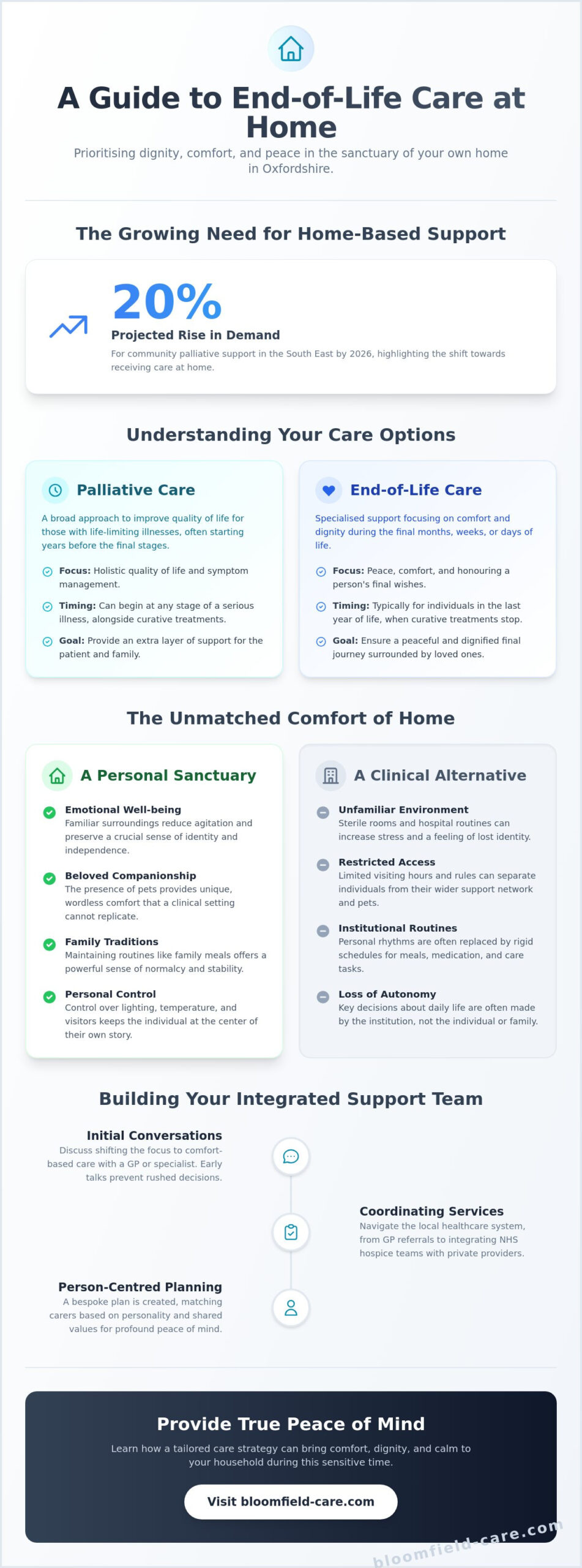
Imagine sitting at your kitchen table in Witney, looking at a hospital discharge letter and wondering how you’ll manage the nights ahead. By 2026, the demand for community palliative support in the South East is projected to rise by 20%, leaving many families searching for high-quality end of life care at home Oxfordshire. You believe that home should be a sanctuary, and the thought of your loved one spending their final days in a clinical ward feels like a compromise on the dignity and independence they’ve always cherished.
It’s natural to feel overwhelmed by the logistics of the NHS while managing your own emotional exhaustion. We understand that you want a peaceful environment where you can focus on being a family rather than just a caregiver. This guide shows you how bespoke care plans provide the professional 24/7 support needed to maintain comfort and safety. You’ll learn how to coordinate local services, manage a crisis with confidence, and build a tailored care strategy that brings true peace of mind to your household during this sensitive time.
Key Takeaways
- Understand the 2026 healthcare framework for end of life care at home Oxfordshire, prioritising your loved one’s dignity and comfort within their own familiar sanctuary.
- Learn the vital distinctions between palliative and end-of-life support to ensure the care provided evolves seamlessly with your family’s changing needs.
- Discover why the warmth of a private residence offers a more peaceful, flexible alternative to clinical hospital settings for these precious final moments.
- Gain clarity on navigating the local healthcare system, from GP referrals to coordinating bespoke private support alongside NHS hospice teams.
- Explore how a person-centred approach—matching carers based on personality and shared values—provides profound peace of mind for the entire family.
Understanding End of Life Care at Home in Oxfordshire
In 2026, the healthcare landscape in Oxfordshire has shifted significantly toward person-centred, community-based support. Families in towns like Wallingford and Abingdon are increasingly moving away from the clinical setting of a hospital, choosing instead to create a sanctuary within their own four walls. Choosing end of life care at home Oxfordshire allows a person to remain in a place where every corner holds a memory, ensuring their final weeks are defined by peace rather than sterile routines. This philosophy prioritises the sanctity of the home, treating it as a space of profound dignity where medical needs are met with a gentle, professional touch.
The Care Quality Commission (CQC) plays a vital role in this journey, regulating home care providers across Oxfordshire to ensure safety and compassion remain at the forefront of service. As of early 2026, the emphasis on integrated care means that private providers work closely with local district nurses and palliative specialists. This collaborative framework ensures that clinical excellence never comes at the expense of the human connection. Understanding End of Life Care involves recognising that medical intervention is just one part of a much larger, bespoke plan designed to honour an individual’s lifestyle and wishes.
When is it time to consider end of life care?
Recognising the right moment to transition from curative treatment to comfort-focused support is a deeply personal process. It often begins when a specialist or an Oxfordshire GP suggests that the focus should shift toward managing symptoms and enhancing the quality of remaining life. Early conversations are essential; they prevent rushed decisions during a crisis and allow for a tailored care plan to be established. End of life care is a holistic support system that provides physical comfort and emotional stability for both the person receiving care and their loved ones.
The emotional benefits of staying in familiar surroundings
The psychological impact of remaining at home shouldn’t be underestimated. For many in our Oxfordshire community, the sight of a well-tended garden in Abingdon or the comfort of a favourite armchair can significantly reduce the agitation often associated with advanced illness. Staying at home preserves a sense of identity and independence that is frequently lost in institutional settings. It allows for the small, vital rhythms of life to continue uninterrupted:
- Pets and Companionship: Keeping a beloved dog or cat nearby provides a unique form of wordless comfort that hospitals cannot replicate.
- Family Traditions: Whether it’s a Sunday roast or a specific evening radio programme, these routines offer a sense of normalcy and stability.
- Bespoke Environment: Having control over lighting, temperature, and visitors empowers the individual, keeping them at the centre of their own story.
By choosing end of life care at home Oxfordshire, families ensure that their loved ones are surrounded by the people and things they cherish most. This approach transforms a difficult season into a period of shared intimacy and profound respect, providing a sense of calm that resonates through the entire family unit.
Palliative vs. End of Life Care: Bespoke Support for Your Loved One
Understanding the difference between palliative and end of life care is the first step in planning a peaceful future. While the terms are often used together, they represent distinct phases of support. Palliative care is a broad approach that improves quality of life for those with life-limiting illnesses, often starting years before the final stages. In contrast, end of life care focuses on the final months, weeks, or days. When arranging end of life care at home Oxfordshire families can rely on a transition that feels natural, unhurried, and deeply respectful of the individual’s wishes.
Bloomfield Care provides palliative care that evolves alongside the patient. We don’t believe in “one size fits all” solutions. Instead, we coordinate a multidisciplinary approach involving your GP, district nurses, and our dedicated carers. This ensures that clinical requirements, such as pain management, are balanced with the emotional warmth of a familiar face. It’s about creating a sanctuary where medical needs are met without the clinical atmosphere of a hospital ward.
Specialist support for complex conditions
Every diagnosis brings its own set of hurdles. For those navigating the later dementia stages, the challenge is often communication and sensory comfort. Our carers are trained to recognise non-verbal cues of distress or pain, ensuring that comfort is maintained even when words are difficult to find. For patients with advanced cancer, we focus heavily on managing symptoms like breathlessness and anxiety with professional precision. Medication is always administered with gentleness, ensuring that dignity remains the priority during every interaction.
Holistic care for the whole family
Care doesn’t end with the patient; it extends to the partners and children who are often exhausted by the emotional weight of a terminal diagnosis. We provide psychological reassurance to Oxfordshire families, acting as a steady hand during turbulent times. Companionship plays a vital role here. By preventing isolation for both the patient and their partner, we help maintain the human connections that make life meaningful.
Bespoke care plans are reviewed daily to reflect changing needs. This flexibility means that as a condition shifts, our support shifts with it, providing total peace of mind for everyone involved. If you need a partner in this journey, you can learn more about our approach at Bloomfield Care.
Why Home is the Preferred Choice for Oxfordshire Families
Choosing the setting for a loved one’s final chapter is a decision that carries immense emotional weight. While Oxford’s renowned hospitals provide world-class medical intervention, they often lack the quiet intimacy required for a dignified, peaceful farewell. End of life care at home Oxfordshire transforms a private residence into a sanctuary, allowing families to avoid the rigid schedules and clinical hum of a hospital ward. It’s about maintaining a sense of normalcy and familiarity when everything else feels uncertain.
The benefits of staying at home extend far beyond emotional comfort. Clinical environments, despite their expertise, carry a higher risk of hospital-acquired infections, which can be particularly distressing for someone in a frail state. By choosing live-in care, families secure 24/7 clinical safety without the institutional atmosphere. There are no restricted visiting hours here. Grandchildren can visit after school, pets can remain by the bedside, and family members can stay involved in every aspect of the daily routine without feeling like they’re in the way of busy medical staff.
Home vs. Hospice: Making the right decision
While excellent facilities like Sobell House provide vital specialist support, many Oxfordshire families prefer the continuity of their own four walls. A primary advantage of end of life care at home Oxfordshire is the 1-to-1 carer ratio. In a hospital or large facility, a single nurse might look after six or eight patients at once; at home, the focus remains entirely on your loved one. This bespoke attention ensures that subtle changes in comfort or pain levels are noticed and addressed immediately. The “Bloomfield Care Home or Care at Home” debate often settles on the latter because it preserves the individual’s lifestyle and independence for as long as possible.
Financial considerations for Oxfordshire residents
Understanding the cost of home care is a practical necessity for families in 2026. While residential fees in the county can be high, home-based support often proves to be a more flexible financial choice. Some residents may qualify for Oxfordshire County Council funding or Continuing Healthcare (CHC) through the NHS. However, many choose private funding to ensure a higher level of consistency and choice in their caregivers. The ultimate return on investment isn’t just the professional medical support; it’s the profound peace of mind that comes from knowing a loved one is safe, comfortable, and truly at home.
Coordinating Care: Working with Oxfordshire NHS and Private Providers
Navigating the complex healthcare landscape during a sensitive time requires a steady hand and clear communication. You can initiate the journey by speaking with your GP surgery, whether you’re registered at the Malthouse Surgery in Abingdon or the Summertown Health Centre in Oxford. This initial conversation triggers the necessary referrals for end of life care at home Oxfordshire families rely on for dignity and comfort. We work in close synergy with the NHS Home Hospice Care Team, ensuring our private support complements the clinical resources provided by the state. This partnership creates a robust safety net around your loved one.
Managing the transition from a hospital ward to the familiarity of home is a critical phase. If your family member is being discharged from the John Radcliffe Hospital or a facility in West Berkshire, we coordinate directly with the hospital discharge teams. We ensure that the transition is seamless, with equipment and care staff ready the moment the patient crosses their own threshold. In 2026, we utilise shared digital records to maintain continuity. This technology allows every professional involved to see real-time updates, which means you won’t have to repeat your story to different clinicians during an already exhausting time.
Advance Care Planning (ACP) in Oxfordshire
An ACP is a vital tool for respecting a loved one’s wishes and maintaining their personal agency. It outlines specific preferences for medical interventions and comfort measures, providing a roadmap for the entire care team. For those needing to set up a Lasting Power of Attorney (LPA), local resources like Age UK Oxfordshire or Oxford-based legal specialists offer guidance to ensure legal protections are in place. An Advance Care Planning (ACP) is a living document that guides all clinical decisions.
The role of the District Nurse and GP
Our Bloomfield carers provide the daily, heart-centred support that keeps a home running smoothly, but we don’t work in isolation. We collaborate with Oxfordshire District Nurses who visit to perform clinical tasks such as managing syringe drivers or wound care. We also participate in Gold Standards Framework (GSF) meetings with your GP. These meetings are essential for reviewing the care plan and ensuring every medical need is anticipated. For peace of mind during the night, the Oxfordshire 111 service provides reliable out-of-hours support, ensuring clinical advice is always just a phone call away.
We’re here to help you coordinate every detail of this journey with grace and expertise. Discover our bespoke end of life support services and how we can support your family.
How Bloomfield Care Supports Families Across Oxfordshire
Choosing the right support for a loved one is a profound decision. At Bloomfield Care, we believe that every individual deserves to remain in the sanctuary of their own home, surrounded by the sights and sounds they love. Based in Wallingford, our dedicated team extends this commitment to families across the entire county. We don’t just provide medical assistance; we offer a partnership built on trust and genuine affection. This is what we call the Bloomfield Difference. We carefully match our carers with your loved one based on personality and shared interests, not just clinical skills. It’s about finding a companion who understands their history, respects their lifestyle, and brings a sense of warmth into the home.
The transition to end of life care at home Oxfordshire often places an immense emotional burden on family members. You might find yourself overwhelmed by the roles of nurse, coordinator, and advocate. Our presence changes that dynamic. By handling the complex logistics and physical requirements of care, we provide you with the respite needed to be a daughter, a son, or a spouse again. We focus on the details so you can focus on the moments that matter most. Our goal is to return a sense of normalcy to your household, ensuring that your time together is defined by connection rather than the stresses of caregiving.
Our local expertise in Oxfordshire and West Berkshire
Our service area is broad, reaching from the historic streets of Oxford city centre to the rural reaches of the Thames Valley. Being local matters. It means our carers are part of your community and can respond with the agility that local knowledge provides. Our recruitment process is exceptionally selective. In 2025, our records showed that only 8% of applicants met our rigorous standards for both clinical excellence and emotional intelligence. We only hire those who demonstrate a natural capacity for compassion. Verified testimonials from families in areas like Abingdon and Didcot highlight the peace of mind our local presence brings, often noting that our carers feel like an extension of their own family within days of arriving.
Beginning the journey with reassurance
Taking the first step is often the hardest part of the process. We aim to make it as gentle as possible. During our initial home visit, we take the time to listen to your story. We don’t rush through a checklist. Instead, we discuss your loved one’s daily routines, their favourite comforts, and their specific medical needs. This information allows us to build a bespoke care team around your family. Every plan we create is unique, designed to protect the independence and dignity of the person we’re supporting. We believe that care should enhance life, providing a stable foundation of safety and comfort. To explore how we can help, you can book a free, no-obligation care assessment. We’ll visit your home to discuss a tailored approach for end of life care at home Oxfordshire, ensuring you have the professional support you need during this sensitive time.
Ensuring Comfort and Connection for Your Family’s Future
Deciding on the best path for a loved one is a journey rooted in love and the desire for lasting peace. You’ve seen how a tailored approach to end of life care at home Oxfordshire transforms these final chapters into a time of genuine comfort. By combining bespoke care plans with the coordination of local NHS services, families ensure their loved ones remain in the familiar sanctuary of their own home. It’s about more than medical management; it’s about honoring a life lived with dignity and respect.
Bloomfield Care provides the professional stability needed during these sensitive times. Our team is CQC Rated “Good” for safety and leadership, offering clinical excellence alongside the warmth of a family-oriented support system. Every one of our carers completes specialist end-of-life training to provide high-quality, holistic support that adapts to your family’s unique needs. We’re here to listen and help you navigate these choices with grace and clarity.
Request a Compassionate Care Assessment in Oxfordshire Today
Taking this first step ensures your loved one receives the expert care they deserve in the place they feel most secure.
Frequently Asked Questions
What is the difference between palliative care and end of life care at home?
Palliative care is holistic support for anyone living with a life-limiting illness, often starting years before the final stages. End of life care is a specific type of palliative support for people considered to be in their last 12 months of life. Both focus on managing symptoms and providing comfort. Our bespoke approach ensures that dignity remains the priority throughout every stage of the journey.
Can end of life care be provided 24/7 in Oxfordshire?
Yes, 24/7 end of life care at home Oxfordshire is available through live-in care or dedicated overnight waking shifts. This level of support ensures a professional is always present to manage pain or provide emotional reassurance. It’s a vital service for families who want to avoid hospital admissions. We tailor these schedules to provide peace of mind during the most challenging hours.
How much does end of life care at home cost in Oxford for 2026?
Based on the Homecare Association’s 2024 report, the minimum sustainable rate for home care is £30.49 per hour. By 2026, families in Oxford should budget between £33 and £39 per hour for specialist visiting care due to inflation. Live-in care options typically start from £1,650 per week. These costs vary depending on the complexity of the medical needs and the frequency of visits required.
Does the NHS pay for end of life care at home in Oxfordshire?
The NHS pays the full cost of care if your loved one qualifies for Continuing Healthcare (CHC) funding. This isn’t means-tested and is based on having a primary health need. For those in the final weeks of life, the Fast Track Pathway ensures a funding decision is made within 48 hours. This allows for immediate, high-quality support without placing a financial strain on the family.
How quickly can Bloomfield Care start providing support in Wallingford?
We can typically begin providing support in Wallingford within 24 to 48 hours of your initial enquiry. We understand that circumstances change rapidly, so we prioritise end of life assessments to ensure a safe transition. Our team works closely with local GPs to get your bespoke care plan in place. This quick response helps maintain the home as a sanctuary during a difficult time.
What happens if my loved one’s needs change suddenly during the night?
If needs change during the night, our 24/7 on-call team or your live-in carer will coordinate immediately with the Oxfordshire Out of Hours GP service. We also maintain close links with District Nurses who can provide clinical interventions at any hour. This collaborative approach ensures that pain relief is adjusted promptly. You’re never alone, as our professional network provides a constant safety net.
Can I still use the Sobell House Home Hospice service if I have a private carer?
You can certainly use Sobell House services alongside a private provider like Bloomfield Care. Sobell House offers specialist clinical advice and consultant-led support, while we provide the daily, hands-on personal care and companionship. This partnership creates a robust, holistic support system for the individual. It combines expert medical oversight with the consistent, familiar presence of a dedicated care team.
What equipment will be needed for end of life care at home?
Most families will need a profiling bed, a pressure-relieving mattress, and a commode to ensure comfort and safety. The Oxfordshire Equipment Service usually provides these items free of charge after an assessment by a District Nurse or Occupational Therapist. We help coordinate these deliveries to ensure everything is ready. Having the right tools is essential for maintaining independence and protecting the dignity of your loved one.