
What if the financial support your family needs to stay safely at home is already available, waiting behind just a few misunderstood forms? We know that the thought of funding home care in Oxfordshire often feels overwhelming, especially when you are trying to balance the emotional weight of a loved one’s changing needs with the complex reality of capital limits and benefit applications. It is completely natural to worry about how to protect your savings while ensuring the highest standard of dignity and comfort for someone you love.
This guide provides a clear, compassionate roadmap through the 2026 funding landscape, from mastering the Attendance Allowance application to understanding local authority support. We will break down the latest capital thresholds for Oxfordshire County Council and explain the difference between NHS and social care funding. By the end, you’ll have a step-by-step plan to secure the specialist support your family deserves, ensuring your home remains a sanctuary of familiar comfort and professional care.
Key Takeaways
- Distinguish between means-tested and non-means-tested benefits to ensure you don’t miss out on vital financial assistance regardless of your savings.
- Master the Attendance Allowance claim process with our guide on documenting specific care needs to secure this essential benefit.
- Understand the specific 2026 capital limits used by the local council when assessing eligibility for funding home care in Oxfordshire.
- Explore the criteria for NHS Continuing Healthcare to determine if complex health needs could qualify your family for fully funded support.
- Learn how a person-centered care assessment provides the necessary evidence for funding applications while simplifying the transition to home care.
Understanding Home Care Funding Options in Oxfordshire
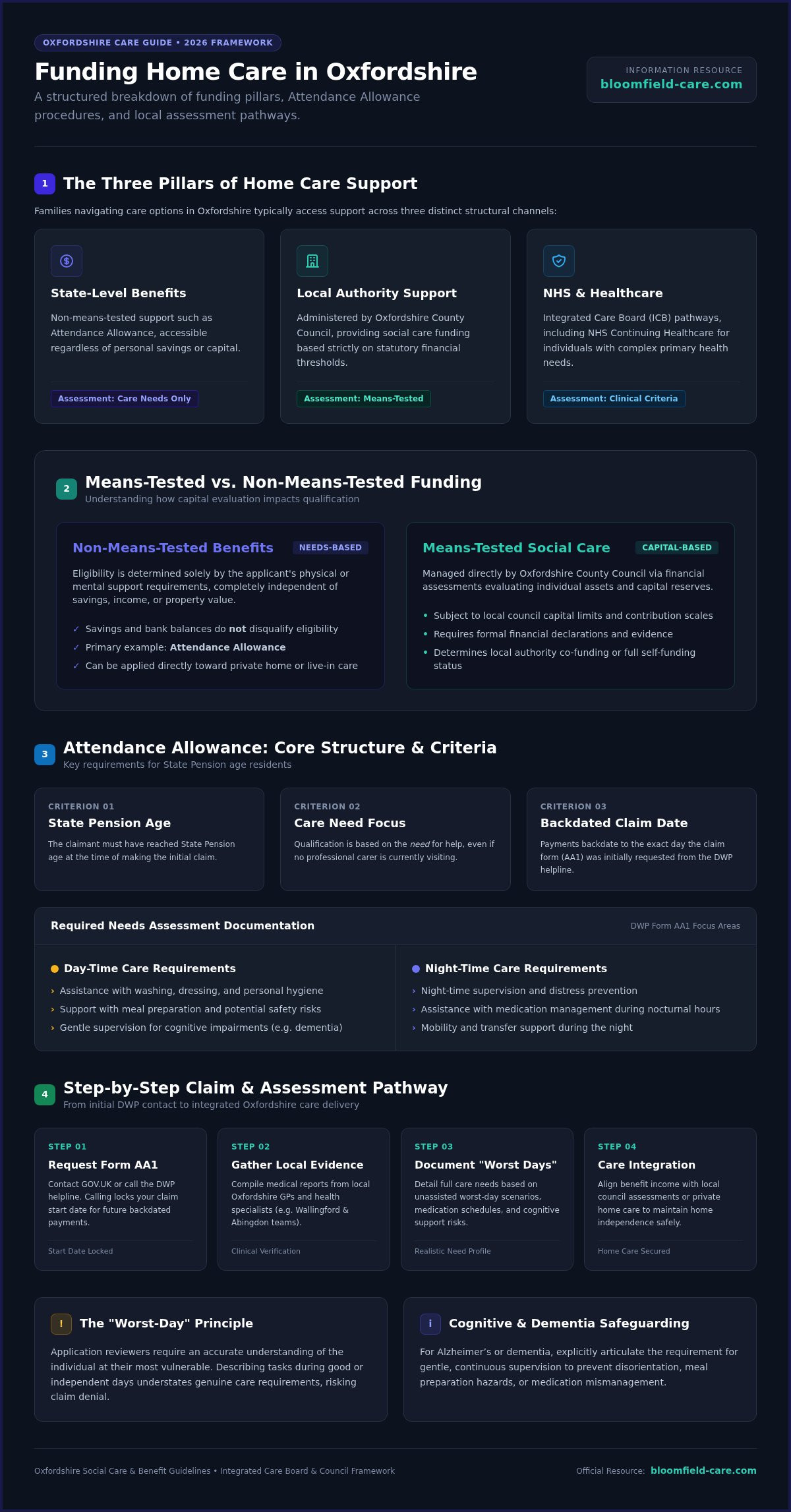
Finding the right path for funding home care in Oxfordshire often feels like solving a puzzle with missing pieces. Most families start their journey by looking at the “three pillars” of support: State-level benefits, Local Authority assistance, and private resources. Understanding which pillar applies to your situation is the first step toward securing a stable future for your loved one. This structure ensures that even if you don’t qualify for council help, other avenues remain open to support a high quality of life.
In the UK, support is split into means-tested and non-means-tested categories. Means-tested support, managed by Oxfordshire County Council, depends on your savings and assets. Conversely, non-means-tested benefits are based solely on care needs, regardless of how much money you have in the bank. We often see families in Wallingford and Abingdon delay their applications because they assume their savings disqualify them from help. Early financial planning isn’t just about the money; it’s about preserving independence and ensuring your loved one stays in the sanctuary of their own home. It provides a sense of stability that alleviates the sudden panic of a health crisis.
What is Attendance Allowance?
Attendance Allowance is perhaps the most overlooked resource for families. It’s a non-means-tested benefit designed for individuals over State Pension age who require help with personal care due to physical or mental disability. You don’t need to have a professional carer already visiting your home to qualify. Instead, the focus is on the need for support. For many of our clients, this benefit serves as the foundational step toward funding live-in care, providing a consistent stream of income that respects their autonomy and lifestyle.
The Local Oxfordshire Landscape in 2026
By 2026, the way local services coordinate has become more integrated. Oxfordshire County Council works closely with private providers to bridge the gap between hospital and home. The Integrated Care Board (ICB) oversees healthcare funding, specifically for those with complex needs. Whether you’re in the heart of Oxford or across the border toward Newbury, your local support pathway is governed by specific regulations regarding home care in the United Kingdom. These local bodies determine how care is commissioned, making it vital to understand their specific assessment criteria early in your journey. Living in different parts of the county can change which local health teams you interact with, but the underlying goal remains the same: providing excellence in service that honors the individual’s dignity.
How to Claim Attendance Allowance for Oxfordshire Residents
Securing Attendance Allowance is often the first practical victory for families looking into funding home care in Oxfordshire. While the process involves several steps, it’s a manageable journey when you take it one stage at a time. The first step is to apply for Attendance Allowance on GOV.UK or by calling the DWP helpline to request form AA1. Once you receive the form, the date you called becomes your claim start date. This is vital because it ensures your payments are backdated to that initial phone call, providing immediate financial relief once the claim is approved.
The application form focuses heavily on your loved one’s specific care requirements. You’ll need to document ‘day-time’ needs, such as help with washing or dressing, and ‘night-time’ needs, like assistance with supervision or medication management. Gathering medical evidence from local Oxfordshire GPs or specialists in Wallingford and Abingdon adds a layer of professional validation to your claim. Submitting the completed form promptly ensures that the support begins from the earliest possible date, helping to maintain the sanctuary of the home environment.
Tips for a Successful Application
When filling out the form, it’s helpful to describe your loved one’s ‘worst day’ rather than a day when they feel relatively independent. This ensures the DWP has an accurate picture of the support they truly need to remain safe and comfortable. Be specific about how they manage medication or the potential risks involved in meal preparation. If you’re caring for someone with cognitive impairments like dementia or Alzheimer’s, emphasize the need for gentle supervision to prevent distress. These details help demonstrate the necessity of person-centered support that honors their autonomy.
Local Support for Your Claim
You don’t have to handle these complex forms alone. Local resources like Age UK Oxfordshire offer dedicated support for residents in Abingdon and Wallingford who need help with form-filling. They understand the nuances of the local system and can guide you through the process with patience and clarity. At Bloomfield Care, our initial care assessments are designed to do more than just plan a service. They provide a professional record of care needs that can serve as powerful evidence for your application, helping you secure the funding home care in Oxfordshire demands while ensuring your loved one’s dignity is always the priority.
Navigating Oxfordshire County Council Financial Assessments
While Attendance Allowance provides a helpful foundation, many families find that funding home care in Oxfordshire requires a deeper look at local authority support. The journey usually begins with a request for a ‘Care Needs Assessment’. This is a free, professional review where a social worker visits your home in Oxford or Newbury to understand your daily rhythm and challenges. They look at ‘eligible needs’ as defined by the Care Act 2014, focusing on your ability to maintain a safe, dignified lifestyle. Before this visit, it’s wise to review the NHS continuing healthcare criteria, as some individuals with complex medical needs might qualify for fully funded care regardless of their financial status.
If the assessment confirms that support is necessary, the council will then conduct a financial means-test. For 2026, the capital thresholds determine who pays for care. If your savings and qualifying assets are above £23,250, you’ll likely be responsible for your own costs as a ‘self-funder’. If your assets fall between £14,250 and £23,250, the council usually contributes toward the cost, though you’ll be expected to make a partial payment. For those with less than £14,250, the council typically covers the majority of the care costs. Homeowners often worry about their property, but for domiciliary care, the value of your main home isn’t usually included in this calculation. If you’re considering live-in care, a ‘Deferred Payment Agreement’ can sometimes act as a loan against your property, ensuring you don’t have to sell your home to pay for support.
The Care Needs Assessment Process
Preparing for your assessment is vital for ensuring your loved one’s sanctuary remains safe. When the social worker visits, they’ll want to see how you manage tasks like mobility, nutrition, and personal hygiene. We recommend having a family member or a trusted advisor present to help describe a ‘typical difficult day’. This ensures that every safety concern is noted and that the resulting care plan truly reflects the level of assistance required to maintain autonomy and well-being.
Self-Funding: Taking Control of Your Care
Many families in Oxfordshire choose to self-fund their care to maintain maximum choice and flexibility. When you manage the cost of home care privately, you aren’t limited to council-commissioned providers. You can partner with a specialist agency like Bloomfield Care, focusing on person-centered support that prioritizes human connection. Some families use private annuities or equity release to bridge the gap. If you do qualify for council help, you can ask for ‘Direct Payments’, which give you the funds to choose your own provider rather than having the council choose one for you. This partnership-driven approach ensures that the care fits your lifestyle, rather than you having to fit into a rigid system.
Exploring NHS Continuing Healthcare and Local Grants in Oxford
Beyond the standard local authority support, some individuals qualify for NHS Continuing Healthcare (CHC). This is a package of care arranged and funded solely by the NHS for those with significant, ongoing health needs. Unlike the council funding discussed previously, this unique pathway is a vital component of funding home care in Oxfordshire for those with the most complex medical requirements. If your loved one has a ‘primary health need’, the NHS covers the full cost of their care, regardless of savings or property value. The Buckinghamshire, Oxfordshire and Berkshire West Integrated Care Board (ICB) manages these assessments, looking at the complexity and unpredictability of the person’s condition. For families facing a rapid decline in health, the ‘Fast Track’ pathway ensures that palliative care at home can be implemented quickly, providing comfort and dignity during sensitive times.
The CHC Checklist and Full Assessment
The process usually begins with a screening checklist performed by a nurse or social worker. If this initial stage suggests eligibility, a full assessment follows. This involves a multi-disciplinary team of health professionals who evaluate the individual’s needs across twelve ‘care domains’. It’s vital to advocate strongly during these meetings, ensuring every nuance of the daily routine is captured. It’s also important to distinguish CHC from NHS Funded Nursing Care (FNC). While FNC is a standard contribution toward nursing costs in a care home, CHC is a comprehensive funding stream that can facilitate high-quality support within your own private residence. If you’re unsure about your eligibility, our team at Bloomfield Care can help you prepare for these clinical discussions.
Disabled Facilities Grants (DFG) in Oxfordshire
Adapting the home environment is another practical way to manage the long-term requirements of funding home care in Oxfordshire. If your loved one needs physical modifications to remain safe, you can apply for a Disabled Facilities Grant through South Oxfordshire or Vale of White Horse District Councils. These grants help pay for essential changes like installing ramps, stairlifts, or converting a bathroom into a wet room. These modifications often reduce the intensity of daily care required, helping to maintain a sense of self-sufficiency. Disabled Facilities Grants are means-tested but can provide up to £30,000 in support. Local Oxfordshire charities and small grant schemes also exist to help with smaller home adaptations, ensuring the house remains a sanctuary of familiarity and ease.
How Bloomfield Care Supports Your Funding Journey and Independence
While the logistics of funding home care in Oxfordshire can seem purely technical, the heart of the matter is always human. We believe that financial planning should serve a single, vital purpose: enhancing the quality of life and independence of your loved one. Our team assists families across Wallingford, Abingdon, and Oxford as they move from the stress of benefit applications to the comfort of a personalized care routine. We don’t just look at the hours of support needed; we look at the individual’s history, their personality, and their unique rhythm of life. This partnership-driven approach ensures that the transition to home care feels like a gentle step forward rather than a sudden, overwhelming change.
Bespoke Care Plans for Oxfordshire Families
Every family has a different budget and a unique set of requirements. We tailor our services, whether you require companionship for a few hours a week or comprehensive live-in care, to ensure the support is both sustainable and effective. Regular reviews are a core part of our philosophy. As health needs evolve, we adjust the care plan so it remains cost-effective and relevant to the individual’s current lifestyle. Our expertise in dementia stages allows us to provide specialist support that adapts to cognitive changes, ensuring that your loved one’s home remains a sanctuary of safety and familiarity.
The Bloomfield Difference: Reassurance and Professionalism
Choosing a care provider is a significant emotional and financial decision. We act as a trusted advisor, helping you make confident choices about how to best use your resources to maintain autonomy. Because we are a fully managed, CQC-regulated service, you don’t have to worry about the complexities of being a legal employer or managing staff yourself. We handle the training, the scheduling, and the rigorous quality assurance, providing a sense of stability that is often missing during times of health crisis. Our team understands the nuances of funding home care in Oxfordshire and is here to ensure that every pound spent translates into excellence in service and mental well-being.
Our commitment to dignity means we take the time to match carers with your loved one’s lifestyle and personality, fostering genuine human connection. We believe that the right match is the foundation of successful care. If you’re ready to explore how we can help your family, contact our Oxfordshire team today to book a free, no-obligation care consultation. We’ll listen to your story, answer your questions about local support, and help you find the best path forward for your loved one’s future.
Securing Your Loved One’s Future at Home
Securing a stable future for your family starts with understanding the options available today. From claiming Attendance Allowance to navigating the latest 2026 capital thresholds, you now have the tools to make informed decisions about funding home care in Oxfordshire. We’ve seen how local grants and NHS support can bridge the gap, ensuring your loved one remains in the sanctuary of their own home. You’ve taken the first step by gathering this knowledge; now you can move forward with a sense of profound reassurance.
Taking the next step doesn’t have to be daunting. As a CQC regulated provider with deep local Oxfordshire expertise and specialist dementia support, Bloomfield Care is ready to act as your trusted advisor. We invite you to Book a Free Care Consultation with our Oxfordshire Team to discuss your specific needs. Together, we can create a person-centered plan that honors your loved one’s lifestyle while providing the professional safety they require. You don’t have to navigate this journey alone; we’re here to support you with patience and integrity every step of the way.
Frequently Asked Questions
Can I get Attendance Allowance if I have savings over £23,250?
Yes, you can claim Attendance Allowance regardless of your savings or income. It’s a non-means-tested benefit, which means your bank balance or property value won’t affect your eligibility. This makes it a vital resource for funding home care in Oxfordshire for families who might not qualify for council support. The focus is entirely on your care needs and the help you require to stay safe and comfortable in your own home.
How much is Attendance Allowance in 2026?
In 2026, Attendance Allowance is paid at two different rates depending on the level of support you need. The lower rate is for those who need frequent help during the day or supervision at night. The higher rate is for individuals who require assistance both day and night, or those with terminal illnesses. These tax-free payments help cover the costs of person-centered support, ensuring your home remains a sanctuary of familiarity and ease.
Does Oxfordshire County Council pay for live-in care?
Oxfordshire County Council can contribute toward live-in care if your Care Needs Assessment identifies it as an eligible requirement. While the council often suggests domiciliary care first, you can use Direct Payments to choose a live-in service instead. This gives you the autonomy to partner with a provider like Bloomfield Care, ensuring you receive consistent, one-to-one support that honors your lifestyle and maintains your independence within your local community.
What happens to my funding if I need to go into hospital temporarily?
If you enter an NHS hospital temporarily, your Attendance Allowance payments usually stop after 28 days. It’s important to notify the DWP to avoid overpayments during your recovery. Once you return to the comfort of your own residence, your payments can be reinstated to help with your ongoing care needs. We work closely with families during these transitions to ensure that professional support is ready the moment you arrive back home.
Can I claim Attendance Allowance and Carer’s Allowance at the same time?
Yes, these two benefits are designed to work together to support your household. An individual can claim Attendance Allowance for their own care needs, while a friend or family member who provides at least 35 hours of support a week may be eligible for Carer’s Allowance. This combined approach helps manage the financial aspects of funding home care in Oxfordshire, providing much-needed stability for families who are dedicated to supporting a loved one’s well-being.
How long does it take for Oxfordshire County Council to complete a financial assessment?
The timeline for a financial assessment by Oxfordshire County Council can vary, but it typically takes several weeks following your initial Care Needs Assessment. Once the council identifies your eligible needs, they will schedule a review of your finances to determine your contribution. We recommend starting this process early to avoid delays in securing support. Our team can offer reassurance and guidance as you prepare for these essential local authority meetings.
Is home care cheaper than a care home in Oxfordshire?
For many families in Abingdon and Wallingford, home care is a more cost-effective and personal alternative to a residential care home. Domiciliary care allows you to pay only for the specific support you need, while live-in care provides 24-hour presence at a rate often comparable to high-quality nursing homes. Most importantly, staying at home preserves your autonomy and keeps you in the sanctuary of familiar surroundings, which is vital for mental wellness.
Can I use my Attendance Allowance to pay for Bloomfield Care services?
Absolutely, you can use your Attendance Allowance to pay for any of our services, including dementia care and companionship. Because the benefit is paid directly to you, you have the freedom to spend it on the professional support that best fits your lifestyle. Whether you need help with medication or meal preparation, these funds empower you to choose a high-quality, CQC-regulated provider that prioritizes your dignity and specific personal needs.