

Did you know that over 30% of Dorset’s population is now aged 65 or over? While our county is a wonderful place to grow older, many families find themselves feeling isolated and anxious when they first notice a loved one struggling. It’s often not a single crisis that alerts you, but a series of small, quiet changes. Identifying the signs your parents need home care in Dorset is the first step toward ensuring they remain safe in the private residence they consider their sanctuary.
You likely feel a deep sense of responsibility to provide this care yourself. The thought of suggesting outside help might bring up intense guilt or a fear that your parents will feel they’re losing their freedom. We understand those worries. This guide will help you recognize the subtle indicators of need with empathy and show you how to approach the topic with the dignity your parents deserve. We will explore how to turn a difficult realization into a collaborative family conversation that focuses on preserving their independence and keeping them in the home they love.
Key Takeaways
- Learn to identify the physical and environmental signs your parents need home care in Dorset, allowing for a proactive rather than reactive approach to their well-being.
- Understand the vital differences between flexible hourly domiciliary care and comprehensive live-in support to ensure the right level of assistance for your family.
- Discover gentle communication strategies, such as the “I” statement technique, to lead a dignified conversation that focuses on partnership rather than loss of control.
- Address the common fear of “strangers in the house” by learning how professional companionship and careful matching can preserve the sanctuary of the private residence.
- Gain a clear roadmap for the next steps, including how to verify CQC ratings and navigate the professional Care Needs Assessment process with confidence.
Recognising the Subtle Signs Your Parents Need Home Care in Dorset
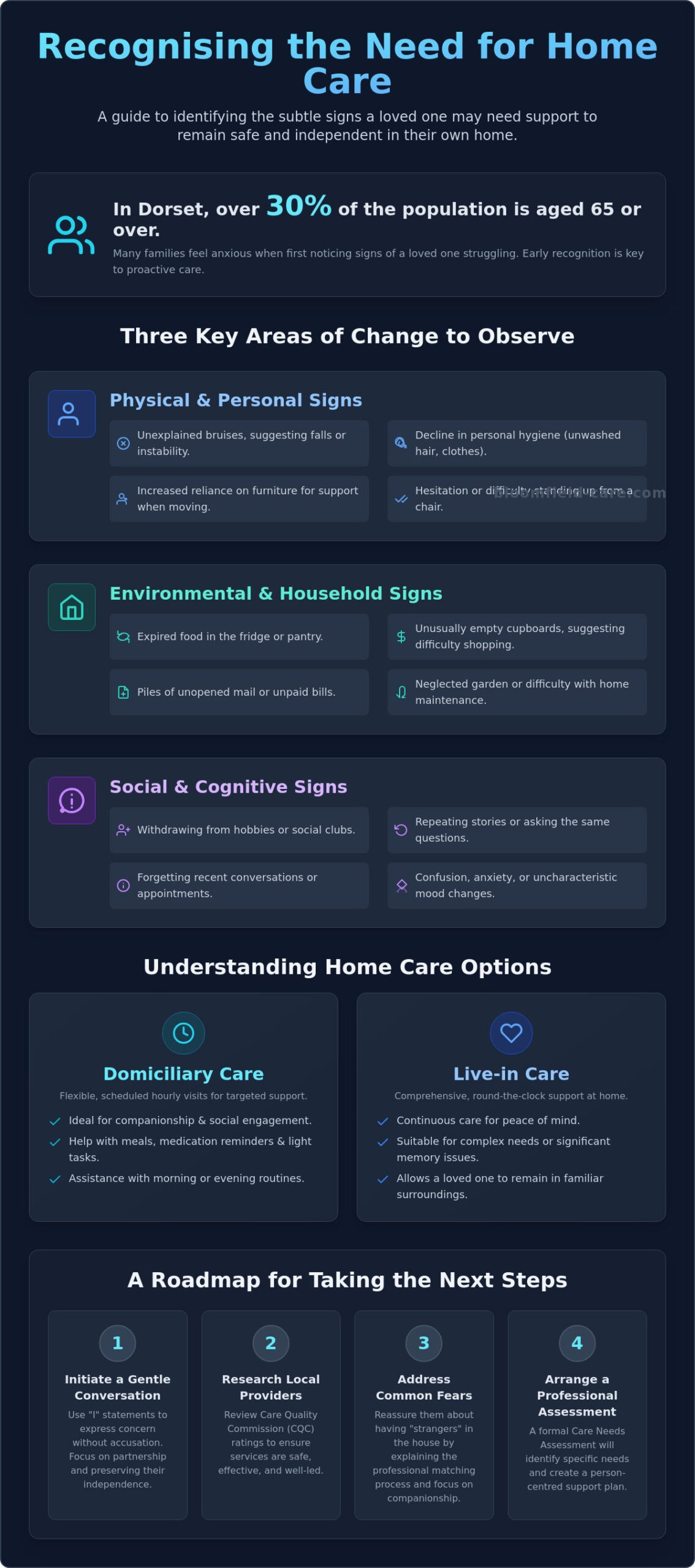
It’s rarely a single, dramatic moment that changes everything. Instead, it’s often the quiet observation that a loved one is no longer thriving in the sanctuary of their own home. Perhaps you’ve noticed they’re leaning on furniture more often for support, or there’s a slight hesitation before they stand up from a favourite chair. These are often the first signs your parents need home care in Dorset, marking the point where family support needs to be supplemented by professional expertise to ensure their safety and comfort.
Physical indicators are frequently the most visible red flags. Look for unexplained bruising on their arms or legs, which might suggest a recent tumble or a loss of balance they haven’t mentioned. Personal hygiene can also shift; unwashed hair or wearing the same clothes for several days can signal that the daily routine of bathing and laundry has become overwhelming. Inside the home, check the kitchen. Expired food in the fridge or a larder that’s unusually empty can suggest that grocery shopping and meal preparation have become too difficult to manage alone.
Social and cognitive changes are just as significant. If a parent who once loved their local bridge club or gardening group is now making excuses to stay home, it may be due to anxiety or confusion. Repeating stories or forgetting recent conversations are also signals that a person-centred approach to support could help maintain their mental well-being. Understanding different types of elderly care can help you decide if companionship or more structured domiciliary care is the right fit for their current lifestyle.
The Emotional Weight of the Care Conversation
This transition often triggers a sense of role reversal that’s uncomfortable for everyone involved. You don’t want to feel like you’re parenting your parents, and they certainly don’t want to feel they’re losing their autonomy. The primary barrier to accepting help is usually a deep-seated fear of the care home, which many people associate with a loss of identity. By identifying these needs early, you can frame support as a way to help them stay in their private residence safely, rather than a step toward leaving it. Starting the talk early prevents crisis decisions made in a rush following a fall or illness.
Spotting Lifestyle Changes in Dorset and Oxfordshire
Living in rural parts of Dorset or Oxfordshire brings unique challenges as we age. A large property that was once a source of pride can quickly become a burden to maintain. Are they still able to navigate the shops in Wallingford or the busy streets of Poole and Weymouth? If they’re avoiding driving or struggling with the upkeep of a garden, it’s a sign that their environment is no longer working for them. Using a gentle observation technique allows you to note these changes without making your parents feel scrutinized, keeping the focus on their continued independence.
Preparation: Researching Home Care Options in Your Region
Once you’ve identified the signs your parents need home care in Dorset, the focus shifts to finding a solution that respects their history and preserves their future. This isn’t just about ticking boxes for safety; it’s about enhancing their quality of life. Start by researching the Care Quality Commission (CQC) ratings for providers in your area. These reports offer an independent view of whether a service is safe and well-led, providing the reassurance you need during a stressful time. A regional, family-founded agency often provides better continuity than a national franchise, as they have deeper roots in the local community and a more personal investment in every individual’s well-being.
The most effective support plans are person-centred. This means the care is built around your parent’s personality, their preferred morning routine, and even how they like their tea. It’s a partnership-driven approach where the caregiver becomes a trusted visitor in the sanctuary of their home. If you’re feeling overwhelmed by the choices, speaking with a local advisor can help clarify which path best suits your family’s specific needs.
Domiciliary vs. Live-in Care: Which Fits Their Life?
Choosing between different levels of support depends on your parent’s daily challenges. Domiciliary care involves scheduled hourly visits and is ideal for companionship, light meal preparation, or help with morning routines in towns like Newbury or Thatcham. It’s a flexible way to introduce support without disrupting their established rhythm. For those with higher dependency or complex needs like dementia, live-in care provides a reassuring 24-hour presence. This ensures someone is always on hand to provide professional assistance while allowing your parent to remain in the comfort and familiarity of their own private residence.
Financial Foundations and Local Authority Support
Understanding the financial landscape is a vital part of the preparation process. Both Dorset and Oxfordshire County Councils offer care assessments to help determine what level of support is required. These assessments are a right for everyone, regardless of their financial situation, and they provide a clear roadmap for practical next steps for arranging care. Many families find that staying at home is not only more emotionally fulfilling but also a more cost-effective alternative to residential care. For a more detailed breakdown of what to expect, you can explore our guide on the cost of home care in Oxfordshire and Dorset.
Starting the Conversation: Strategies for a Gentle Approach
Once you have identified the signs your parents need home care in Dorset, the next hurdle is often the conversation itself. It is a delicate bridge to cross, requiring a blend of honesty and profound tenderness. To set the stage for success, choose a setting where your parent feels most secure. A relaxed, familiar environment like their own living room, away from the distractions of a television or a ringing phone, provides the stability needed for a sensitive discussion. Avoid bringing up the topic during a moment of frustration or immediately after a domestic mishap. Instead, wait for a quiet afternoon when everyone feels calm and connected.
The “I” Statement Technique is an invaluable tool for keeping the dialogue collaborative. By focusing on your own feelings rather than their perceived failings, you reduce the likelihood of a defensive reaction. Instead of saying, “You aren’t managing the house anymore,” try saying, “I’ve been feeling a bit anxious about the maintenance of the garden, and I want to make sure you have more time to enjoy it.” This approach frames care as a home enhancement rather than a medical intervention. It’s about adding a layer of support to their sanctuary, ensuring they remain the primary decision-maker in their own life.
If the idea of regular help feels overwhelming, suggest a trial run. Proposing just a few hours of companionship care each week is a low-pressure way to introduce a new face into the home. It allows your parent to experience the benefits of a helping hand without feeling they’ve made an irreversible commitment to their lifestyle. Keeping them in the driving seat throughout the process is essential for maintaining their dignity.
Scripts for a Compassionate Conversation
Finding the right words can be challenging. You want to express concern without sounding patronising. Try using the “sanctuary pitch” to shift the focus toward comfort: “I love how much you enjoy your home. Let’s look into getting someone to help with the heavy chores so you can focus on the things you actually love doing.” For families near the coast, exploring Bespoke Domiciliary care in Weymouth can be a practical way to start this journey, offering professional support that feels like a natural extension of the family circle.
Listening More Than Speaking
In these moments, your ability to listen is far more powerful than your ability to persuade. Validate their fears by using simple, supportive phrases like “I hear you” or “I understand why that feels worrying.” Often, resistance isn’t about the care itself but about a hidden objection like a loss of privacy or the cost of services. Sometimes, the fear stems from the difficulty of Recognising the signs of cognitive decline and what that might mean for their future. Maintain an unhurried rhythm throughout the talk. Give them the space and time they need to process the idea, showing that you value their perspective above all else.
Overcoming Resistance: Addressing Fears of Lost Independence
Resistance is a natural response to change, especially when that change involves the sanctuary of one’s own home. When you first notice the signs your parents need home care in Dorset, their initial reaction might be one of denial or even anger. This often stems from the care home myth. Many people believe that accepting a few hours of help is the first step toward leaving their house forever. In reality, professional support is the very thing that prevents a crisis. By addressing small challenges early, we ensure that a minor trip or a forgotten meal doesn’t escalate into a situation where residential care becomes the only safe option.
The fear of strangers in the house is deeply personal. We overcome this through a meticulous matching process. It isn’t just about finding a qualified professional; it’s about finding a companion who shares your parent’s interests, whether that’s a love for local history or a passion for the Dorset coastline. This turns a stranger into a trusted visitor, preserving the sanctity of their private residence. There is a powerful paradox at play here. Accepting help actually increases independence. When someone handles the heavy cleaning or the grocery run, your parent has more energy for the activities they truly enjoy. It’s about delegating the chores to save their strength for their life. Utilizing professional garment care from services like bancrofts.com.au is a great example of how outsourcing specific tasks can help maintain a parent’s wardrobe and personal pride without the physical effort.
If the conversation feels stalled, consider involving a trusted third party. Sometimes a word from a GP or a lifelong friend can bypass the emotional complexities of the parent-child relationship. They can offer an objective perspective that feels less like a prescription and more like sound advice. If you’re ready to explore how a gentle introduction to support could work for your family, contact our team today to discuss our person-centred approach.
When Dementia or Alzheimer’s is Part of the Talk
Communicating with a loved one experiencing cognitive decline requires a shift in strategy. In Dorset and Oxfordshire, we find that focusing on feelings of safety and comfort is far more effective than using logical arguments. Someone with dementia may not understand the logic of why they shouldn’t use the cooker alone, but they will respond to the idea of a friendly person coming over to help prepare their favourite meal. For a deeper understanding of how to navigate these moments, you may find our guide on Understanding Dementia Stages helpful for your family’s journey.
The Collaborative Decision-Making Framework
Maintaining dignity means keeping your parent in the driving seat. Offer specific choices rather than general statements. Instead of saying they need help, ask, “Would you prefer someone to pop in during the morning or the afternoon?” This simple shift returns the power to them. You can also empower them to interview potential carers themselves. This ensures the relationship starts as a partnership based on mutual respect, not a prescription handed down by others. When they choose the person who enters their home, they are much more likely to welcome the support.
From Discussion to Decision: Practical Next Steps
Taking the step from identifying the signs your parents need home care in Dorset to actually booking a visit is a significant emotional milestone. It’s the moment where the abstract idea of “help” becomes a tangible part of daily life. To ensure this transition feels like a natural progression rather than a disruption, the first practical step is a professional Care Needs Assessment. This isn’t a clinical inspection; it’s a gentle conversation designed to identify exactly what support is needed to keep your parent flourishing in their own home. From this, we develop a Person-Centred Care Plan that acts as a living document, ensuring their dignity and personal preferences remain at the heart of every visit.
This commitment to dignity should extend to every aspect of later-life planning, including final arrangements. For an example of a service that prioritises this same level of personal care and respect, you might check out Hjertebegravelse.
For families in Abingdon, Oxford, and Poole, we act as a dedicated partner throughout this transition. We understand that the first day can bring a mix of jitters and relief for both the parent and the adult child. Our caregivers are trained to arrive with a gentle, unhurried presence, focusing on building a human connection before they even begin their domestic or personal care tasks. This approach helps transform the first visit from a source of anxiety into a source of profound reassurance, proving that the sanctuary of the home can be enhanced by a helping hand.
The Bloomfield Difference: A Reassuring Partnership
Our approach is rooted in the belief that care should never feel like a transaction. By taking an unhurried path, we build trust from the very first assessment, ensuring that every family feels heard and respected. Local knowledge is vital here. Our teams in Wallingford, Newbury, and Weymouth understand the local community and the specific challenges of navigating rural or coastal life as we age. If you’re still weighing up the best environment for your loved one, our guide on Bloomfield Care Home or Care at Home? provides a detailed comparison to help you make an informed choice for 2026 and beyond.
Your Action Plan for the Next 48 Hours
If you have recently had “the talk” with your parents, follow these steps to maintain the positive momentum:
- Step 1: Reflect and Note. Take a quiet moment to reflect on the conversation. Note any specific concerns your parents raised, whether they were about privacy, cost, or a specific daily task they find difficult.
- Step 2: Reach Out. Contact a local advisor for a friendly, no-obligation chat. This is your chance to ask questions about how we match caregivers to personalities and how we maintain the sanctuary of the private residence.
- Final Step: Arrange an Assessment. Book a bespoke home assessment. This allows us to meet your parent in their environment and begin the journey of sanctuary-first support together.
Embracing a Future of Safety and Sanctuary
Recognising the subtle shifts in your parents’ daily lives is the first step toward ensuring they remain in the sanctuary of their own home. By identifying the signs your parents need home care in Dorset early, you move from a place of anxiety to one of proactive support. This journey isn’t about taking away their independence; it’s about providing the specific, person-centred assistance that allows them to live with dignity and safety. Whether it’s companionship or specialist dementia care, the right support preserves their lifestyle while giving your family much-needed peace of mind.
Since 2014, our family-founded team has provided CQC-regulated support across Dorset, Oxfordshire, and West Berkshire. Our specialist dementia-trained carers are dedicated to building trusting partnerships that honour the individual’s history. You don’t have to navigate these sensitive decisions alone. We are here to listen and guide you through every stage of the process with patience and integrity. Please reach out to us to Book a Compassionate Care Assessment with Bloomfield Care. Take heart in knowing that with the right partnership, your parents can continue to enjoy the comfort and familiarity of the home they love.
Frequently Asked Questions
What if my parent flatly refuses to talk about home care?
If a parent refuses to talk, it’s often because they fear losing the sanctuary of their own home. Instead of pushing for an immediate decision, try asking them to share their specific worries about privacy or daily chores. Shifting the focus from “care” to “home help” can lower the barrier to entry. This allows them to stay in control while you express your desire for their continued comfort and safety.
How do I explain the difference between a care home and home care?
The fundamental difference lies in the setting and the level of autonomy your parent retains. A care home involves moving into a communal residential facility with 24-hour staffing and shared spaces. Home care brings professional support directly into their private residence. This allows your parent to keep their familiar routines, pets, and possessions. It’s about adapting the environment they love to meet their changing needs rather than asking them to leave it.
Can we start with just companionship care to see how it goes?
Starting with companionship is an excellent way to introduce support without it feeling medical or intrusive. Many families find that a few hours of shared conversation or a walk in a local Dorset park helps build trust with a new face. This gentle trial period often makes it much easier to transition to more practical assistance later. It shows your parent that the caregiver is a partner in their lifestyle, not a stranger taking over their house.
How do we handle the conversation if my parent has dementia?
When a parent has dementia, conversations should focus on feelings of safety and reassurance rather than complex logical arguments. Use simple, short sentences and give them plenty of time to process what you’ve said. If they become distressed, it’s best to pause the talk and try again later during a quiet time of day. The goal is to make them feel supported and secure in their environment without feeling pressured by facts they may struggle to recall.
Should I involve my siblings in the first conversation about care?
Involving siblings is important for a united family approach, but be careful not to make the parent feel overwhelmed. Have an initial private chat with your siblings to ensure you’re all on the same page regarding the signs your parents need home care in Dorset. One or two siblings should lead the actual talk to keep the atmosphere relaxed and intimate. This ensures the conversation remains a supportive partnership rather than a prescription handed down by a committee.
How do I deal with the guilt of suggesting my parent needs help?
Feeling guilty is a common reaction for adult children who believe they should be the sole providers of care. It’s helpful to remember that professional support isn’t a replacement for your love; it’s a way to enhance your parent’s quality of life. By bringing in a dedicated caregiver, you can focus on being a daughter or son again rather than a full-time assistant. This often improves the family dynamic and ensures your parent receives expert, person-centred assistance.
What are the first signs that my parent in Dorset needs support?
Some of the first signs your parents need home care in Dorset include a neglected garden or difficulty navigating local high streets in towns like Weymouth or Poole. You might also notice they are avoiding driving or struggling with the upkeep of a larger rural property. These environmental red flags often appear before physical decline becomes obvious. Catching these subtle changes early allows for a much more unhurried and dignified transition into professional support.
Is home care safer than a residential care home during the winter months?
Both options offer safety, but home care provides the unique benefit of keeping a parent in their warm, familiar sanctuary. During the winter months, a professional caregiver ensures the heating is adequate, the larder is stocked, and the risk of falls on icy paths is managed. This consistent monitoring prevents the isolation that often leads to health declines during the colder season. It provides professional safety while maintaining the emotional comfort that only a private home can offer.