

What if the safest mobility support is the kind that helps an older person do more for themselves, rather than taking over? Finding safe mobility support for elderly at home in Poole can feel daunting when you’re worried about falls, unsure what a care worker can help with, or concerned that support might affect privacy and independence.
Those concerns are understandable. The right help should respect the person’s choices and familiar routines while making everyday movement feel more manageable. It should also be clear which tasks a care worker can support under an individual care plan, and when advice from another professional may be needed.
This guide explains how to think about mobility needs at home, what to ask a Poole care provider about assessment and safe assistance, and how home visits or live-in care might be considered according to assessed needs. You’ll also find practical ways to discuss support as a partnership, so an older person can move with greater confidence while retaining as much control and dignity as possible.
Key Takeaways
- Learn what safe mobility support for elderly at home in Poole may involve, and why agreed assistance should reflect the person’s needs and preferences.
- Use a simple conversation to share mobility concerns, everyday routines and the older person’s priorities before support is arranged.
- Compare providers by asking how they assess needs, agree tasks, communicate changes, maintain continuity and review the arrangement.
- Prepare for a useful care discussion by noting preferred routes around the home, access needs and lighting, without rushing into equipment purchases or structural changes.
- Explore whether Bloomfield Care’s domiciliary or live-in care may be suitable, and confirm current Poole availability and which tasks can be included.
What Does Safe Mobility Support for Elderly at Home in Poole Involve?
It can be difficult to see someone you love feeling less sure on their feet, especially when home is where they feel most comfortable. Families often want to reduce worry without taking over familiar routines or choices. The idea of Aging in place reflects the value of remaining in a familiar home as needs change. In practice, support should be shaped around the older person, not just the family’s concerns.
Safe mobility support is agreed, person-centred help with everyday movement, provided only where it suits the person’s assessed needs and care plan. It isn’t a substitute for clinical advice, physiotherapy or an assessment for specialist equipment. If there are concerns about balance, pain, a recent change in movement or the safest way to assist, speak with an appropriate health professional. A care provider can clarify what its team may support and what falls outside its role.
What everyday mobility support may look like
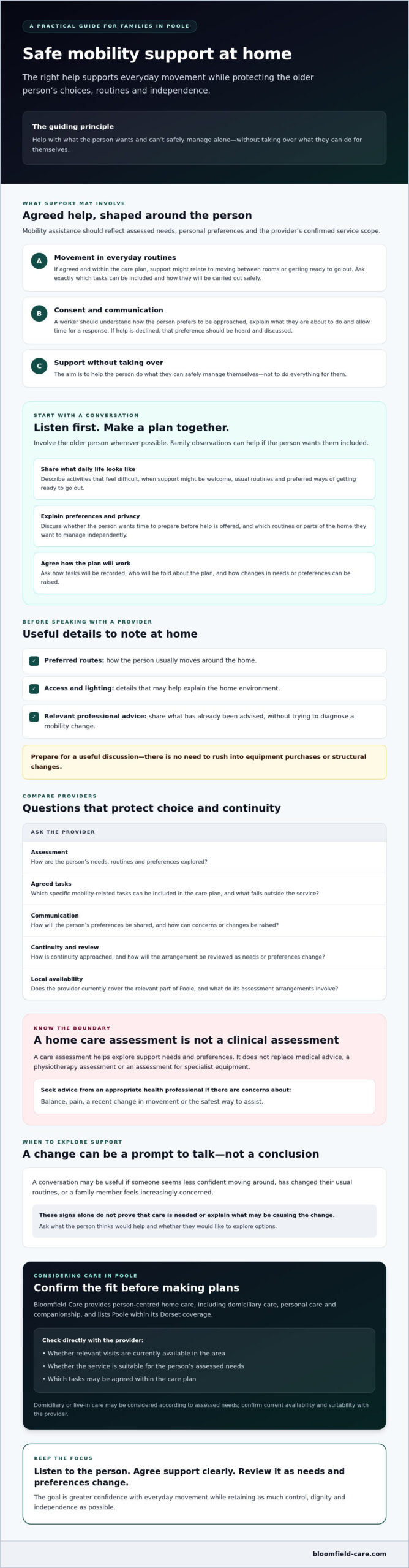
Depending on the person’s needs and the provider’s confirmed service scope, agreed help might relate to moving between rooms as part of a daily routine or getting ready to go out. These examples don’t mean every care worker can provide that assistance. Ask which specific tasks can be included in the care plan and how they’ll be carried out safely.
Consent and communication matter at every step. A worker should understand how the person prefers to be approached, explain what they’re about to do and allow time for a response. The aim is to support what the person can safely manage themselves, rather than doing everything for them. If the person doesn’t want help with a task, that preference should be heard and discussed.
When families in Poole may begin exploring support
A conversation may be useful if an older person seems less confident moving around, has changed their usual routines, or a family member feels increasingly concerned. These changes don’t, on their own, prove that care is needed or explain what may be causing them. They can be a gentle prompt to ask what the person thinks would help and whether they’d like to explore options.
For families considering safe mobility support for elderly at home in Poole, the next step can be a conversation with a provider about current local coverage, assessment arrangements and tasks that may be agreed. Bloomfield Care provides person-centred home care, including domiciliary care, personal care and companionship, and lists Poole within its Dorset coverage. Confirm whether mobility-related visits are currently available and suitable for the person’s needs before making plans.
Assessing Safe Mobility for Older People at Home
A helpful assessment starts with listening, not assumptions. The older person should be involved in decisions wherever possible, with family members adding observations if the person wants them to. This keeps the conversation centred on what matters to them, rather than treating support as something decided on their behalf.
An individual mobility assessment should reflect the person’s preferences, daily routines and agreed goals, so any support fits their life at home.
What to discuss during a home care conversation
Before speaking with a provider, note which everyday activities feel difficult and when support might be welcome. Describe a typical day, including when the person prefers to get up, how they move around the home, and whether they would like assistance as part of getting ready to go out.
Ask about communication and privacy, too. Does the person prefer a moment to prepare before help is offered? Are there routines or parts of the home where they want to remain independent? Share any relevant advice already given by health professionals, without trying to interpret or diagnose a change in mobility.
Then clarify how the provider will record agreed tasks, who will be told about the plan, and how changes in needs or preferences can be raised. For safe mobility support for elderly at home in Poole, also ask whether the provider currently covers the relevant area and what its assessment arrangements involve.
What a care assessment cannot replace
A home care assessment helps explore support needs and preferences. It isn’t a medical examination, physiotherapy assessment or prescription for a walking aid. If there are clinical concerns, seek advice from an appropriate health professional. For general information about mobility aids, the NHS guidance on walking aids explains options such as walking sticks and frames. Ask a health professional what may be suitable for the individual.
Keep the conversation practical and unhurried. You could follow this sequence:
- Discuss concerns: Explain what prompted the conversation and listen to the older person’s view.
- Share routines: Describe the activities, timings and preferences that matter day to day.
- Agree support: Confirm which tasks can be included and how consent and independence will be respected.
- Review arrangements: Ask how the plan can be revisited if circumstances or preferences change.
Families can ask Bloomfield Care about its home care services, current Poole coverage and assessment process, then consider whether its support may suit the person’s needs.
How Can You Compare Mobility Care Providers in Poole Without Losing Independence?
Accepting help doesn’t mean giving up independence or choice. A suitable arrangement should let the older person set priorities, decide what assistance feels comfortable and keep doing what they can safely manage. Use the questions below to compare how providers would approach the person’s specific needs, rather than relying on broad promises of personalised care.
| What to compare | Questions to ask |
|---|---|
| Assessment | How will you discuss the person’s needs, preferences and usual routines before support begins? |
| Agreed tasks | Which mobility-related tasks could be included in the care plan, and what is outside the care worker’s role? |
| Communication | How will the person and, with their agreement, family members raise concerns or share updates? |
| Continuity | How do you explain who may provide the support, and what happens if arrangements change? |
| Review | How can the plan be revisited if the person’s needs, preferences or confidence change? |
Questions to ask a home care provider in Poole
Ask for clear, practical answers. A provider should be able to explain how it learns what the person wants, how agreed tasks are recorded and how changes can be discussed. Check current Poole coverage and whether the provider can consider the specific support being requested. The details matter: help with one part of a routine shouldn’t be assumed to include every movement or activity.
For safe mobility support for elderly at home in Poole, families may also want to check provider information and the latest Care Quality Commission (CQC) details directly. The CQC regulates health and social care services in England. Review the provider’s current profile and available inspection information, and ask the provider to clarify anything that’s unclear.
How to protect dignity, choice, and confidence
Invite the older person to describe what they would like to keep doing and what kind of help feels reassuring. They may prefer a carer to offer an arm only when asked, for example, or to allow extra time to complete a familiar task. Agreeing these preferences helps make support collaborative rather than automatic.
Ask how care workers encourage participation without taking over unnecessarily, and how they respond if the person changes their mind. Bloomfield Care’s person-centred domiciliary care in Weymouth offers related Dorset service context, but doesn’t confirm Poole availability or suitability. For Poole, discuss the person’s needs and confirm current coverage directly. A thoughtful comparison can help the family find support that respects both safety and self-direction.
How Can Families Prepare the Home and Agree a Mobility Support Plan?
Preparing for support doesn’t mean turning a familiar home upside down. Start with the older person’s permission and perspective. A calm walk-through of ordinary routines can help identify where they’d welcome assistance while keeping their preferences at the centre of any plan.
A practical, non-clinical home discussion checklist
Use these prompts to guide a conversation with the person and, if appropriate, a care provider:
- Routines: Which everyday activities feel straightforward, and where would the person like help? Note preferred times and how much notice or prompting feels comfortable.
- Access and routes: Which entrances and routes around the home do they usually use? Are there areas they prefer to avoid or where they’d like support?
- Lighting and frequently used items: Is lighting a concern at certain times? Are everyday belongings easy for the person to reach?
- Household considerations: Note concerns such as clutter or pets, and discuss them with the person and provider rather than assuming what should change.
- Preferences: How would the person like a carer to communicate, offer help and respect their privacy?
This is a conversation checklist, not a formal home safety inspection. Don’t make structural changes or buy mobility equipment solely on the basis of this article. If there are concerns about hazards, falls or equipment, seek advice from an appropriate professional who can consider the person’s circumstances.
Agreeing and reviewing support in Poole
A written, agreed plan can make support feel more predictable. Discuss which tasks may be included, suitable visit times, how the person prefers assistance to be offered and who to contact if a routine or need changes. Confirm what the provider can support and how any changes will be reviewed. For safe mobility support for elderly at home in Poole, check current local availability and the provider’s assessment arrangements rather than assuming a particular service or task is available.
Depending on assessed needs and confirmed suitability, families might explore visiting domiciliary care or ask whether live-in care merits consideration. If you’re weighing different care settings, Bloomfield Care’s guide to home care and care home options offers related information for families considering care at home or in a care home.
For a personalised next step, discuss home care options with Bloomfield Care and ask whether support is currently available in Poole and suitable for the person’s needs.
Choosing Bloomfield Care for Personalised Home Support in Poole
Choosing support at home is a personal decision. Bloomfield Care provides person-centred home care across Dorset, with Poole listed within its local coverage. Its services include personal care and companionship, which may be relevant to an older person’s wider support needs. Whether a particular mobility-related task can be included depends on the individual’s needs and the provider’s confirmed service scope.
Bloomfield Care also operates across Wallingford, Newbury, Thatcham, Abingdon, Oxford, Weymouth and Christchurch, as well as Dorset and Poole. Care workers aren’t a substitute for a physiotherapist or a specialist mobility-equipment assessment. A helpful first conversation can clarify what the person wants assistance with, what they prefer to do independently, and whether Bloomfield Care’s current services in Poole may be suitable. There’s no need to have every answer before making an enquiry.
What to clarify before arranging Bloomfield Care
Before making plans, ask about the practical details so the older person and family know what to expect:
- Availability: Does Bloomfield Care currently provide support in the person’s part of Poole, and what types of visits may be available?
- Assessment: How will the team discuss the person’s needs, daily routines and preferences?
- Agreed tasks: Which mobility-related tasks, if any, can be included in an individual care plan? Ask what the care team cannot provide, too.
- Communication: How will the team speak with the older person, and how may family members be involved with their agreement?
These questions help keep expectations clear. They also give the older person a chance to explain what support would feel comfortable, including how they’d like assistance to be offered and where they want to remain self-sufficient. If needs change, ask how to raise this and how any agreed support would be reviewed.
A calm next step for Poole families
A conversation doesn’t commit anyone to ongoing care. It can simply help you understand the options and decide together whether to explore them further. Before getting in touch, it may help to note the older person’s priorities, the routines they’d like to maintain and any questions about visit arrangements or the provider’s current Poole coverage.
If you’re considering safe mobility support for elderly at home in Poole, Bloomfield Care can be asked whether its domiciliary or live-in care may be suitable for the person’s assessed needs. The right next step is an informed discussion, led by the older person wherever possible.
Talk with Bloomfield Care about support at home and ask what may be available in Poole.
Take a Thoughtful Next Step Towards Support at Home
Safe mobility support for elderly at home in Poole should be shaped around the person’s needs, preferences and familiar routines. A clear conversation can help families understand which everyday tasks a provider may support, how assistance will be agreed, and how the plan can change if circumstances do.
Before arranging care, involve the older person wherever possible and ask about assessment, communication and current local availability. Bloomfield Care provides person-centred home care, including personal care and companionship. Poole is included in its stated Dorset coverage, but confirm current availability and whether the support needed is suitable.
You don’t have to decide everything at once. A first conversation can help you explore options and prepare the right questions. Talk with Bloomfield Care about personalised support at home and discuss what may work for your family.
With the person’s voice at the centre, support can be considered at a comfortable pace, with dignity, choice and independence kept in view.
Frequently Asked Questions
What does mobility support at home for an older person include?
Mobility support may include agreed help with everyday movement, depending on the person’s assessed needs and the care provider’s scope. For example, a care plan might include support as the person moves through a daily routine or prepares to go out, if the provider confirms it can safely assist. The older person’s consent and preferences should guide how help is offered. Clinical advice, physiotherapy and mobility equipment assessments are separate.
Can a home carer help an older person move around safely?
A home carer may be able to help with specific agreed tasks, but this depends on the individual care plan, the person’s needs and the provider’s procedures. Ask exactly what assistance can be provided, how it will be carried out, and what is outside the carer’s role. The aim should be to support the person’s own abilities, not take over unnecessarily. For clinical concerns, seek advice from an appropriate health professional.
How do I find mobility support for an older person in Poole?
Start by discussing the older person’s preferences and the everyday activities where they may want assistance. Then contact home care providers to ask about assessment, the tasks they can agree, and current availability in Poole. Bloomfield Care provides person-centred home care and lists Poole within its Dorset coverage, but confirm current availability and suitability directly. You can also ask BCP Council about a care needs assessment if you’re exploring support options.
Is home care suitable if an older person is worried about losing independence?
It may be suitable if the support is shaped around the person’s choices and agreed needs. Accepting help doesn’t have to mean giving up independence: the older person can explain what they want to keep doing, when they welcome assistance, and how they prefer a carer to communicate. Discuss these preferences during assessment and ask how they’ll be recorded and reviewed. The person should be involved in decisions wherever possible.
What should I ask a care agency about safe mobility support?
Ask how the provider discusses needs and preferences before care begins, which mobility-related tasks may be included, and how agreed assistance is recorded. Find out who to contact if routines or needs change, how updates are shared with the older person and family, and how the plan is reviewed. For safe mobility support for elderly at home in Poole, also confirm current local availability and whether the requested tasks are within the provider’s scope.
Can a home care agency recommend mobility aids or assess fall risks?
A home care agency can explain what its care workers may support, but don’t assume it provides clinical falls assessments or recommends or supplies mobility aids. For concerns about falls, movement or equipment, speak with an appropriate health professional, such as the person’s GP or another relevant clinician. Ask the provider to clarify its role and whether it can work in line with advice already given by a professional.
How often can an older person receive mobility support at home in Poole?
The frequency depends on the person’s assessed needs, the agreed care arrangement and the provider’s current availability. Domiciliary care involves visits, while live-in care may be considered where a different level of support is appropriate. Ask what visit patterns can be discussed, which tasks could be included, and how arrangements might be reviewed if needs change. Confirm directly whether the provider currently offers suitable support in the person’s part of Poole.