

What if the most loving decision you make for your ageing parents isn’t about finding them a room in a care home, but about transforming their own house into a safer sanctuary? You likely feel a heavy weight of guilt every time you leave their doorstep, wondering if a few hours of help is enough or if they truly need someone there around the clock. It’s completely natural to feel overwhelmed when weighing up live-in care vs domiciliary care for parents, especially when you’re trying to balance their desire for independence with your need for their safety.
We understand that inviting a professional into a family home is a deeply personal step. You want to ensure your parents are respected, not just “managed.” This 2026 guide will clarify the critical differences between visiting support and 24-hour care, helping you choose the most compassionate and secure path forward. We’ll explore how these options compare in terms of safety, lifestyle, and cost, providing a clear roadmap to help your parents stay exactly where they feel most comfortable. By the end, you’ll have the confidence to move from a place of anxiety to a place of informed, peaceful action.
Key Takeaways
- Learn how home-based care serves as a dignified, person-centred alternative to residential care homes, allowing your parents to stay in their own sanctuary.
- Understand the critical differences between live-in care vs domiciliary care for parents to determine whether they need a few hours of help or 24/7 support.
- Discover how domiciliary care provides flexible, routine-based assistance for parents who remain mostly independent but need a helping hand.
- Explore how live-in care reduces the risk of falls and nighttime wandering, offering a safer environment for those with advanced dementia or Alzheimer’s.
- Gain clarity on how to begin a free, no-obligation care needs assessment to create a bespoke support plan tailored to your family’s unique lifestyle.
Understanding Home-Based Care: Domiciliary vs Live-in Care
Choosing how to support an ageing parent is one of the most significant decisions a family makes. It’s about more than just physical safety; it’s about protecting their dignity and sense of self. Home-based care offers a compassionate alternative to residential care homes, allowing your loved one to stay in the place they love most. The decision between live-in care vs domiciliary care for parents often starts as a small step and evolves as their needs change. At Bloomfield Care, our person-centred approach ensures that every plan is bespoke, treating the home as a sanctuary rather than a clinical environment.
What is Domiciliary Care? (Visiting Care)
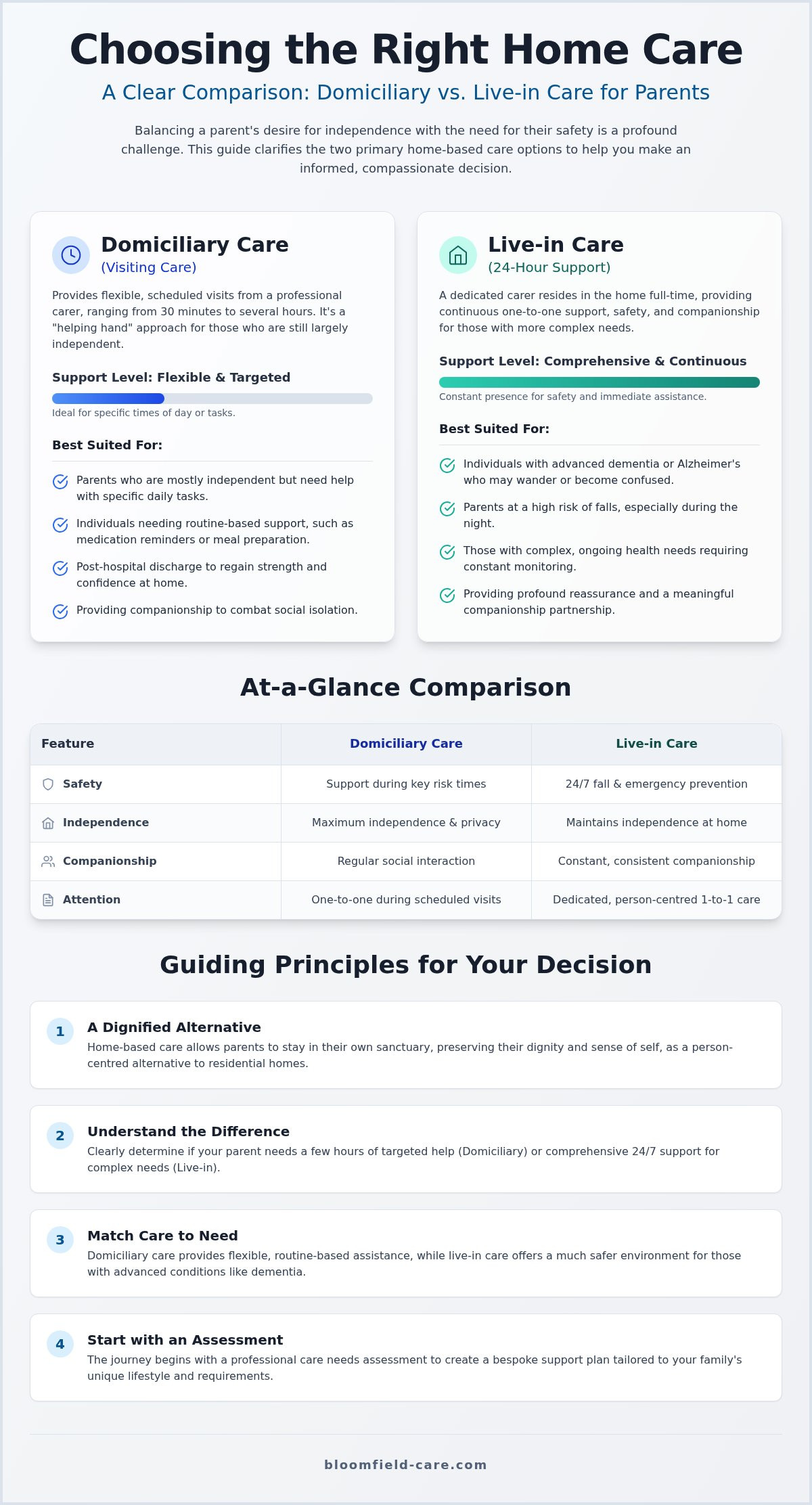
Domiciliary care involves scheduled visits from a professional carer. These sessions can last from 30 minutes to several hours. It’s a perfect fit for parents who are still largely independent but might struggle with specific parts of their day. This type of support acts as a “helping hand” rather than a total takeover of the household.
Common support tasks include:
- Assistance with morning or evening routines like dressing and bathing.
- Medication support to ensure health is maintained safely.
- Help with laundry, shopping, or light cleaning.
- Nutritional support through meal preparation.
By using domiciliary care, your parent keeps their independence. They choose when they wake up, what they eat, and how they spend their afternoon. This consistency is vital for seniors who rely on a familiar rhythm to feel secure and in control of their own lives.
What is Live-in Care? (24-Hour Support)
When a parent’s needs become more complex, live-in care provides a dedicated carer who resides in the home full-time. This 24/7 presence is about more than just safety; it’s about companionship and profound reassurance. It’s often the next logical step when hourly visits are no longer enough to ensure a parent’s well-being throughout the day and night.
The primary difference between this and a care home is the level of individual attention. In a residential setting, staff often manage multiple residents at once, which can lead to a “one size fits all” routine. With live-in care, your parent receives one-to-one support tailored entirely to their preferences. This constant presence significantly reduces the risk of falls and provides immediate help if they become confused at night. It transforms the care experience from a series of tasks into a meaningful partnership, allowing your parent to thrive in familiar surroundings with a trusted advisor by their side.
Domiciliary Care: Flexibility for Early-Stage Support
Many families find that the journey into care starts with a single realization: a parent is struggling with just one or two daily tasks. When weighing up live-in care vs domiciliary care for parents, the visiting model often serves as the most flexible starting point. It acts as a professional helping hand, providing just enough support to maintain safety without encroaching on a parent’s sense of privacy. For those in Dorset, bespoke domiciliary care in Weymouth offers an early intervention that can prevent minor issues from becoming major health crises.
Ideal Scenarios for Visiting Carers
Visiting care is particularly effective when a parent faces specific “pinch points” throughout the day. This might include help with morning dressing, preparing a nutritious evening meal, or managing complex medication regimes. It is also an invaluable resource for post-hospital discharge. A few weeks of focused support can help a parent regain their strength and confidence in their own environment.
In rural parts of Oxfordshire, social isolation is a growing concern for the elderly. A visiting carer provides more than just physical assistance; they offer vital companionship and a window to the outside world. If you are unsure where to begin, the NHS provides clear guidance on how to arrange homecare through your local authority to ensure all safety standards are met.
The Logistics of Hourly Visits
The beauty of domiciliary support lies in its predictability. For seniors living with routine-based needs, having a carer arrive at the same time each day provides a sense of security. We build these care plans around your parent’s existing schedule, ensuring minimal disruption to their lifestyle. This consistency is a cornerstone of our person-centred philosophy.
For family members living far from Oxfordshire or Dorset, the “check-in” benefit offers immense peace of mind. You don’t have to wonder if your mum has eaten or if your dad has taken his pills. We use digital care records to provide updates, allowing you to monitor progress and stay connected to their daily wellness. This model is also highly scalable. You might start with three visits a week and increase the frequency as their needs evolve over time. If you’d like to discuss how this could work for your family, our team can help you explore personalised visiting options that fit your specific requirements.
Live-in Care: Comprehensive Support and Peace of Mind
While visiting care provides a vital helping hand, many families eventually reach a point where their parent’s safety requires a more permanent presence. Choosing compassionate live-in care means your loved one never has to face the night alone. This model provides a safety net that hourly visits simply cannot match, especially when managing the risk of falls or nighttime wandering. It’s the ultimate choice for those who value the sanctuary of their own home and wish to avoid the upheaval of a residential move.
For couples, live-in support is often the only way to stay together. Residential homes frequently struggle to accommodate partners with different care needs, which can lead to a heartbreaking separation. Live-in care adapts to both individuals, allowing them to continue their life as a pair in familiar surroundings. It preserves their shared history while ensuring both receive the professional assistance they need to thrive.
Specialist Support: Dementia and Alzheimer’s
A constant, familiar presence is often essential for those navigating different dementia stages. When confusion sets in during the late afternoon, a phenomenon known as “sundowning,” having a known face nearby can prevent significant distress. A live-in carer learns the subtle cues of your parent’s behaviour, de-escalating anxiety through gentle reassurance rather than clinical intervention. This approach maintains a sense of autonomy that institutional settings often lack, keeping the home environment calm, predictable, and safe.
Hosting a Carer: Practical Home Requirements
Inviting a professional into the family home is a significant step, but it’s a partnership built on mutual respect and dignity. To make this work, your parent will need to provide a private spare room for the carer. This space should be a comfortable retreat, equipped with a bed and storage for personal belongings. It’s important to remember that while the carer is there to support your parent 24/7, they also require scheduled breaks and periods of privacy to rest and recharge. This ensures they can provide the highest standard of attentive care.
We don’t just assign a staff member; we focus on matching carers’ personalities with your parent’s interests. Whether they enjoy gardening in Dorset or discussing local history in Oxfordshire, we find someone who fits the household’s unique rhythm. This careful matching process is what turns a professional service into a deep, meaningful bond. When comparing live-in care vs domiciliary care for parents, the primary difference is this level of dedicated, one-to-one companionship that grows and strengthens over time.
The Head-to-Head Comparison: Which is Right for Your Parent?
Deciding between live-in care vs domiciliary care for parents is often a choice between maintaining a lifestyle and managing a crisis. While residential care homes offer safety, they often rely on shared staff-to-resident ratios. In contrast, home-based care provides dedicated 1:1 attention. This ensures your parent remains the centre of their own world. It protects the home as a sanctuary, preventing the emotional trauma of relocation and the loss of precious memories tied to a family house.
This shift also heals family dynamics. When professional support arrives, you can stop being the primary caregiver and start being a son or daughter again. You can enjoy tea and conversation instead of worrying about laundry or medication. To understand the financial side of these options, you can read our summary on the cost of home care in Oxfordshire and Dorset.
Cost Comparison: Hourly vs Weekly Rates
There is a natural “tipping point” in every care journey. Domiciliary care is often the most cost-effective solution when support is only needed for a few hours a day. However, if your parent requires multiple daily visits or overnight stays, the cumulative costs of hourly care can quickly exceed those of a live-in professional. Live-in care offers a fixed weekly rate, which provides much-needed financial predictability for families.
In the UK, funding options vary depending on your parent’s assets and location. Local authorities provide support if savings fall below specific thresholds, though these differ between England, Scotland, and Wales. It’s always worth requesting a needs assessment from your local council to see what financial help is available. This is a vital first step in ensuring your parent receives the level of support they deserve without putting undue strain on family finances.
Safety and Risk Management
Safety is the most common reason families transition from visiting care to live-in support. If a parent has high mobility risks or a history of falls, a one-hour visit isn’t enough to prevent accidents during the other 23 hours of the day. A live-in carer acts as a constant, watchful safety net. They notice the small changes in health or mood that a visiting carer might miss.
Medication compliance is another critical factor. With 24-hour supervision, there’s no risk of missed doses or double-dosing, which is a frequent concern for those with memory loss. Perhaps most importantly, you gain an immediate emergency response. If something goes wrong at 3 AM, there is a trained professional already in the house. They can provide immediate assistance or call emergency services. This level of protection is simply impossible with hourly visits. If you’re ready to see which level of support matches your parent’s needs, book a free care assessment with our team today.
Starting the Journey with Bloomfield Care
Starting a care journey is a profound transition for any family. It represents a move from “managing” to “thriving.” At Bloomfield Care, we don’t just provide a service; we act as a trusted advisor for families across Oxfordshire and Dorset. Our local presence in Wallingford, Weymouth, and Abingdon means we’re part of your community. We understand the specific nuances of local life and the importance of staying connected to familiar surroundings. Our person-centred philosophy treats your parent’s home as a sanctuary. We focus on enhancing their quality of life, ensuring every day is lived with dignity and respect.
When you’re weighing up live-in care vs domiciliary care for parents, the choice can feel heavy with responsibility. We’re here to lighten that load. We help families navigate the emotional shift from providing all the care themselves to welcoming professional support. This isn’t about losing independence; it’s about gaining a partner who values your parent’s lifestyle as much as you do. We’ve been supporting families since 2014, providing a sense of stability during times of change.
Your First Steps: The Care Assessment
The process begins with a free, no-obligation home visit. One of our experienced care managers will visit your parent in their familiar environment. This isn’t a clinical inspection. It’s a conversation. We listen more than we speak. We involve your parent in every part of the decision-making process. This ensures they feel empowered rather than patronised, keeping their autonomy at the heart of the plan.
We look at the whole person. We consider their physical needs, such as mobility or medication. We also focus on their mental well-being and social preferences. The result is a bespoke care plan. It’s a living document that grows as your parent’s needs change. Whether they need a visiting hand or 24-hour support, the plan reflects their unique personality and daily values.
Matching the Right Carer to Your Family
Finding the right person to enter a family home requires more than just a skills check. Our selection process is rigorous, focusing on deep empathy and a genuine heart for care. We match carers based on personality, hobbies, and shared interests. This is how we build the profound bonds that turn a professional service into a meaningful relationship. It’s the “Bloomfield Difference” that provides the reassurance you need.
We offer trial periods to ensure the fit is perfect for everyone involved. If the care model needs adjusting, we’re flexible. You aren’t locked into a rigid structure. We provide ongoing support and regular reviews for total peace of mind. You’ll always know that your parent’s care is being overseen by a CQC-regulated provider that truly cares about the sanctity of their daily life. We’re here to walk this path with you, every step of the way.
Embracing a Supported Future at Home
Finding the right balance between independence and safety is a journey of love and respect. Whether your parent requires the flexible “helping hand” of visiting visits or the profound reassurance of 24-hour support, the goal remains the same: keeping them in the sanctuary of their own home. Choosing between live-in care vs domiciliary care for parents doesn’t have to be a source of anxiety; it’s simply a transition toward a more supported, dignified lifestyle where their well-being is the priority.
As a CQC regulated professional provider with local branches across Oxfordshire and Dorset, we specialise in expert dementia and Alzheimer’s care that honours the individual. We’re here to act as your trusted advisor, listening to your concerns and matching your family with a carer who truly understands your parent’s unique rhythm. You don’t have to navigate these sensitive decisions alone.
Take the first step toward peace of mind and Book a Free Care Needs Assessment with Bloomfield Care Today. We look forward to helping your family create a safer, brighter future together.
Frequently Asked Questions
Is live-in care more expensive than a residential care home in Oxfordshire?
Live-in care is often comparable in cost to residential care, particularly when you consider the high room rates of premium care homes in Oxfordshire. For couples, staying at home with one carer is significantly more cost-effective than paying for two separate beds in a facility. It’s a transition from paying for a room to investing in a bespoke lifestyle within a private sanctuary, providing much better financial predictability for families.
What happens if our live-in carer needs a break or goes on holiday?
We ensure total continuity of care by arranging professional cover whenever your primary carer takes a scheduled break or holiday. This managed approach means you don’t have to worry about gaps in support or safety. We introduce a secondary relief carer who is fully briefed on your parent’s specific routine and preferences. This ensures the transition is seamless and your parent’s daily rhythm remains undisturbed while their main carer recharges.
Can domiciliary care visits be increased to live-in care later on?
Yes, you can transition from visiting support to a full-time presence as your parent’s needs evolve. The choice between live-in care vs domiciliary care for parents is rarely permanent; it’s a flexible roadmap. Many families start with a few hours a week to build trust and then scale up. We regularly review care plans to ensure the level of support matches your parent’s current physical and mental well-being at every stage.
Does my parent have to give up their privacy with a live-in carer?
Your parent’s privacy remains a top priority, as the goal is to enhance their life rather than intrude upon it. A live-in carer is there to support, not to take over the household. They require their own private room to retreat to during their breaks and overnight. This clear boundary ensures that your parent still feels in control of their home while having the security of professional assistance just a room away.
What specific tasks can a domiciliary carer help with in Dorset?
Carers in Dorset provide a wide range of practical support tailored to your parent’s daily “pinch points.” This includes assistance with personal care like bathing and dressing, medication management, and preparing nutritious meals. They can also help with light domestic tasks like laundry or shopping. Beyond physical tasks, they provide vital companionship, helping to reduce social isolation for seniors living in more rural areas of the county.
How do we know if our parent’s home is suitable for live-in care?
A home is generally suitable for live-in care if it has a dedicated, private spare room for the carer to use. This room should be clean and furnished with a bed and storage for personal items. During our initial care assessment, we’ll walk through the property with you to ensure it meets safety standards and provides a comfortable environment for both your parent and the professional dedicated to supporting them.
Are Bloomfield Care staff trained in specialist dementia support?
Our staff are highly trained in specialist dementia and Alzheimer’s support to provide person-centred care. We focus on understanding the unique challenges of memory loss, including managing confusion and “sundowning.” As a CQC regulated provider, we ensure our carers have the empathy and skills needed to create a calm, safe environment. This expertise allows your parent to stay in familiar surroundings, which is often vital for their mental well-being.
What is the minimum number of hours for visiting domiciliary care?
Visiting domiciliary care is designed for flexibility, with sessions typically ranging from 30 minutes to several hours. This allows us to provide just enough help for specific tasks, like a morning wake-up visit or evening meal preparation. There isn’t a rigid one-size-fits-all requirement. We work with you to determine the minimum support needed to maintain your parent’s safety and independence while respecting their established daily routine and personal preferences.