

What if the best way to help your parent isn’t to persuade them to accept everything, but to find one small step they feel comfortable choosing? If you’re wondering how to support a parent who refuses help in Dorset, repeated arguments and growing worries about their safety can leave you feeling stuck. Your concern is understandable, but so is your parent’s wish to protect their independence and remain in control of daily life.
A refusal may have a reason beneath it, such as fear of change, embarrassment or concern about becoming a burden. Listening first can make room for a calmer conversation and help you understand what matters most to them. This article explores ways to raise support without increasing tension, agree practical steps that respect your parent’s preferences, and recognise when a change in safety may call for advice. You’ll also learn where to turn for local guidance in Dorset if risks increase, while keeping your parent involved in decisions wherever possible. The aim isn’t to take over; it’s to help them feel safe, respected and at home.
Key Takeaways
- Explore what may be behind your parent’s refusal, such as concerns about privacy, change or losing control, without labelling or blaming them.
- Choose a calm moment to talk, ask permission, listen carefully and suggest one manageable next step based on a specific concern.
- If your parent keeps saying no, pause before raising the subject again and consider asking one trusted relative to coordinate conversations.
- Learn how to support a parent who refuses help in Dorset while respecting their right to make decisions and recognising when safety concerns call for professional advice.
- Consider whether tailored support at home, such as help with agreed tasks or companionship, could fit your parent’s routines and preferences.
Why might a parent in Dorset refuse help, even when you are worried?
A parent’s refusal can be upsetting, especially if you’ve noticed changes in their daily life or feel they’re less safe at home. But saying no doesn’t automatically mean they’re being difficult or failing to see what you see. It may be a way of protecting privacy, identity, familiar routines or the sense of control that matters deeply to them.
Accepting help can feel like a much bigger change than the practical task itself. A visit to help prepare a meal, for example, might represent having someone unfamiliar in a private space or needing another person to manage part of the day. Illness, bereavement, memory changes or past experiences may also affect how support feels. There may be several reasons, and they won’t always be obvious to family.
Wanting independence and needing some practical help aren’t opposites. Support with a particular task can sometimes make it easier to keep familiar routines and choices. General guidance on elderly care also discusses the importance of promoting independence and avoiding assumptions based on age. For families considering how to support a parent who refuses help in Dorset, start by understanding what the refusal means to that person rather than trying to win an argument about care.
What can make accepting help feel difficult?
Consider whether your parent may be concerned about having someone unfamiliar at home, changing a long-held routine, the cost of support or the stigma of needing assistance. They may worry that accepting help with one task will lead to losing control over other decisions. These are possibilities, not conclusions. Ask gently, “What feels uncomfortable about having help with this?” Then give them time to answer without rushing to offer a solution.
How can you tell what your parent wants to protect?
Ask which parts of the day they most want to keep doing their own way, and notice whether their refusal is about a particular task, person, timing or type of support. For example, they may resist help with washing but welcome assistance with preparing a meal. Reflect their answer back: “It sounds like keeping your morning routine matters most.” This shows you’ve heard them before discussing options.
Small details can be revealing. If your parent objects to a visit at a certain time, ask whether another time would feel better. If they don’t want help from a particular person, ask what concerns them without dismissing the preference. Listening doesn’t mean ignoring your safety concerns; it helps you understand them more clearly and identify a possible next step together.
Takeaway: Begin by understanding what your parent fears losing, whether that’s privacy, routine, identity or control. A patient conversation can reveal a more respectful way to discuss support.
How to talk with a parent who refuses help without creating a confrontation
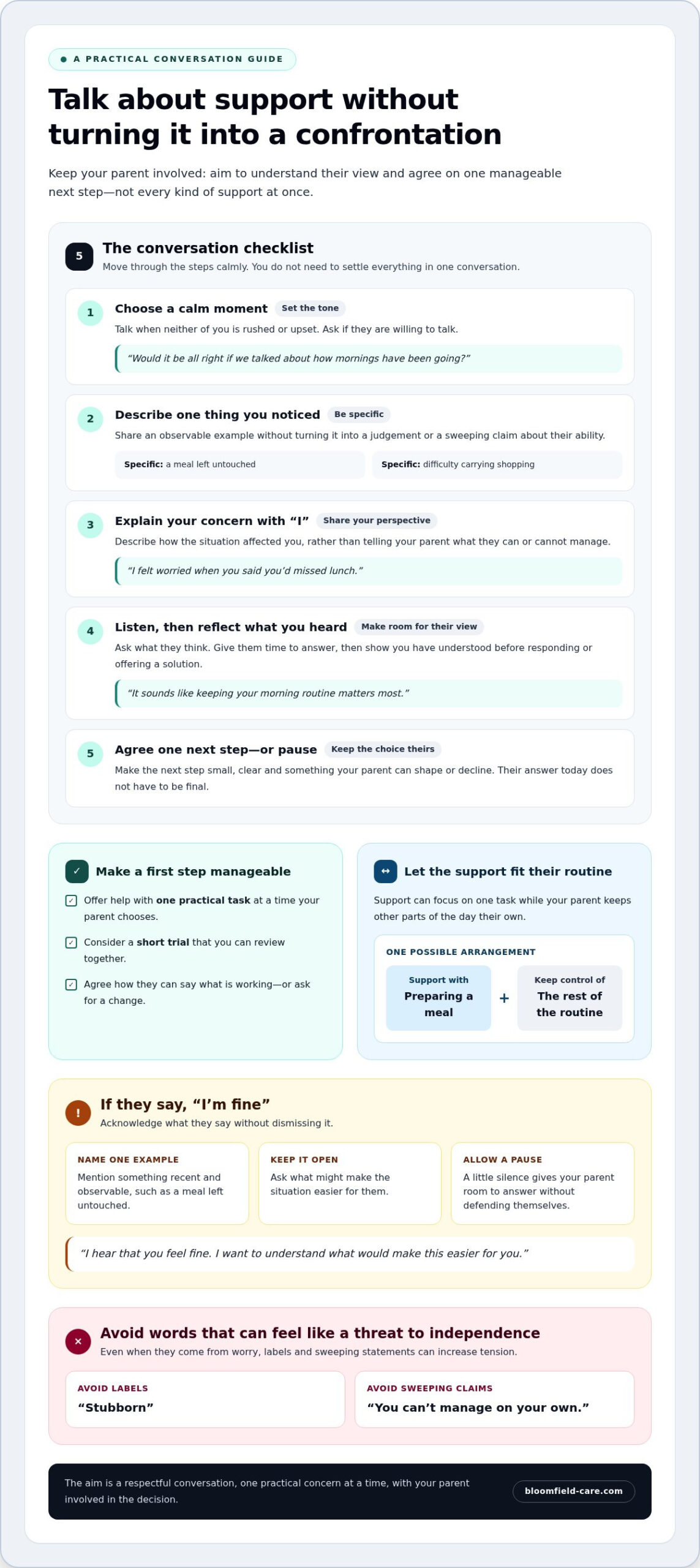
A calm conversation is more likely to keep your parent involved than a sudden appeal in the middle of a difficult moment. Choose a time when neither of you is rushed or upset, and ask if they’re willing to talk. Keep the aim modest: understand their view and see whether there’s one step they would consider, not secure agreement to every kind of support.
Try this sequence:
- Ask permission: “Would it be all right if we talked about how mornings have been going?”
- Describe what you noticed: Share one specific observation without turning it into a judgement.
- Explain your concern: Use “I” statements, such as “I felt worried when you said you’d missed lunch.”
- Listen and reflect: Ask what they think, then show you’ve heard them before responding.
- Agree one next step: Make it small, clear and something your parent can shape or decline.
Avoid labels like “stubborn” and statements such as “You can’t manage on your own.” Even if they come from worry, these words can sound like a threat to your parent’s independence. Practical guidance from Carents UK can also help adult children think about the emotional side of supporting an ageing parent. You don’t need to settle everything in one conversation.
What should you say when your parent says they are fine?
Respond to the reassurance without dismissing it. Mention one recent, observable example, such as a meal left untouched or difficulty carrying shopping, rather than making a sweeping claim about their health or ability. You might say, “I hear that you feel fine. I want to understand what would make this easier for you.” Then pause. A little silence gives your parent room to answer without feeling pressured to defend themselves.
How can you agree a small first step?
Offer a choice with clear limits: help with one practical task at a time your parent chooses, or a short trial you can review together. Agree how they’ll tell you what is working and how they can ask for a change. For example, they might prefer help preparing a meal but want to manage the rest of their routine themselves. The Dorset domiciliary care guide explains how support at home can be shaped around individual routines.
You could close with: “Would you be open to trying this once, then we can talk about how it felt? We can leave it there for now if you’d rather.” That keeps choice with your parent and makes it easier to revisit the subject later without treating today’s answer as final. If you’re exploring how to support a parent who refuses help in Dorset, person-centred home support can start with tasks your parent agrees to.
What to try when a parent in Dorset keeps saying no
A repeated refusal can make you feel that you need to keep raising the issue until something changes. Yet hearing the same concern in every conversation may leave your parent feeling watched or pressured. If there’s no immediate danger, give the subject some space, then return to it when there’s a reason to talk, such as a change in routine or a task your parent has mentioned finding difficult.
Keep the next conversation focused on choices rather than a broad decision about “care”. Your parent might prefer to choose:
- What help to try: companionship, preparing a meal together or help with one household task.
- When it happens: a time that fits their established routine.
- Who is involved: a familiar relative or someone they feel comfortable meeting.
A small, agreed step can feel less intrusive than a major change. It also gives your parent a chance to say what works and what doesn’t, without implying they’ve handed over control of other parts of life.
How can family members avoid making the parent feel pressured?
Before approaching your parent, relatives can agree to keep the conversation calm, respectful and consistent. That doesn’t mean everyone must have identical concerns; it means avoiding a series of separate appeals that could make your parent feel outnumbered. Ask who they’d like involved, and respect their preference where possible. Share only information relatives need to provide practical support, and keep your parent part of decisions about their own life.
One trusted relative can coordinate when the subject is raised and what has already been discussed. This helps prevent family members from unintentionally repeating questions or offering conflicting suggestions. If opinions differ, talk privately as a family rather than expecting your parent to settle the disagreement. Keep the focus on their wishes and any specific changes that are causing concern.
Could a short break or another form of support help?
Family support can be tiring, and needing a break doesn’t mean you’re abandoning your parent. Respite is one possible way for a relative who provides regular help to have time to rest while support continues. Discuss it as a practical way to care for everyone’s wellbeing, not as a consequence of your parent refusing help. Be clear about what support would continue during a break and involve your parent in the conversation where possible.
If your parent’s needs call for ongoing support in their own home, live-in care may be an option to explore. It won’t suit every person or situation, so keep the discussion centred on what your parent wants help with and how they want daily life to feel. Understanding how to support a parent who refuses help in Dorset may mean changing the pace, not abandoning the conversation: pause, listen and revisit possible support with their preferences in view.
When should concern about a parent’s refusal become a safety issue?
A choice you disagree with isn’t automatically an emergency. Your parent may decide against support even if you believe another option would be safer. The concern changes when there’s a specific and serious risk, such as an injury needing urgent attention or an immediate threat to their safety. Focus on what has happened and what help is needed now, rather than treating every refusal as proof that your parent can’t decide.
For immediate danger, contact emergency services. If the concern isn’t urgent, a GP can advise on health changes, while the adult social care service for your parent’s local authority can discuss care and support needs. Dorset Council and Bournemouth, Christchurch and Poole (BCP) Council serve different areas, so contact the authority responsible for your parent’s home.
Does refusing help automatically mean a parent cannot make decisions?
No. Under the Mental Capacity Act 2005, a person should be presumed to have capacity unless it’s established otherwise, and making a decision others consider unwise doesn’t by itself show a lack of capacity. Capacity relates to a particular decision at a particular time. Families shouldn’t try to diagnose it; seek proportionate professional advice if there are specific concerns about your parent understanding or making a decision.
Where can families in Dorset turn when risk is increasing?
For a non-emergency health concern, contact your parent’s GP. For support with daily living or care needs, approach the adult social care service for the council area where they live. If there’s immediate danger or someone needs urgent help, call emergency services. Be ready to describe the specific change you’ve observed, when it happened and what support your parent has accepted or declined.
If memory changes are part of your concern, the guide to dementia stages may help you consider what you’re noticing. It can’t establish a diagnosis or determine a person’s ability to make a particular decision. Keep notes on concrete examples, such as a missed appointment or difficulty managing a familiar task, to share with an appropriate professional.
Knowing how to support a parent who refuses help in Dorset means balancing their right to make choices with a calm response to real risks. If support at home could address an agreed need, explore person-centred home care as a possible next step.
How Bloomfield Care can help a parent accept support at home in Dorset
After listening to your parent and considering what would feel manageable, it may help to explore support that fits around the life they already have. Bloomfield Care provides person-centred support in people’s own homes in Dorset, including Weymouth, Christchurch and Poole. Bloomfield Care also supports people in Wallingford, Newbury, Thatcham, Abingdon and Oxford. The conversation can begin with what your parent wants to keep doing independently, which tasks feel harder, and what kind of help they might be willing to try.
Domiciliary care doesn’t have to mean handing over control of the day. Support can be shaped around agreed needs and familiar routines, with your parent’s preferences guiding the approach. That can make the idea feel more personal and less like a demand.
What might person-centred home support look like?
It starts with the person, not a standard schedule. Your parent might value choosing when support fits into the day, how a task is approached, and which routines stay unchanged. In familiar surroundings, help could focus on a specific agreed task, such as preparing a meal, while leaving other activities and family involvement as they are.
Depending on individual needs, support may include companionship, personal care, medication assistance, meal preparation or specialist dementia care. The aim is to support wellbeing and independence in ways that respect the person’s choices. If needs call for continuous support at home, live-in care is another option families can consider.
How can families take a first step with Bloomfield Care?
A first conversation can be about understanding, not committing to a particular arrangement. Include your parent where possible, and share what they say matters to them: preferred routines, concerns about accepting help, and the tasks they’d like to manage themselves. It can also be useful to describe specific changes that prompted the discussion, while giving your parent space to express their own view.
From there, you can explore whether tailored support might address an agreed need. Your parent may want to begin with one practical area and discuss other options only if they feel ready. This keeps the focus on their goals and makes room to shape support around the person, rather than expecting them to adapt to a fixed plan.
For families considering how to support a parent who refuses help in Dorset, a calm discussion with Bloomfield Care can help you explore a person-centred way forward. Talk with Bloomfield Care about support at home in Dorset, with your parent’s needs and preferences at the centre.
Make the next step feel manageable
Supporting a parent who resists help takes patience, and progress may come through small, willing steps rather than one decisive conversation. As you consider how to support a parent who refuses help in Dorset, keep their preferences at the centre while staying attentive to changes that may affect their wellbeing. You don’t have to work out every part of the future today.
If your parent is open to exploring support, Bloomfield Care can discuss a person-centred approach in the familiar surroundings of home. Support may include companionship, personal care, medication assistance, meal preparation or specialist dementia support, shaped around the person’s needs and routines. A conversation can be a gentle way to explore what might feel acceptable, with no need to decide everything at once.
Talk with Bloomfield Care about a person-centred approach to support at home. One thoughtful next step can help your family move forward with greater confidence and care.
Frequently Asked Questions
Can I make my parent accept care if they refuse help?
Usually, you can’t make an adult accept care simply because you’re worried. If your parent can make the particular decision, they can refuse support, even if you think that choice is unwise. Keep the conversation open and ask what they would consider acceptable. If you have specific concerns about their ability to make that decision, seek advice from a suitable health or social care professional rather than trying to assess capacity yourself.
What should I do if my parent refuses medication or help with essential daily tasks?
Contact the prescribing GP or another appropriate health professional for advice if your parent refuses prescribed medication, especially if missing a dose could cause harm. Don’t change the dose, hide medicine in food or stop treatment without professional guidance. For difficulties with essential tasks, note what’s happening and seek advice from the GP or local adult social care team. If there’s immediate danger, contact emergency services.
How often should I bring up care if my parent keeps saying no?
There’s no set interval that suits every family. Avoid bringing it up in every conversation, as this can make your parent feel under pressure. Consider waiting until there’s a natural reason to revisit it, such as a new difficulty or a change in their routine. You might ask, “Would you be comfortable talking about this again next week?” Let their answer guide the timing where it’s safe to do so.
Can I arrange a home-care visit without my parent’s agreement?
You can seek information about care, but arranging a visit doesn’t mean your parent must accept it or let someone into their home. If they can make decisions about care, their consent matters. If you’re concerned they may not be able to make a specific decision, ask health or social care professionals for guidance on the appropriate next steps. Don’t assume that being a relative gives you authority to consent on their behalf.
Who can help if my parent lives in Bournemouth, Christchurch and Poole rather than Dorset Council’s area?
Contact the adult social care service for the local authority area where your parent lives. Bournemouth, Christchurch and Poole are served by BCP Council, while other parts of Dorset fall under Dorset Council. If you’re unsure which area applies, check the council responsible for your parent’s home before making a referral. This helps ensure your enquiry reaches the right team for local care and support advice.
Can a GP help when an older parent refuses support at home?
Yes. A GP can discuss health concerns that may be affecting your parent’s daily life, review relevant treatment and advise on possible next steps. If possible, ask your parent whether they’d like you to attend an appointment or help them prepare questions. The GP may need your parent’s agreement to discuss personal health information with you. A GP can offer advice, but your parent may still choose whether to accept support.
What can I do if my siblings disagree about my parent’s care?
Start by separating what each person has observed from what they fear might happen. Share specific examples, such as a change in eating or difficulty managing an everyday task, and keep your parent’s wishes central. If discussion becomes tense, consider asking a relevant professional involved in your parent’s care to clarify needs and possible options. Agreeing how to share updates can also reduce misunderstandings and prevent your parent receiving conflicting messages.