
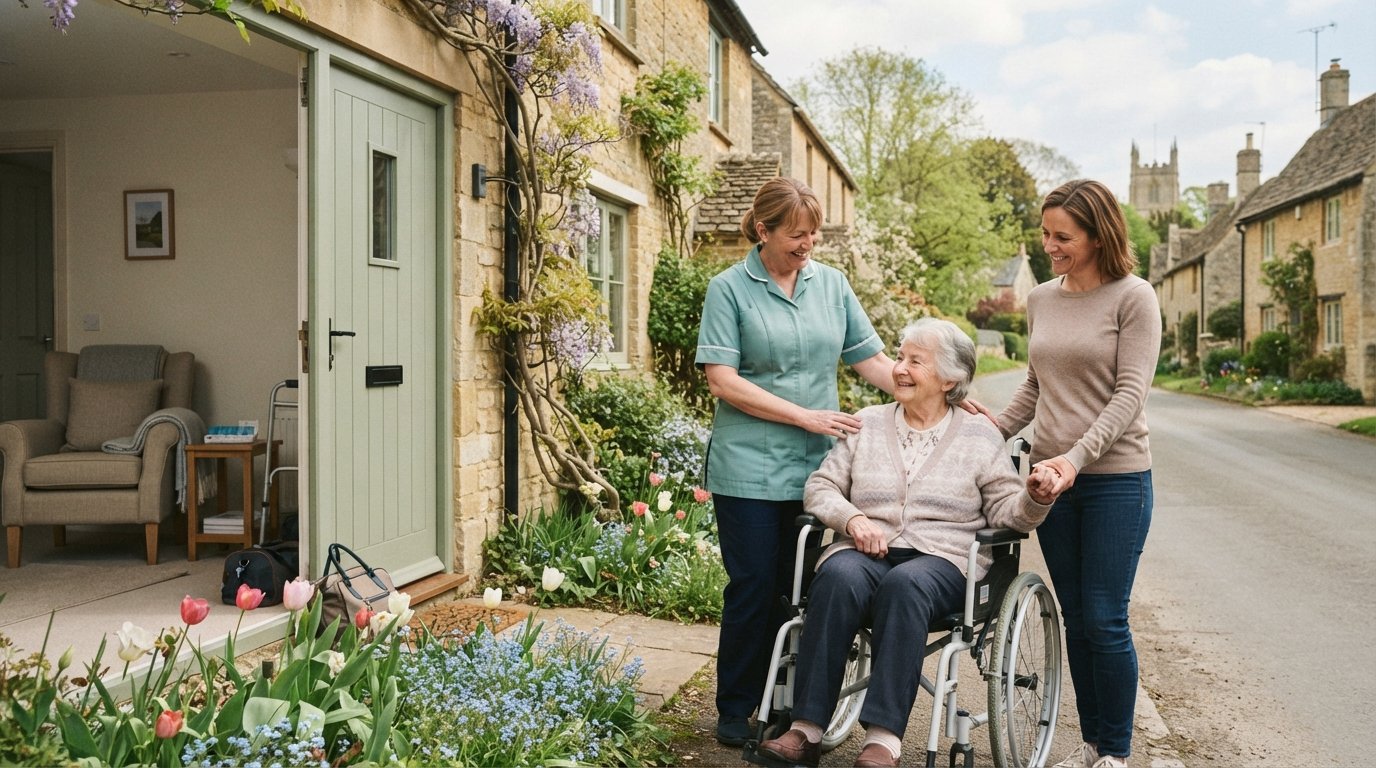
Waiting passively for ward rounds to dictate a departure date is the quickest route to unnecessary delays and preventable stress. When an acute stay comes to an end, arranging dependable hospital discharge support John Radcliffe Hospital Oxford requires proactive, bedside-to-home coordination rather than simply waiting on busy ward staff.
It’s completely natural to feel overwhelmed by complex NHS discharge pathways, or to worry that a rushed return home could lead to a fall and an immediate readmission. You want your family member back in the familiar sanctuary of their own home, supported by a reassuring routine that protects their independence, dignity, and physical safety.
This guide reveals how to navigate hospital discharge at John Radcliffe Hospital Oxford and arrange seamless, compassionate home care tailored to your loved one’s personal recovery. We explain how local Oxfordshire transfer pathways work, explore the practical differences between visiting care and live-in support, and outline how to transition smoothly from bedside to domestic comfort with complete peace of mind.
Key Takeaways
- Understand how the John Radcliffe Hospital’s Discharge to Assess model works so you can avoid ward delays and have recovery assessments completed in familiar home surroundings.
- Follow clear, collaborative planning steps to arrange reliable hospital discharge support John Radcliffe Hospital Oxford before your loved one departs the ward.
- Distinguish between hourly domiciliary care and full-time live-in care to match personal mobility, companionship, and daily assistance requirements.
- Protect against readmission risks during the critical first 72 hours by properly coordinating new medication routines, mobility aids, and specialized dementia care.
- Discover how partnering with an experienced Oxfordshire care team creates a smooth transition from bedside to domestic sanctuary with complete peace of mind.
Understanding the John Radcliffe Hospital Discharge Process
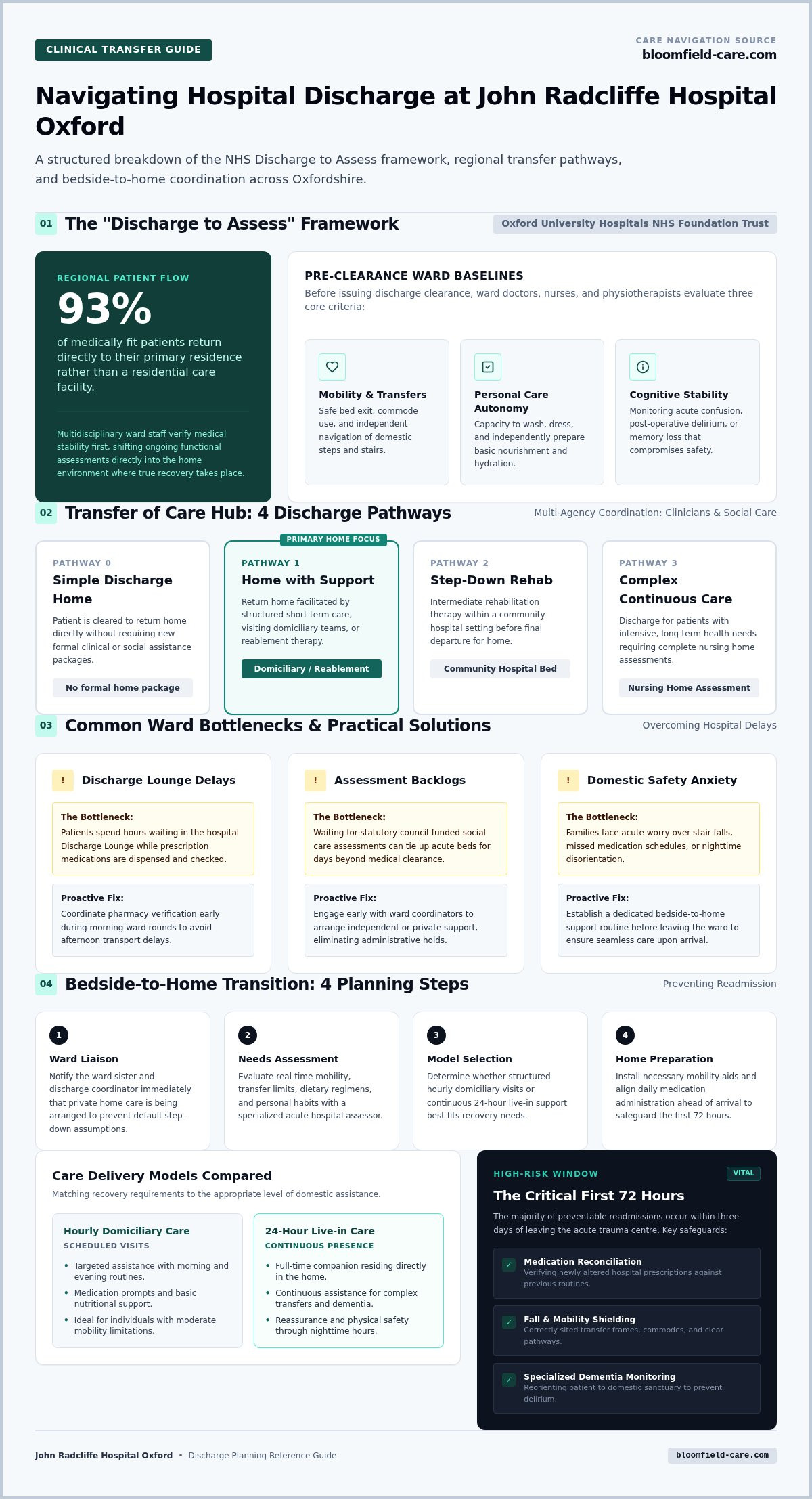
Leaving an acute ward requires structured coordination across clinical teams, therapists, and community services. As the primary acute trauma centre for the region, the John Radcliffe Hospital in Oxford operates under the national Discharge to Assess framework. Under this model, multidisciplinary ward staff establish that a patient is medically stable before arranging their departure, moving ongoing functional assessments into the domestic environment where recovery actually happens.
Before issuing medical clearance, ward nurses, doctors, and physiotherapists evaluate several core baselines:
- Physical mobility and transfers: Can the individual safely get out of bed, use a commode, and manage household steps?
- Personal care autonomy: Can they wash, dress, and prepare basic meals independently?
- Cognitive stability: Is there acute confusion, post-operative delirium, or memory loss that compromises domestic safety?
Waiting for council-funded care or local rehabilitation beds frequently introduces delays. Engaging early with ward coordinators allows families to explore private hospital discharge support John Radcliffe Hospital Oxford, avoiding prolonged hospital stays and ensuring a smooth transition home.
The Role of the Transfer of Care Hub at John Radcliffe
Patient discharges across Oxford University Hospitals NHS Foundation Trust are orchestrated by the Transfer of Care Hub. This multi-agency team connects ward clinicians with social care professionals to assign each individual to a recovery pathway:
- Pathway 0: Simple discharge home without the need for new formal assistance.
- Pathway 1: Returning home with short-term support, such as visiting domiciliary care or reablement therapy.
- Pathway 2: Step-down rehabilitation in a community hospital setting before going home.
- Pathway 3: Discharge for individuals with complex, ongoing health conditions who require full nursing home assessments.
Data from the local health system indicates that roughly 93% of medically fit patients return directly to their primary residence. Establishing reliable care early ensures Pathway 1 patients return home without unnecessary ward delays.
Common Discharge Hurdles for Oxfordshire Families
Even when clinical teams confirm that someone is ready to leave, practical bottlenecks often arise on the ward. Pinpointing these hurdles early helps families organize tailored hospital discharge support John Radcliffe Hospital Oxford before complications delay departure.
Prescription dispensing remains a frequent bottleneck. Patients often spend hours in the hospital Discharge Lounge waiting for their discharge medications to be checked and dispensed. At the same time, waiting for statutory social work assessments can tie up acute beds for days. Beyond logistics, families often carry heavy emotional worry about nighttime wandering, forgotten medication, or unsteadiness on the stairs. Having a dedicated home care plan in place relieves this pressure, turning an anxious departure into a calm, supported homecoming.
How to Arrange Post-Hospital Home Care: A 5-Step Guide
Proactive planning turns an uncertain hospital departure into a steady, dignified return home. While acute clinical teams focus on medical stabilization, families must coordinate the domestic environment to prevent readmission within the vulnerable first month. Arranging responsive hospital discharge support John Radcliffe Hospital Oxford early bridges clinical handovers with personalized daily care.
Step 1 & 2: Ward Liaison and Rapid Needs Assessment
Tell the ward sister and discharge coordinator as soon as possible that you are organizing private support. This prevents the hospital from making default step-down assumptions. Next, schedule an assessment with a professional care agency experienced in acute hospital liaison.
A skilled assessor reviews your loved one’s real-time mobility, transfer capabilities, dietary restrictions, and personal routines. Gathering this detailed picture ensures the care plan accurately reflects daily living needs rather than hospital ward baselines.
Step 3 & 4: Care Model Selection and Home Preparation
Decide whether structured hourly domiciliary visits or continuous 24-hour live-in care best fits your relative’s recovery requirements. As outlined in standard NHS hospital discharge guidance, establishing safety measures before leaving the ward is essential. Reviewing the cost of home care helps families plan transparently around visiting versus full-time care options.
Meanwhile, prepare the private residence to be a safe, comforting sanctuary. Verify that necessary equipment, such as raised toilet seats, commodes, or walking frames, has been delivered by community occupational therapy teams. Stock the kitchen with wholesome meals, set comfortable room temperatures, and ensure fresh bedding is ready.
Step 5: Discharge Day Transport and Handover
On discharge morning, track the progress of To Take Out (TTO) medications and the electronic medical summary. Coordinate the carer’s arrival to coincide directly with hospital transport arriving at the front door. This eliminates gaps in supervision, eases sensory overload, and allows for an unhurried settling-in period. If you need responsive assistance to navigate this timeline smoothly, reaching out to Bloomfield Care can bring clarity and immediate structure to the entire discharge process.
Domiciliary Care vs. Live-in Care After Hospital Discharge
Every individual leaves the ward with a unique level of frailty and resilience. Matching post-acute needs to the right care model is essential for long-term recovery and personal comfort. While the government’s statutory hospital discharge and community support guidance emphasizes returning individuals to their own communities, families often grapple with how much assistance is truly necessary. Arranging tailored hospital discharge support John Radcliffe Hospital Oxford comes down to choosing between scheduled hourly visits and full-time, round-the-clock presence.
When Visiting Domiciliary Care Is the Ideal Choice
Visiting domiciliary care works best when a loved one retains moderate physical autonomy but needs practical help during peak hours of the day. A professional carer visits at agreed times to provide person-centred assistance, leaving the individual to enjoy their private space between calls.
Visiting care routinely supports:
- Morning and evening routines: Safe assistance with bathing, dressing, and gentle transfer into and out of bed.
- Nutritional support: Preparing fresh meals, ensuring proper hydration, and maintaining kitchen hygiene.
- Medication management: Providing timely reminders and checking that doses are taken accurately.
- Morale-boosting companionship: Dedicated social interaction that alleviates isolation and encourages emotional recovery.
Visits can range from a single daily welfare check to four calls spread across morning, lunchtime, teatime, and bed preparation.
Why Live-in Care Delivers Complete Reassurance for Complex Recoveries
Following major surgery, a stroke, or a significant loss of balance, leaving an older adult unattended between hourly visits can induce immense anxiety. Opting for comprehensive live in care introduces a dedicated, compassionate professional who resides in the home, delivering one-on-one assistance whenever needed.
Nighttime represents the highest risk period for frail seniors. Waking disoriented in the dark to visit the bathroom often triggers severe falls and ward readmissions. A live-in carer eliminates this danger by providing gentle, immediate guidance throughout the night.
Unlike institutional step-down facilities, continuous home care preserves familiar household surroundings, preferred meal choices, and cherished personal rhythms. This constant, reassuring presence gives families complete confidence that experienced hospital discharge support John Radcliffe Hospital Oxford is maintaining their loved one’s comfort and dignity every hour of the day.
Managing Common Discharge Challenges: Medication, Mobility, and Dementia
The first 72 hours following hospital departure represent the most delicate phase of recovery. Stepping away from round-the-clock ward observation back into the quiet of home often exposes unforeseen physical weakness and cognitive fatigue. Securing proactive hospital discharge support John Radcliffe Hospital Oxford bridges this vulnerable window, turning potential crisis points into managed, steady rehabilitation.
Medication Administration and Pharmacy Coordination
Hospital admissions frequently trigger major changes to prescription regimens. New medications are added, dosages adjust, and long-standing prescriptions are sometimes paused. When patients arrive home with their To Take Out (TTO) packs, cross-referencing these boxes against older pill organizers can quickly cause confusion.
Professional home carers eliminate medication errors through disciplined oversight:
- Cross-checking discharge medication sheets against existing household supplies to prevent accidental double-dosing.
- Setting up prompt-based administration systems or organizing compliance blister packs.
- Liaising with local Oxfordshire pharmacies and general practices to ensure repeat prescriptions are ordered well in advance.
- Monitoring hydration, appetite, and subtle side effects that could signal an adverse reaction.
Supporting Cognitive Well-being and Dementia Transitions
Bright ward lighting, unfamiliar noises, and disrupted sleep schedules frequently induce hospital delirium or accelerate existing memory decline. Returning to familiar domestic surroundings helps ground an older adult, but the transition itself requires patience and steady reassurance.
Understanding progressive symptoms through detailed dementia stages guidance helps families tailor home environments to meet evolving cognitive needs. Professional dementia carers introduce gentle conversational orientation, encourage restful sleep-wake patterns, and create a calm, soothing atmosphere that reduces sensory overload.
Prolonged bed rest also diminishes muscle strength, turning simple transfers into hazardous moments. Experienced carers provide steady, encouraging mobility assistance that rebuilds confidence without pushing beyond safe limits. If your family is preparing for an upcoming ward departure, contact Bloomfield Care today to arrange dedicated hospital discharge support John Radcliffe Hospital Oxford that safeguards your loved one’s health and independence at home.
Bloomfield Care: Compassionate Discharge Support Across Oxfordshire
Returning home from an acute ward should feel like a relief, not a logistical ordeal. Established in 2014, Bloomfield Care serves as a trusted community partner for families seeking seamless hospital discharge support John Radcliffe Hospital Oxford. We coordinate directly with ward staff, social workers, and primary health teams across Oxford, Abingdon, Wallingford, and surrounding villages to rapidly deploy skilled carers into domestic settings.
Fast-Track Assessments and Direct Ward Liaison
Bedside handovers demand prompt action. Long delays waiting on administrative allocations can take an emotional toll on recovering individuals and their families. Our local management team conducts swift, unhurried home and ward assessments across Oxfordshire, evaluating practical mobility, clinical recovery needs, and domestic routines.
By communicating directly with John Radcliffe discharge coordinators, ward sisters, and occupational therapists, we ensure every detail is addressed before departure. From verifying that mobility equipment is properly installed to syncing carer arrival times with hospital transport, our hands-on liaison prevents avoidable discharge postponements and ward confusion.
Comprehensive Care Tailored to Your Family’s Routine
Every recovery journey requires personalized attention. Whether an individual needs visiting domiciliary calls to assist with bathing, dressing, and warm meals, or round-the-clock live-in care, our person-centred philosophy protects personal dignity and lifestyle independence. For family members feeling the physical strain of bedside vigils, we also arrange flexible respite care to allow primary caregivers necessary rest while professional standards remain uninterrupted.
Our carers bring specialized capabilities in dementia care, Alzheimer care, and post-operative mobility reablement, transforming an anxious hospital exit into a steady homecoming. We focus on establishing comforting daily rhythms within your loved one’s private sanctuary, ensuring nourishment, prompt medication administration, and genuine companionship.
To arrange dependable hospital discharge support John Radcliffe Hospital Oxford and bring your loved one home with complete confidence, contact Bloomfield Care today to speak directly with our Oxfordshire team.
Taking the Next Step Toward Confident Recovery at Home
Transitioning out of hospital shouldn’t feel like an uphill climb against ward bureaucracy. Navigating the Discharge to Assess framework proactively, arranging meticulous medication oversight, and choosing between scheduled visiting calls and full-time live-in care transforms discharge day from an anxious scramble into a calm, structured homecoming.
Since 2014, Bloomfield Care has helped Oxfordshire families bridge the gap between bedside discharge and domestic comfort. Fully regulated by the Care Quality Commission, our dedicated team provides flexible, person-centred support ranging from daily visiting calls to 24-hour live-in assistance. Every carer is thoroughly vetted and trained to protect physical safety while honoring personal dignity.
When you need responsive, dependable hospital discharge support John Radcliffe Hospital Oxford, our compassionate advisors are here to guide you through each step. Speak with us today to arrange hospital discharge care with Bloomfield Care, ensuring your loved one returns to their familiar sanctuary with safety, warmth, and complete peace of mind.
Frequently Asked Questions
How quickly can Bloomfield Care arrange home care following discharge from John Radcliffe Hospital?
Bloomfield Care can deploy carers rapidly once an initial needs assessment is completed. Because our management team is locally based in Oxfordshire and established since 2014, we collaborate directly with ward discharge coordinators and social workers to complete swift assessments bedside or at home. This allows us to arrange responsive hospital discharge support John Radcliffe Hospital Oxford without keeping your loved one waiting in an acute bed.
What is the difference between NHS reablement care and private home care in Oxford?
NHS reablement is a short-term rehabilitation program designed to restore basic independence, whereas private home care offers continuous, customized ongoing support. Reablement generally lasts up to six weeks with a focus on recovery targets, but local allocation delays are common. Private home care gives families immediate control over visit schedules, carer consistency, and long-term routines tailored precisely to personal preferences.
Can home care be arranged if the patient has not yet been medically cleared for discharge?
Yes, starting the care planning process before formal medical clearance is actually the best approach. Early planning allows our assessors to liaise with John Radcliffe ward staff, review anticipated mobility levels, and draft an individualized care plan in advance. When the medical team finally confirms discharge, everything is already organized at home, avoiding days of unnecessary discharge lounge delays.
What happens if my loved one’s care needs increase after returning home?
Care plans can be adjusted quickly to match evolving physical or cognitive health changes. Recovery isn’t always linear. If a relative needs additional help after returning home, our management team conducts a prompt reassessment. We can easily scale support up from short domiciliary visits to multi-call daily routines or seamlessly transition to full-time live-in care, ensuring safety without disrupting domestic comfort.
Does Bloomfield Care support patients living with dementia after an acute hospital stay?
Yes, Bloomfield Care provides specialized dementia and Alzheimer care specifically tailored to post-hospital transitions. Hospital stays often trigger heightened confusion and disorientation for individuals with memory loss. Our carers are experienced in gentle, person-centred dementia support. We focus on rebuilding calm domestic routines, reducing sensory agitation, and providing constant reassurance in the comfort of familiar home surroundings.
Who coordinates the delivery of hospital discharge medications and mobility aids?
The John Radcliffe Hospital ward team arranges discharge medications and refers urgent mobility equipment to community occupational therapy services. Ward staff prepare To Take Out medications, while occupational therapy organizes items like walking frames or commodes. Bloomfield Care liaises directly with the ward and family on discharge day to confirm these essentials have arrived before your loved one enters their home sanctuary.
Can a live-in carer stay with my loved one immediately upon discharge from John Radcliffe?
Yes, a live-in carer can be present to greet your loved one the moment they step through their front door. By organizing live-in hospital discharge support John Radcliffe Hospital Oxford ahead of time, we ensure a professional carer settles into the home before hospital transport arrives. This provides immediate, one-on-one supervision, assistance with evening settling, and reassuring overnight presence right from day one.