

The most critical phase of your hip replacement recovery doesn’t happen in the hospital; it happens in the quiet, familiar corners of your own home. It’s perfectly natural to feel a wave of anxiety as your discharge date from Dorset County Hospital approaches. You might worry about a sudden misstep in the hallway or wonder how you’ll manage your medication and wound care without a nurse just a button-press away. This transition is often the most daunting part of the journey, but you don’t have to face it alone. Choosing professional elderly care after hip replacement in Weymouth allows you to recover where you feel most comfortable while ensuring every safety protocol is met with expert precision.
We understand that maintaining your dignity is just as important as your physical healing. You want to stay in your own sanctuary, surrounded by your own things, rather than moving into a clinical residential setting. This guide provides a clear roadmap for navigating the first six weeks of your recovery. We’ll cover everything from managing your daily exercises and personal care to accessing local Weymouth resources like Westhaven Hospital for rehabilitation. You’ll discover how a partnership with a dedicated carer can prevent social isolation and provide the steady hand needed for a confident, successful return to the life you love.
Key Takeaways
- Understand why the first two weeks post-surgery are considered the “Golden Period” for establishing long-term mobility and independence.
- Learn how to conduct a comprehensive fall-risk audit to transform your private residence into a safe, accessible sanctuary for healing.
- Compare the benefits of hourly and live-in elderly care after hip replacement in Weymouth to bridge the gap between hospital discharge and full recovery.
- Discover how to navigate local Dorset healthcare resources, including physiotherapy services at Weymouth Community Hospital and Westhaven Hospital.
- Identify the essential equipment and person-centred support strategies that allow you to maintain your dignity while receiving personal care at home.
Understanding the Hip Replacement Recovery Timeline for Seniors
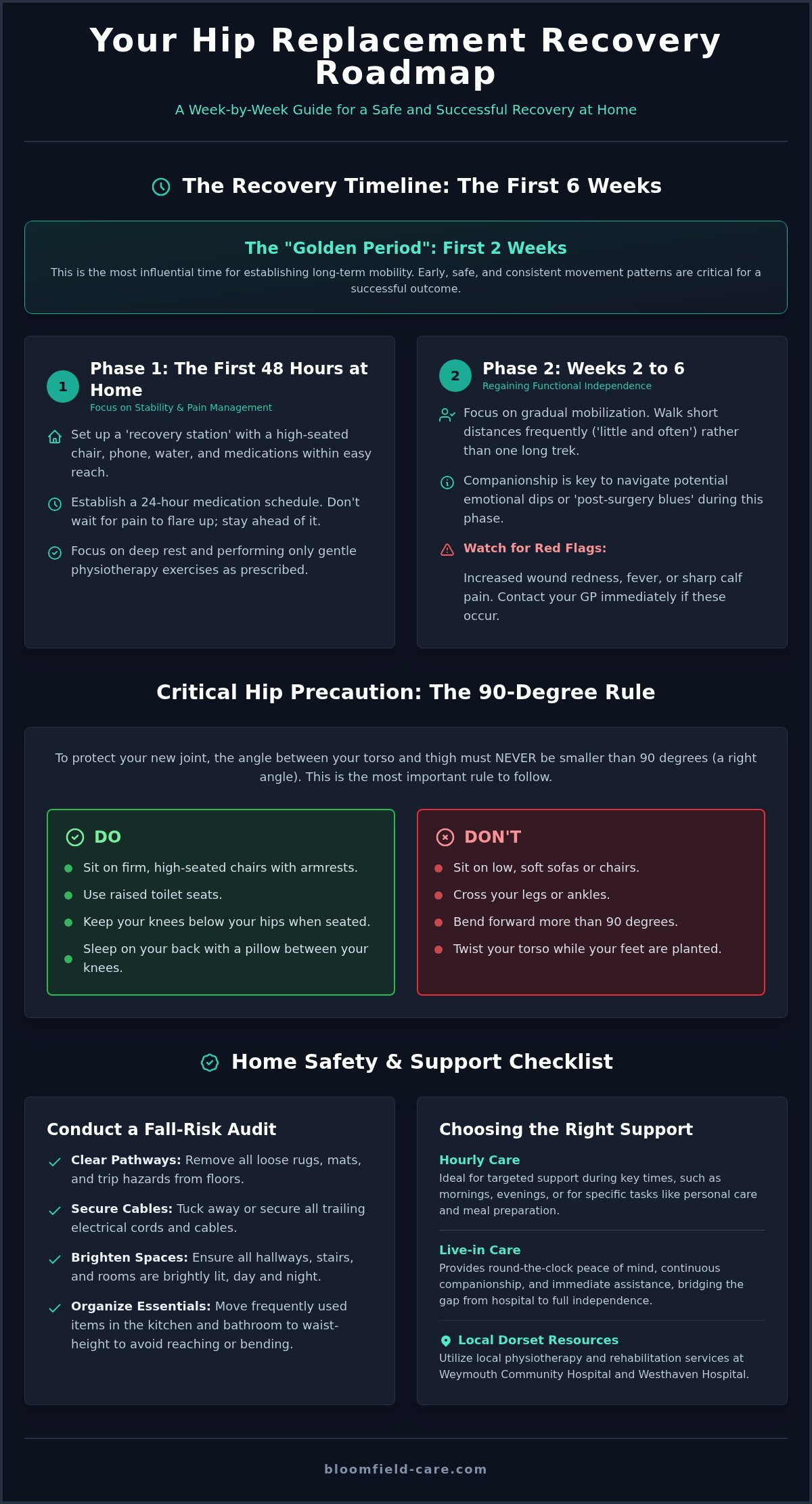
The first fourteen days following a hip replacement procedure are often called the ‘Golden Period.’ During this window, your body begins the delicate process of knitting bone and tissue back together. It’s the most influential time for determining your long-term mobility. Successful elderly care after hip replacement in Weymouth focuses on this period to ensure that early movement patterns are safe and consistent. While the surgeon performs the technical work, the true recovery happens at home, where the environment must support every small win.
Strict adherence to ‘hip precautions’ is essential during these weeks. You’ll need to follow the 90-degree rule; essentially, never letting the angle between your torso and thigh become smaller than a right angle. This means no low chairs, no crossing your legs, and no twisting your torso while standing. These restrictions protect the new joint while the surrounding muscles strengthen. Professional carers can help you navigate these rules, ensuring you don’t accidentally compromise your surgery during simple tasks like reaching for a cup of tea.
Phase 1: The First 48 Hours at Home
The transition from the hospital ward to your own living room is a significant hurdle. Once you arrive home via hospital transport or a family car, your immediate priority is stability. We recommend setting up a ‘recovery station’ in your primary living space. This area should include a firm, high-seated chair, your phone, water, and all medications within arm’s reach. Staying ahead of the pain is vital. Establish a 24-hour medication schedule immediately. Don’t wait for discomfort to flare up before taking your prescribed relief. This consistency allows you to rest deeply and start your gentle physiotherapy exercises without distress.
Phase 2: Weeks 2 to 6 – Regaining Functional Independence
As you move into the second week, the focus shifts toward gradual mobilisation. The mantra here is ‘little and often.’ Walking across the room several times a day is far more beneficial than one long, exhausting trek. This period is also when the psychological ‘blues’ can set in as the initial adrenaline of the surgery fades. Dedicated elderly care after hip replacement in Weymouth provides the companionship needed to navigate these emotional dips, turning the recovery process into a shared journey rather than a solitary struggle.
Watch for ‘red flags’ during this phase. If you notice increased redness around the wound, a sudden spike in temperature, or sharp calf pain, contact your GP or local Dorset healthcare team immediately. By the sixth week, many seniors find they can manage short, assisted strolls along the Weymouth Esplanade, marking a beautiful return to the community and a shift from being a ‘patient’ to a recovering individual in their own sanctuary.
Preparing Your Weymouth Home for a Safe Recovery
Returning to your own home should feel like a relief, but it requires a shift in perspective to ensure your sanctuary remains safe. For those arranging elderly care after hip replacement in Weymouth, the home environment is the most critical factor in preventing complications. A standard living room often hides subtle dangers that only become apparent when your mobility is restricted. For instance, that plush, low-profile sofa might be your favourite spot to relax, but for a new hip, it’s a significant hazard. Soft furniture makes it nearly impossible to maintain the 90-degree rule, putting undue stress on the joint. Instead, you’ll need a firm, high-backed chair with armrests that allow you to push yourself up safely.
A thorough fall-risk audit is your first line of defence. Start by clearing away any loose rugs or mats that could catch the tip of a walker or crutch. Secure trailing cables behind furniture and ensure every hallway and corner is brightly lit. These small adjustments are foundational to a successful hip replacement recovery timeline, preventing the slips that often lead to hospital readmission. Kitchens and bathrooms also need attention; moving frequently used items to waist-height counters prevents the need for dangerous reaching or bending.
The Essential Equipment Checklist
Maintaining your independence and dignity starts with having the right tools in place. While some items are optional, others are non-negotiable for a safe home environment.
- Raised toilet seats and shower chairs: These allow you to manage personal hygiene without over-flexing the hip joint, keeping you safe and comfortable.
- Long-handled reachers and shoehorns: These are essential for getting dressed or picking up dropped items without breaking the forbidden 90-degree bend.
- Supportive, non-slip footwear: Ditch the loose slippers for sturdy, closed-back shoes that provide reliable grip on varied floor surfaces.
Professional Home Assessments
While family members mean well, they often overlook hazards they’ve lived with for years. An Occupational Therapist or a professional carer brings a clinical eye to your home layout, spotting everything from a slightly uneven floorboard to a poorly placed towel rail. By integrating domiciliary care in Weymouth into your recovery plan, you ensure that your environment is constantly monitored for safety. Professional carers spot environmental hazards that families often overlook because they are trained to anticipate the specific physical limitations of post-operative movement.
This expert oversight is a cornerstone of effective elderly care after hip replacement in Weymouth, providing peace of mind for both you and your loved ones. It transforms your house from a place of potential risk into a true recovery sanctuary. If you’re feeling overwhelmed by these preparations, reaching out for a professional home assessment can make the transition back from the hospital much smoother.
Choosing the Right Support: Hourly vs. Live-in Care
Deciding on the level of support you need is a deeply personal choice that often defines the success of your rehabilitation. Many families encounter what we call the ‘Care Gap’ during the first few weeks home. This is the space between what a loving spouse or child can realistically provide and the intensive, round-the-clock safety required after surgery. While family members offer vital emotional strength, the technical demands of elderly care after hip replacement in Weymouth often require a professional partner to prevent carer burnout and ensure every movement remains within safe limits.
When comparing professional home care to residential rehab centres, the benefits of staying in your own sanctuary are clear. In a facility, you’re one of many patients following a rigid schedule. At home, you’re the sole focus of a dedicated professional. This one-to-one attention allows for a ‘luxury’ recovery experience where your personal preferences, from the timing of your morning tea to the pace of your exercises, are respected. This autonomy often leads to a faster, more positive psychological recovery, as you remain the master of your own environment.
When Hourly Visiting Care is the Best Fit
Hourly visiting care, or domiciliary care, is frequently the ideal solution when a primary carer is already present but needs a reliable partner for respite. It’s particularly effective during high-risk periods like the ‘morning rush.’ Assisting with washing, dressing, and safely navigating the first steps of the day requires specific physical techniques that a professional carer handles with ease. These visits also ensure that nutrition and hydration aren’t overlooked. Professional meal preparation keeps your strength up while you focus on your physiotherapy, removing the burden of standing at a cooker during those early, fatiguing days.
The Benefits of Live-in Care for Hip Recovery
For those living alone or facing higher dependency needs, live-in care provides an unparalleled level of safety. The most significant advantage is the immediate assistance available for night-time bathroom trips. These moments are the highest fall-risk times for seniors, as fatigue and dim lighting can lead to missteps. Having a dedicated professional sleeping under the same roof removes the anxiety of being alone in the dark. Beyond the physical safety, the consistent companionship helps combat the isolation that often comes with restricted mobility. You can learn more about our compassionate live-in care and how it offers total peace of mind for families across Dorset. This constant presence ensures that elderly care after hip replacement in Weymouth is not just about managing a procedure, but about nurturing your overall well-being.
Local Rehabilitation Resources in Weymouth and Dorset
Returning home from Dorset County Hospital (DCH) or a private clinic like the Winterbourne is a major milestone. However, the discharge paperwork is just the beginning of your local recovery journey. Successfully managing elderly care after hip replacement in Weymouth requires a deep understanding of the local healthcare landscape. You aren’t just a patient in a system; you’re a member of a community with access to specific, high-quality resources designed to get you back on your feet. Using these local assets effectively can significantly shorten your path to full independence.
Physiotherapy and Mobilisation in Weymouth
Your physiotherapist is the architect of your new mobility, but your carer is the one who helps you build it every day. There’s a vital synergy between these roles. While a therapist from Weymouth Community Hospital or Westhaven Hospital might visit for scheduled sessions, your daily exercises happen in the gaps between those appointments. A dedicated carer ensures you perform these movements safely and accurately, preventing the ‘short-cutting’ that often happens when fatigue sets in. Consistent compliance with your prescribed physiotherapy exercises is the single most important factor in achieving a full, pain-free recovery. Local clinics within the Dorset HealthCare University NHS Foundation Trust offer specialised post-operative orthopaedic rehab that focuses on restoring your natural gait in a supportive environment.
Dorset Community Support Networks
Recovery involves more than just physical movement; it requires a logistical safety net. Weymouth has a robust network of community support, from local pharmacies offering prescription delivery to volunteer drivers who can assist with follow-up appointments. Our team at Bloomfield Care works closely with local GPs and district nurses to coordinate your care, ensuring everyone is on the same page regarding your progress. This integrated approach removes the stress of managing multiple contacts, allowing you to focus entirely on your health. Once your mobility improves, you might look toward joining local ‘gentle exercise’ groups, which provide both physical benefit and essential social connection with others on similar journeys.
The ultimate goal of elderly care after hip replacement in Weymouth is to move beyond the walls of your home and enjoy the beauty of our Dorset coastline again. Whether it’s a steady walk through Lodmoor Country Park or enjoying the views from Nothe Gardens, these local landmarks serve as perfect milestones for your progress. We’re here to ensure you reach those goals with confidence and dignity. If you’re ready to discuss how a local, person-centred approach can support your journey, explore our domiciliary care in Weymouth to see how we can assist your recovery at home.
The Bloomfield Care Difference: Person-Centred Recovery
At Bloomfield Care, we believe that successful elderly care after hip replacement in Weymouth extends far beyond clinical checklists. While the surgical procedure focuses on the joint, our support focuses on the individual. We see the person who wants to get back to gardening in Upwey or enjoying a quiet afternoon at a local café. This person-centred philosophy ensures that your recovery isn’t just about physical rehabilitation, but about reclaiming the lifestyle and independence that matter most to you. We’re a community-focused service that values human connection and the sanctity of your lifestyle above all else.
Every home in Dorset is unique, and so is every recovery journey. Our bespoke care planning involves a detailed look at your daily rhythms and personal preferences. We don’t just provide a service; we build a partnership that respects your autonomy. Whether it’s ensuring your morning tea is served exactly how you like it or timing your exercises to coincide with your highest energy levels, we tailor every aspect of our assistance to fit seamlessly into your life. This commitment to dignity and respect ensures that our presence feels empowering rather than patronizing.
Our Reassuring Approach to Post-Op Care
We understand that inviting someone into your sanctuary requires immense trust. That’s why we place great importance on matching the right carer to your personality and interests. A shared conversation about local Weymouth history or a mutual love for the Dorset coast can be just as healing as physical support. This approach transforms a professional service into a warm, family-oriented support system that alleviates the anxieties often associated with seeking help. To help your family make informed decisions about this journey, you can read about the cost of home care in our comprehensive 2026 guide.
Taking the Next Step
Arranging elderly care after hip replacement in Weymouth starts with a gentle, no-obligation conversation. During our free care needs assessment, we listen more than we speak. We’ll visit your home to understand your specific challenges and goals, looking at everything from the layout of your living room to your medication schedule. This allows us to create a roadmap for a smooth transition from hospital discharge to home-based support. Our Weymouth team is here to guide you through this process with patience and integrity, ensuring you feel stable and supported at every turn. Contact us today to begin your journey toward a safe, dignified recovery in the comfort of your own home.
Embracing Your Recovery with Confidence
Your journey back to full mobility doesn’t have to be a source of anxiety. By transforming your home into a safe sanctuary and choosing the right level of support, you’re setting the foundation for a successful return to the activities you love. Whether it’s the security of live-in assistance or the targeted help of hourly visits, professional elderly care after hip replacement in Weymouth ensures that every step you take is a safe one. We’ve explored how local resources and a person-centred approach can turn a challenging transition into a period of steady, dignified progress.
As a CQC-regulated provider rated ‘Good’, Bloomfield Care is dedicated to providing professionalism with heart. Our local Weymouth-based care teams are specialists in post-operative rehabilitation. We focus on your mental well-being just as much as your physical healing. We’re here to listen, support, and empower you throughout these critical weeks. If you’re ready to discuss a tailored plan for your sanctuary, Book a Free Care Needs Assessment in Weymouth today. You have the strength to recover. We have the heart to help you get there.
Frequently Asked Questions
How soon can an elderly person go home after a hip replacement?
Most seniors return home within one to three days after surgery at Dorset County Hospital. The medical team ensures you can safely get in and out of bed, walk short distances with a frame or crutches, and manage basic stairs. Your discharge depends on your pain levels and physical stability. Having a professional support system waiting at home provides the reassurance needed to make this transition as smooth as possible.
What are the biggest risks for seniors recovering at home in Weymouth?
Falls and joint dislocation are the primary concerns during the initial six weeks. Simple household items like loose rugs or low chairs become significant hazards. Breaking the 90-degree hip precaution rule while dressing or reaching can also compromise the new joint. Professional elderly care after hip replacement in Weymouth mitigates these risks by providing a steadying hand and constant environmental monitoring to keep your recovery sanctuary safe and secure.
Does the NHS provide carers for post-hip replacement recovery?
The NHS often provides short-term “reablement” care for those with significant clinical needs, typically lasting between one and six weeks. This service focuses on helping you regain basic independence. However, many families find that this limited support isn’t enough for total peace of mind. Supplementing with private domiciliary care ensures you have consistent, familiar faces helping with meal preparation, personal hygiene, and companionship throughout your entire recovery journey.
Can a live-in carer help with physiotherapy exercises?
Yes, a live-in carer provides vital supervision and encouragement for your daily rehabilitation routine. While they aren’t physiotherapists, they ensure you follow the specific exercises prescribed by your local Weymouth clinic. They help you maintain the “little and often” movement philosophy, ensuring you don’t overexert yourself. This consistent support builds your confidence, making it much easier to reach milestones like walking safely to your garden or local park.
Is home care more expensive than a residential care home in Weymouth?
Home care is often a more cost-effective and person-centred alternative to residential settings. In 2026, the average cost for a residential care home in Weymouth is approximately £1,292 per week. Domiciliary care allows you to pay only for the specific hours of support you require. This flexibility means you receive high-quality, one-to-one assistance in the comfort of your own home, often at a lower total cost than a full-time facility.
What should I wear during the first few weeks of hip recovery?
Choose loose-fitting clothing with elasticated waistbands to avoid any pressure on your surgical incision. Sturdy, non-slip footwear is absolutely essential for your safety. Avoid backless slippers or flip-flops, as these increase the risk of trips. Well-fitted, closed-back shoes provide the grip and stability needed as you begin to mobilise. Your carer can assist with dressing to ensure you don’t bend past the restricted 90-degree angle during these early weeks.
How do I manage stairs after coming home from the hospital?
You’ll use the “up with the good, down with the bad” technique taught by your hospital therapist. Lead with your unoperated leg when going up and your operated leg when coming down. At home, a carer provides a reassuring presence, standing just behind or beside you to offer stability. This partnership removes the fear of navigating your home, allowing you to move between floors with growing confidence and safety.
Can Bloomfield Care provide support for just a few weeks of recovery?
Yes, we offer flexible, short-term support specifically tailored for post-operative rehabilitation. Our elderly care after hip replacement in Weymouth is designed to adapt to your unique healing timeline. Whether you need intensive live-in care for the first fortnight or a few hours of domiciliary care each day to help with morning routines, we’re here. We focus on enhancing your quality of life until you feel fully self-sufficient again.