

Could an Outstanding rating tell you less about your loved one’s day-to-day care than you expect? If you’re searching for “CQC outstanding-rated care in Dorset what it means,” the rating can be reassuring evidence of exceptional performance, but it’s only one part of choosing support that feels right.
It reflects what the Care Quality Commission found about an inspected service, including whether care was safe, effective, caring, responsive and well-led. It doesn’t guarantee that every person will have the same experience, or that every branch or service run by a provider has the same rating. Inspection information can also change, so check the specific service’s latest CQC profile and report.
It’s understandable to want a clear sign that your family member will be safe, respected and supported. This guide explains what an Outstanding rating can and can’t tell you, how to check findings for a Dorset service, and what to ask about your loved one’s needs. Use inspection evidence alongside a conversation about the person, their routines and the support that could help them feel at home.
Key Takeaways
- Understand CQC outstanding-rated care in Dorset what it means: an Outstanding rating is evidence about an inspected service, not a guarantee of identical care for everyone.
- Learn which areas the CQC assesses and how inspection findings contribute to a service’s rating.
- Find out how to locate the right provider profile and check its current rating, report date and findings.
- Compare inspection information with your loved one’s needs, preferences and care arrangements before making a decision.
- Prepare useful questions to ask home-care providers about respectful, person-centred support at home.
What does CQC Outstanding-rated care in Dorset mean?
The Care Quality Commission (CQC) is the independent regulator of health and adult social care services in England. It checks and reports on care quality. You can read a neutral overview of the Care Quality Commission (CQC), but use the relevant provider profile on the CQC website for current ratings and inspection findings.
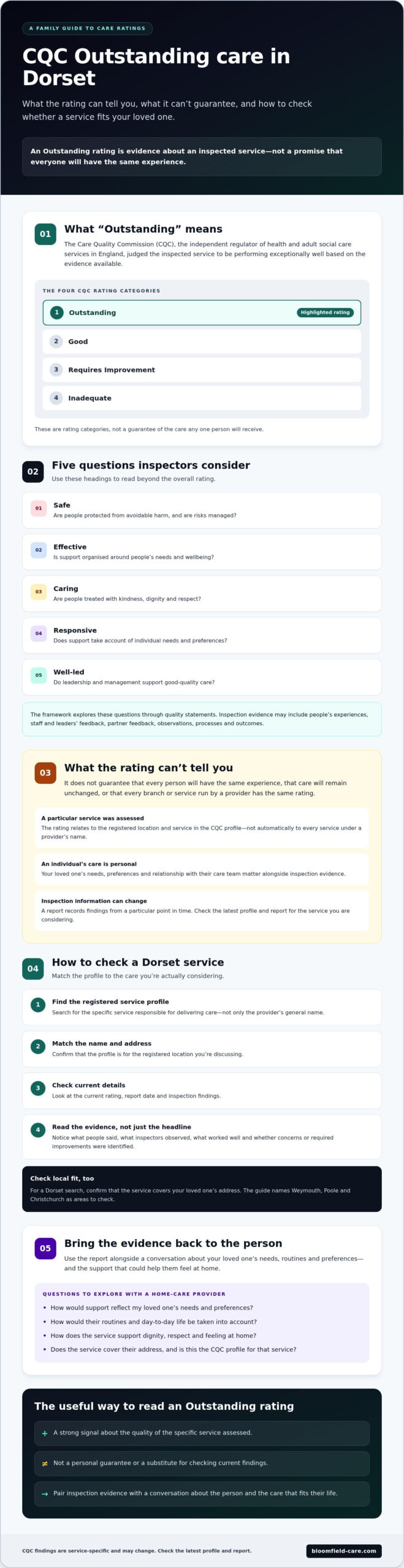
In plain English, an Outstanding rating means the CQC judged the inspected service to be performing exceptionally well. It is one of four rating categories: Outstanding, Good, Requires Improvement and Inadequate. The CQC considers whether care is safe, effective, caring, responsive and well-led. Findings can help families understand what inspectors observed and what other evidence indicated about the service.
What does an Outstanding rating indicate?
An Outstanding rating is a strong signal about the quality of the service assessed, based on the evidence available to the CQC. It can offer reassurance, but it isn’t a promise that every person will have the same experience or that care will remain unchanged. Each person’s needs, preferences and relationship with their care team are individual. Treat the rating as useful evidence, not a personal guarantee.
If you’re searching for CQC outstanding-rated care in Dorset what it means, keep that distinction in mind: the rating describes regulatory findings, while your family’s decision also depends on whether the support suits your loved one’s daily life.
Why does the specific Dorset service location matter?
Check the profile for the registered service responsible for delivering care, rather than relying on a provider name or a general claim. A provider may operate across several areas, while a CQC profile and its findings relate to a particular registered location. Match the name and address with the service you’re discussing, then read the report to see what was assessed.
A Dorset search may show home-care services with different registered locations and coverage areas. If you’re looking for support in Weymouth, Poole or Christchurch, check that the provider covers your loved one’s address and that you’re looking at the relevant CQC profile. Bloomfield Care states that its home-care coverage includes Dorset, Weymouth, Christchurch and Poole. Confirm the appropriate service location and current profile when making an enquiry.
A location-specific CQC rating describes the service assessed at that registered location. It doesn’t automatically apply to every service or guarantee an individual’s future experience.
How does the CQC assess care quality and reach its rating?
The CQC draws on inspection findings and other evidence to assess how a service is working. As of September 2026, its Single Assessment Framework (SAF) uses five key questions: is the service safe, effective, caring, responsive and well-led? These questions give families a useful structure for reading beyond the overall rating.
The framework explores those questions through 34 quality statements. Evidence may include people’s experiences, feedback from staff and leaders, feedback from partner organisations, observations, processes and outcomes. For home care, this can help inspectors consider not only what a provider’s procedures say, but also how people experience support in their own homes.
What areas of care quality should families look for?
- Safe: whether people are protected from avoidable harm and risks are managed.
- Effective: whether support is organised to meet people’s needs and help them maintain their wellbeing.
- Caring: whether people are treated with kindness, dignity and respect.
- Responsive: whether support takes account of individual needs and preferences.
- Well-led: whether leadership and management support good-quality care.
These are the five key questions, but the published report may also show findings against individual areas or statements. That detail can reveal strengths or concerns that an overall rating alone doesn’t convey. For wider context, The King’s Fund offers an analysis of social care quality, including how quality is considered across the sector.
What can an inspection report tell you?
Read the latest report for the registered service you’re considering. Check its publication or inspection date, then look for the evidence behind the findings: what people said, what inspectors observed, what the service was doing well, and whether concerns or required improvements were identified. The date matters because a report records findings from a particular point in time and may not reflect later changes.
A rating is the headline; the report is the evidence that helps explain it. If you’re asking “CQC outstanding-rated care in Dorset what it means”, reading the report can help you form practical questions about your loved one’s support, such as how the service respects routines, preferences and independence at home.
After reviewing the findings, discuss your family’s needs with a local provider. Talk with Bloomfield Care about home-care support, and verify the current CQC profile for the specific service location before relying on a rating.
Does an Outstanding rating guarantee the right care for your loved one?
No. An Outstanding rating is useful evidence about the service the CQC assessed, but it can’t promise that everyone will have the same experience or that the service will suit your family. Care is personal. Your loved one’s needs, routines, preferences and relationship with the people supporting them all matter.
What an Outstanding rating can and cannot tell you
A rating reflects the CQC’s assessment evidence at a particular point in time. It can help you understand how the service was judged, but it doesn’t guarantee future quality or show exactly how support will feel for your loved one. Services can change, and published information may be updated as the CQC receives further evidence. Check the latest profile and report rather than relying on an old rating or a provider’s headline claim.
A rating below Outstanding doesn’t automatically mean a service is unsuitable. Read the report to understand what the CQC found, when it assessed the service and whether any concerns relate to your family’s priorities. A Good rating, for example, means the service is performing well and meeting the CQC’s expectations. Compare the evidence with the person’s needs rather than judging by the label alone.
How to assess personal fit as well as quality
Alongside checking inspection findings, ask providers how they approach everyday support. Useful questions include:
- How would support take account of familiar routines and personal preferences?
- How would the person be encouraged to make choices and maintain independence?
- How would staff communicate respectfully with your loved one and family?
- If dementia care is needed, what experience and approach can the provider describe?
Listen to how the provider responds. Do they ask about the person as an individual, explain how support could reflect their circumstances and make space for your questions? Their answers can help you assess whether the approach feels respectful and whether it appears suitable for the support required.
For families considering home support in Weymouth, our guide to person-centred domiciliary care in Weymouth offers more detail on thinking about individual needs at home. Understanding CQC outstanding-rated care in Dorset what it means involves looking beyond the rating: consider the latest evidence, then weigh it against your loved one’s wishes and the provider’s ability to discuss their needs clearly.
How can Dorset families check a CQC rating and compare home-care providers?
A few careful checks can take you from a rating headline to a clearer picture of the service your loved one may receive. Search the CQC website by provider name, location or type of care, then make sure the profile matches the registered service you’re considering. A similar name or a nearby town isn’t enough to confirm you’ve found the right record.
A simple checklist for checking the CQC profile
- Match the service: Check the registered provider and location against the details given by the care provider. Confirm that the service covers your loved one’s address.
- Check the latest information: Note the overall rating and the date of the latest inspection or report. Read the report itself, not just the rating label.
- Look at the findings: Note what the CQC identified as working well, any concerns and any improvement actions. Ask the provider to explain points you’re unsure about.
Then compare the findings with the home-care options in your part of Dorset. If you live in Weymouth, Poole or Christchurch, ask whether the provider supports your locality and which registered service location is relevant. Bloomfield Care states that its coverage includes Dorset, including these towns. Confirm the specific service location and current CQC profile when making an enquiry.
Questions to ask a Dorset home-care provider
Start with your loved one’s everyday needs. Ask how the provider would understand their preferences and build person-centred support around their routines, independence and dignity. You could also ask:
- Who should we contact if care needs or circumstances change?
- How would you adapt support to the person’s preferences and usual routines?
- How do the latest CQC findings relate to the specific service location we’re discussing?
- If dementia care is needed, how would you take the person’s individual needs into account?
Clear answers can help you connect inspection evidence with the practical support on offer. For more on local support, explore home-care services and support in Dorset. If you’re also considering the financial side of arranging care, the guide to the cost of home care in Oxfordshire and Dorset may be useful.
Understanding CQC outstanding-rated care in Dorset what it means is one part of choosing support. Speak with Bloomfield Care about your home-care needs, and check the relevant service profile and rating as part of your decision.
Next steps for families seeking CQC-rated care in Dorset
Choosing care is personal, and you don’t need to settle everything at once. Start by confirming that the CQC profile belongs to the registered service you’re considering. Read the latest report and note its date, rating and findings. Then compare that evidence with your loved one’s needs and preferences before asking providers what support may be suitable.
This puts CQC outstanding-rated care in Dorset what it means into perspective. A rating can inform your decision, but it can’t tell you on its own whether a particular care arrangement will feel right for the person receiving support.
Prepare for an initial care conversation
A few notes can make an initial conversation easier and keep the focus on the person. Write down their usual routines, interests, preferences and support needs, along with any questions raised by the CQC report. Where possible, include the person receiving care and give them time to express what matters to them. Their perspective can help shape a respectful, individual discussion.
Explain what has changed or prompted the search for care, and what the person hopes to continue doing independently. A conversation with a provider can clarify whether its care options and local availability may meet those needs. Ask for clear answers and take time to consider them.
Discuss home-care options with Bloomfield Care
Bloomfield Care provides home-care support in Dorset, including domiciliary care, companionship and live-in care. Its stated local coverage includes Dorset, Weymouth, Christchurch and Poole. Confirm whether the relevant service can support your area and discuss the individual’s needs directly. Check the current CQC profile for the specific service location too. The information provided here doesn’t confirm an Outstanding rating for a Bloomfield Care location.
If live-in care is one option you’re considering, you can read Bloomfield Care’s guide to live-in care for further information. A conversation can give your family space to describe what matters, ask practical questions and understand which options may be appropriate.
For a calm discussion about your circumstances, contact Bloomfield Care about support in Dorset. Ask about your family member’s needs and whether support may be available in your area, then consider that conversation alongside the CQC report and your own assessment of personal fit.
Take the next step with confidence
Choosing care involves more than finding an Outstanding rating. Check that the CQC profile matches the service location, read the latest report and consider how its findings relate to your loved one’s needs, routines and preferences. Understanding CQC outstanding-rated care in Dorset what it means can help you treat a rating as one useful source of evidence, not a guarantee of personal experience.
Bloomfield Care provides domiciliary and live-in support in people’s own homes, with services including personal care, medication assistance, meal preparation, companionship and dementia care. Before deciding, confirm current service availability in your area and check the latest CQC information for the relevant location.
A thoughtful conversation can help you explore what support may suit your family. Speak with Bloomfield Care about support in Dorset and share what matters most to your loved one. Take your time, ask the questions you need to ask, and choose the next step that feels right for your family.
Frequently Asked Questions
What does an Outstanding CQC rating mean for home care?
An Outstanding rating means the CQC judged the inspected service to be performing exceptionally well based on the evidence available at the time of assessment. It can offer useful reassurance about assessed care quality, but it doesn’t promise the same experience for everyone or guarantee future performance. For CQC outstanding-rated care in Dorset, read the service’s report as well as its rating to understand what inspectors found.
Does an Outstanding rating apply to every branch of a care provider?
No. A rating relates to the service and registered location assessed by the CQC, not automatically to every branch operated by the same provider. Match the provider name and registered location on the CQC profile with the service you’re considering. If the provider serves more than one area, ask which registered service would deliver support at your relative’s home.
How can I check a care provider’s CQC rating in Dorset?
Search the CQC website by provider name, location or type of care, then open the profile that matches the service you’re considering. Check its overall rating, latest report date and inspection findings. Bloomfield Care states that its coverage includes Dorset, Weymouth, Christchurch and Poole, as well as Wallingford, Newbury, Thatcham, Abingdon and Oxford. Confirm current local coverage and the relevant CQC profile directly before deciding.
Can an Outstanding CQC rating guarantee good care for my relative?
No. The rating reflects the CQC’s assessment evidence at a particular point in time, so it can’t guarantee how your relative will experience care or what quality will be like in future. Your loved one’s needs, preferences and communication with the provider matter too. Read the latest report, ask about anything that concerns you, and consider whether the support discussed feels appropriate for the person.
What does the CQC inspect when rating home-care services?
The CQC assesses services using five key questions: are they safe, effective, caring, responsive and well-led? Its Single Assessment Framework also uses quality statements and draws on evidence such as people’s experiences, staff feedback, observations, processes and outcomes. For home care, report findings can help you understand how a service approaches dignity, personal needs and safety. Check the report for details behind the overall rating.
Is an Outstanding-rated care provider automatically the right choice for someone in Dorset?
No. An Outstanding rating is valuable evidence, but the right choice also depends on whether the provider can meet the person’s needs, respect their routines and support their independence. Ask how care would be shaped around the individual and confirm the service covers their address. Compare the answers with the CQC report, then take time to consider whether the arrangement feels suitable for your family.