

Imagine the comfort of a familiar armchair or the specific way the morning light hits the kitchen table; for someone living with dementia, these small details are the anchors of their identity. When you begin looking for Alzheimer’s care at home Dorset families often find themselves torn between the desire to protect a loved one’s independence and the growing need for professional safety. It’s a delicate balance to strike, especially when the exhaustion of 24/7 caregiving starts to take its toll on your own wellbeing.
We understand that the decision to bring outside help into your home is often clouded by a sense of guilt or fear of the unknown. You want your loved one to be treated with the same warmth and respect you provide, rather than feeling like a patient in a clinical setting. This guide explores how specialist support enables residents across Weymouth, Poole, and the wider county to live with dignity, ensuring that their daily routines remain uninterrupted and their personal history is honored.
You will discover how the latest 2026 Dorset Council funding updates, including the expansion of Individual Service Funds, can make professional care more accessible. We will also outline a sustainable path forward that prioritizes medical peace of mind and emotional wellness, helping you transition from a weary caregiver back to a devoted family member.
Key Takeaways
- Learn why the private residence acts as a sanctuary, providing the essential anchor points and familiarity needed to maintain a sense of self.
- Understand the advantages of choosing alzheimer’s care at home Dorset over residential settings, focusing on one-to-one attention and a non-clinical environment.
- Discover how specialist support evolves with your loved one, moving from gentle companionship in the early stages to comprehensive safety management as symptoms progress.
- Gain practical insights into conducting a home safety audit and navigating the latest 2026 Dorset Council social care resources.
- Explore a person-centered philosophy that prioritizes the individual’s dignity and history, ensuring care feels like a natural extension of the family.
What is Specialist Alzheimer’s Care at Home in Dorset?
Specialist care is a tailored support system designed specifically to meet the unique challenges of Alzheimer’s disease. It ranges from brief hourly check-ins to comprehensive 24-hour live-in support. This isn’t merely about managing a checklist of tasks. It’s a philosophy of care that prioritizes the individual’s dignity, history, and sense of self. When we talk about alzheimer’s care at home Dorset families often find that the most effective support is the kind that blends seamlessly into their existing domestic life. It’s about looking past the diagnosis to see the person who still values their morning tea and their favorite view of the garden.
We view the private residence as a sanctuary. For someone experiencing cognitive decline, their home is filled with “anchor points” for memory. The tactile feel of a banister, the specific sound of a garden gate, or the layout of a kitchen are all cues that provide comfort and reduce agitation. Specialist care protects these vital connections. Instead of forcing a move to an unfamiliar clinical environment, we bring the expertise to the doorstep. The core goal is to enhance autonomy, allowing your loved one to make choices and maintain their lifestyle for as long as possible. This approach focuses on what a person can still do, rather than just what they have lost.
Our person-centred approach is never static. It evolves as the condition progresses, ensuring that the support remains appropriate and respectful. Providing alzheimer’s care at home Dorset residents can trust means being a steady, reliable presence through every transition. We act as a dedicated caregiver and a trusted advisor, helping families navigate the complexities of cognitive change with grace and professional safety.
Domiciliary vs. Live-in Care for Alzheimer’s
Choosing the right level of support depends on the stage of the journey. Domiciliary care involves scheduled visits to help with medication prompts, meal preparation, or companionship. This is often the first step for families in the early stages of the condition. For those who need local, specific assistance, our bespoke domiciliary care in Weymouth provides a gentle introduction to professional help. Conversely, live-in care offers a constant 24-hour presence. It’s particularly beneficial for individuals who experience night-time wandering or significant confusion, providing a safety net that allows them to remain in their own bed while staying safe.
The Role of Specialist Dementia Carers
Specialist carers possess training that goes far beyond basic personal care. They understand the nuances of “sundowning,” a period of increased confusion in the late afternoon, and are skilled in non-verbal communication. They don’t just “do for” a person; they work in partnership with them. This collaborative approach extends to the family too. By acting as a professional support system, a carer helps reduce the risk of “carer burnout” for relatives. It allows you to step back from the exhausting role of a 24/7 provider and return to being a daughter, son, or spouse. This partnership creates a stable, calm environment where the individual can truly thrive.
How Specialist Care Adapts to Different Dementia Stages
Dementia is a progressive journey. It doesn’t move in a straight line, and the support required today might look very different in six months. Effective alzheimer’s care at home Dorset families rely on is built on the principle of adaptability. We don’t just provide a service; we evolve alongside your loved one. Care plans are reviewed monthly to ensure every adjustment reflects the individual’s changing cognitive needs.
In the early stages, the focus remains firmly on independence and autonomy. Support is often light-touch, involving companionship, help with routine maintenance, and cognitive stimulation to keep the mind engaged. As the journey moves into the middle stage, the focus shifts toward increased personal care and safety. This is often when behavioral changes become more pronounced, requiring a caregiver who understands the root of the frustration. By the late stage, the priority becomes specialist palliative support. Here, 24/7 monitoring ensures your loved one remains comfortable, pain-free, and treated with the utmost dignity in their final sanctuary.
Maintaining Routine and Familiarity
A consistent schedule is one of the most powerful tools in managing dementia. Knowing what happens next reduces the anxiety and agitation that often come with memory loss. Our approach integrates the beauty of local Dorset life into these daily routines. This might mean gentle morning walks along the Weymouth seafront or spending a quiet afternoon in a familiar garden. These activities aren’t just “time fillers”; they’re essential for emotional wellbeing. You can find more detail on how we tailor these approaches in our guide on understanding dementia stages.
Specialist Techniques: Validation and Redirection
Traditional “reality orientation,” which involves correcting a person’s mistakes, can often lead to distress. Instead, we use validation therapy. This technique involves meeting the individual in their current reality, acknowledging their feelings rather than the facts. If a loved one becomes distressed, our carers use gentle redirection to shift their focus to a more calming activity. This requires a deep understanding of their person-centred history. By knowing someone was once a keen gardener or a teacher, we can use those specific memories to soothe and engage them. For more practical advice on managing these daily interactions, the official Tips for Caregivers offer invaluable insights into compassionate communication.
If you’re noticing these changes in a loved one, it might be time to start a gentle conversation about how professional support can help your family find its balance again.
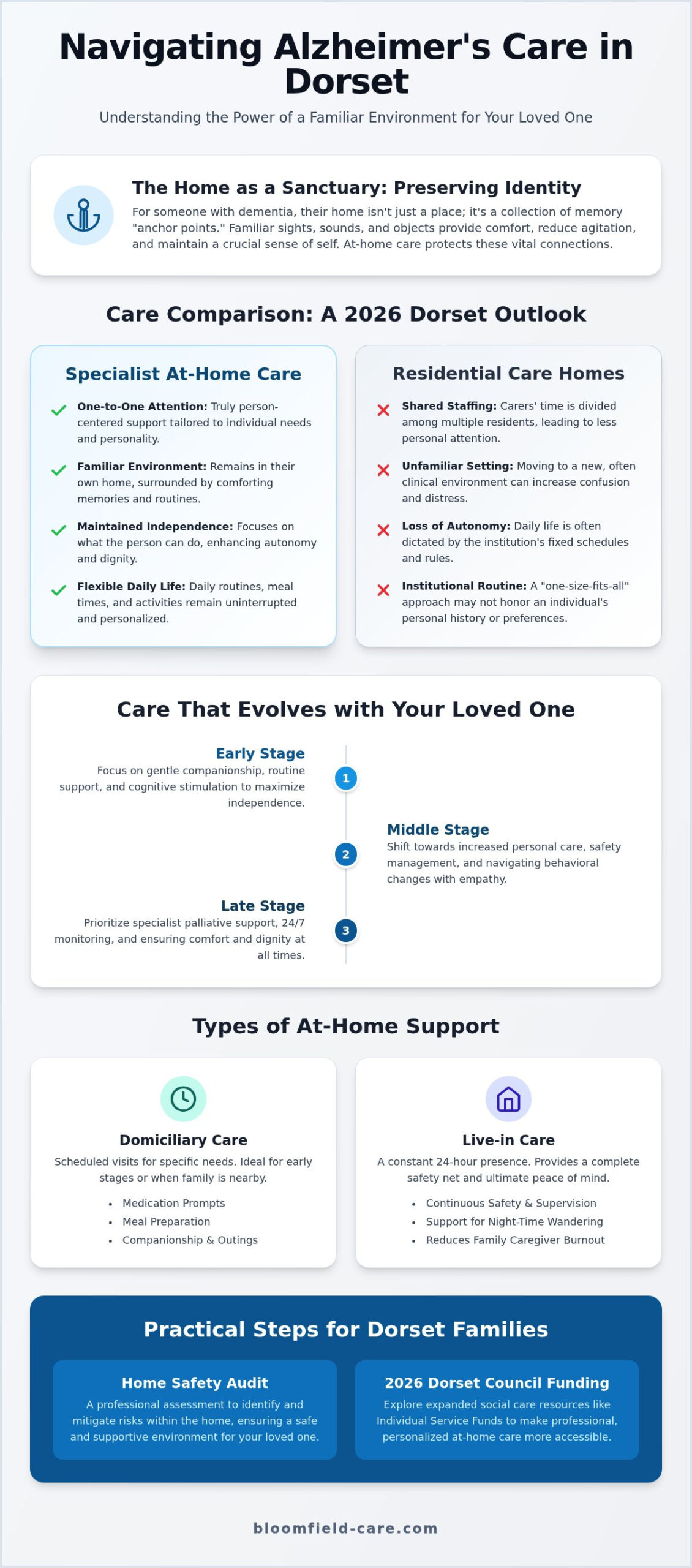
Home Care vs. Residential Care Homes in Dorset: A 2026 Comparison
For many families, the transition from independent living to professional support feels like a crossroads. There’s a common misconception that residential facilities are the only “safe” option once a diagnosis progresses. However, the 2026 landscape of alzheimer’s care at home Dorset offers a compelling alternative that prioritizes the individual’s history and emotional stability. While residential homes operate on a shared-staff model, home-based support provides dedicated one-to-one attention. This means the caregiver isn’t just managing a ward; they’re focusing entirely on your loved one’s specific needs, moods, and preferences in real time.
The environment plays a decisive role in cognitive health. A residential facility, no matter how well-appointed, is an unfamiliar clinical setting with new sounds, smells, and routines. In contrast, staying in a lifetime home allows a person to remain surrounded by their own sanctuary. Safety is no longer a reason to force a move. With modern assistive technology, such as smart sensors and fall detection, combined with the presence of a professional carer, the private residence can be just as secure as any care facility. This approach allows for a level of autonomy and dignity that is often difficult to replicate in a communal living environment.
Addressing the ‘Transfer Shock’ Phenomenon
Moving someone with Alzheimer’s isn’t just a logistical challenge; it can be a significant health risk. “Transfer shock,” or relocation stress syndrome, often leads to a rapid acceleration of cognitive decline and increased anxiety. The sudden loss of familiar surroundings can be deeply traumatizing for someone who relies on environmental cues to navigate their day. Keeping personal belongings, favorite furniture, and even beloved pets can make a profound difference in emotional wellbeing. For a deeper look at these choices, see our guide on Bloomfield Care Home or Care at Home?
The Cost of Home Care in Dorset
Navigating the financial side of care in 2026 requires a clear understanding of the local landscape. While residential fees continue to rise, home-based support often proves to be a more flexible and cost-effective solution. This is particularly true for couples. Paying for two separate beds in a residential home is frequently far more expensive than a single live-in carer who can support both individuals in their own home. You can find a detailed breakdown of these considerations in our cost of home care in Oxfordshire and Dorset. Choosing alzheimer’s care at home Dorset allows families to keep their assets while ensuring their loved ones receive the highest standard of personalized, professional safety.
Practical Steps: Managing Alzheimer’s at Home Safely in Dorset
Moving from the emotional decision to seek help into the practicalities of daily management can feel overwhelming. When arranging alzheimer’s care at home Dorset families often start by evaluating the physical environment. A home safety audit isn’t about stripping away the character of a lifetime home; it’s about subtle, purposeful modifications that prevent falls and reduce confusion. These changes allow your loved one to navigate their sanctuary with a renewed sense of confidence and independence.
Simple adjustments often yield the most significant results. Increasing light levels in hallways and bathrooms helps compensate for changes in depth perception, while using high-contrast colors for items like toilet seats and dinner plates can make daily tasks much easier to navigate. Technology also offers a modern safety net. Automatic pill dispensers ensure medication is taken at the correct intervals, and GPS-enabled devices provide peace of mind for those who still enjoy independent walks but may occasionally lose their bearings. In our county, the Safe and Independent Living (SAIL) project is a vital local initiative that helps residents access home safety checks and energy efficiency advice through a single point of contact.
Creating a Dementia-Friendly Environment
A dementia-friendly home balances professional safety with domestic warmth. Beyond removing trip hazards like loose rugs, consider the “visual clutter” of a room. Busy patterns on carpets can sometimes be perceived as obstacles or holes, leading to hesitation or falls. By simplifying the visual environment and using clear signage on doors, you help your loved one maintain their autonomy. Choosing specialist alzheimer’s care at home Dorset means having a partner who can suggest these bespoke modifications based on your loved one’s specific cognitive journey.
Accessing Respite Care in Dorset
Caregiving is a marathon that requires immense emotional and physical energy. To provide the best support for your loved one, you must also prioritize your own wellbeing. Respite care offers a essential bridge, providing temporary relief that allows primary caregivers to recharge. Whether it’s a few hours of domiciliary support each week or a short-term live-in arrangement, these breaks prevent burnout and ensure the care you provide remains sustainable. This temporary support can also serve as a gentle introduction to professional assistance, making any future transitions feel more natural. You can learn more about these options in our guide to respite care in Oxfordshire and Dorset.
Building a Local Support Network
You don’t have to navigate this path in isolation. Dorset has a robust network of community resources designed to support families. In Poole and Weymouth, local memory cafés provide a safe, social space for individuals and their carers to connect with others in similar situations. Admiral Nurses also offer specialist dementia support, focusing on the needs of the entire family unit. With Dorset Council’s 2026 expansion of Individual Service Funds, you now have more control and choice over how your care budget is spent, allowing for a truly personalized approach to support.
If you’re ready to create a safer, more supportive environment for your loved one, contact our dedicated team for a compassionate home safety consultation today.
Why Families Choose Bloomfield Care for Alzheimer’s Support
Families seeking alzheimer’s care at home Dorset often feel overwhelmed by corporate options that treat support as a logistical exercise. At Bloomfield Care, we take a different path. We believe in treating the individual, not the diagnosis. Our deep roots in the community, spanning from Weymouth and Poole to Christchurch, allow us to provide a level of local expertise that larger agencies often miss. We aren’t just a service provider; we’re a dedicated caregiver and a trusted advisor for your entire family. Our personality is defined by patience, integrity, and a genuine kindness that prioritizes human connection above all else.
Our selection process is rigorous, focusing on professionals who embody our values of compassion and professionalism. Every member of our team undergoes specialist dementia training to ensure they can navigate the complexities of cognitive decline with grace. This partnership-driven approach means we support the wellbeing of the primary caregiver just as much as the client. We understand that for care to be sustainable, it must feel like a natural extension of your own family support system. We listen more than we speak, ensuring our assistance is always tailored to the specific rhythm of your household.
Our Commitment to Dignity and Respect
Maintaining the sanctuary of the home is our highest priority. We achieve this through a steadfast commitment to continuity. By ensuring your loved one sees the same familiar faces, we build the trust necessary for effective alzheimer’s care at home Dorset. This consistency reduces anxiety and allows for a deeper human connection to flourish. Our promise is to provide professional safety without ever losing the heart and warmth of a domestic environment. We focus on enhancing life quality, helping individuals maintain their self-sufficiency and dignity within their own four walls for as long as possible.
Next Steps: Your Free Care Assessment
Every journey begins with a gentle, unhurried care needs assessment. During this visit, we don’t just look at medical requirements; we listen to the life story of your loved one. Understanding their career, their hobbies, and their favorite memories allows us to build a bespoke care plan that honors their identity. This person-centered philosophy ensures that the support we provide is as unique as the individual receiving it. We guide you through these sensitive topics with clarity, never rushing your decision-making process. If you’re ready to explore a long-term plan that prioritizes comfort and peace of mind, contact our Dorset team today to schedule your free assessment.
Choosing a Sustainable Path for Your Loved One’s Future
Your loved one’s home is more than just a building; it’s a sanctuary filled with the memories and routines that define who they are. By choosing alzheimer’s care at home Dorset, you’re preserving their dignity and ensuring they remain surrounded by the familiarity they love. We’ve explored how specialist support adapts as cognitive needs change, providing a safer and more compassionate alternative to the potential stress of residential relocation.
As a family-run provider, our person-centred approach is rooted in the belief that every individual deserves to be seen and heard. Our specialist dementia-trained carers offer CQC regulated support that feels like a natural extension of your own family. You don’t have to carry this weight alone. We’re here to help you transition from the exhausting role of a 24/7 caregiver back to being a devoted daughter, son, or spouse.
Request a Compassionate Care Assessment in Dorset
Taking the first step toward professional support is an act of love, not a sign of defeat. We’re here to listen, to guide, and to help you find the balance your family deserves.
Frequently Asked Questions
Is Alzheimer’s care at home safe for someone who wanders?
Yes, home-based support can be highly effective for those who experience wandering. By choosing live-in care, you ensure a professional presence is available 24 hours a day to provide gentle redirection and safety monitoring. We also use assistive technology, such as door sensors and GPS devices, to create a secure environment without compromising the comfort of your loved one’s sanctuary.
How much does Alzheimer’s care at home cost in Dorset in 2026?
The cost of support depends entirely on your family’s specific needs, ranging from a few hourly domiciliary visits to full-time live-in assistance. Many families find that alzheimer’s care at home Dorset is a more flexible financial option compared to residential fees, especially for couples who wish to stay together. We provide a transparent breakdown of costs during our initial bespoke care assessment.
Can home care support someone with advanced dementia?
Professional home care is fully equipped to support individuals through the late stages of the condition. Our specialist carers provide palliative support that focuses on pain management, personal dignity, and emotional comfort. This high level of one-to-one attention ensures that even those with complex medical needs can remain in the familiar surroundings they find most reassuring.
Does Dorset Council provide funding for Alzheimer’s care at home?
Financial assistance is available through Dorset Council for those who meet the eligibility criteria following a care needs and financial assessment. In 2026, the capital threshold for full self-funding remains at £23,250; if your assets are below this, you may be entitled to support. The expansion of Individual Service Funds (ISFs) also gives you more control over choosing your preferred provider.
What is the difference between dementia care and Alzheimer’s care?
Dementia is an umbrella term for a range of cognitive symptoms, while Alzheimer’s is a specific disease that is the most common cause of dementia. While the care approaches share many similarities, Alzheimer’s support often places a heavier emphasis on managing progressive memory loss and specific behavioral patterns. Both styles of support prioritize person-centred techniques to enhance quality of life.
How do I introduce a carer to a loved one who is resistant to help?
We recommend a gradual introduction to help ease any anxieties. It’s often helpful to introduce a carer as a “household assistant” or a “companion” who is there to help with specific tasks like cooking or gardening. This low-pressure approach allows a bond of trust to form naturally, making the transition to more personal care feel like a choice rather than an imposition.
Are your carers specifically trained in Alzheimer’s support?
Every member of our team undergoes specialist dementia-specific training that goes far beyond basic care requirements. This includes learning advanced communication techniques, understanding the triggers for “sundowning,” and practicing validation therapy. As a CQC regulated provider, we ensure our staff are highly competent and consistently updated on the latest best practices in cognitive support.
Can we get help with Alzheimer’s care in Weymouth or Poole?
We provide comprehensive coverage across the county, with dedicated teams available in Weymouth, Poole, Christchurch, and the surrounding rural areas. Whether you need hourly domiciliary visits or 24-hour live-in support, our local expertise ensures we can respond quickly to your family’s needs. We’re proud to be a community-focused service that understands the specific resources available within the Dorset area.