

What happens when a loved one needs more support, but family members aren’t sure who has the authority to decide what comes next? In Oxfordshire, power of attorney and care decisions can feel difficult when everyone wants to protect the person’s wellbeing while respecting their independence. Having an attorney doesn’t mean they take over every choice. The person’s ability to make a particular decision, their wishes and the type of Lasting Power of Attorney all matter.
It’s understandable to want clear answers before care arrangements change. This guide explains how a Health and Welfare LPA differs from a Property and Financial Affairs LPA, when an attorney may make care decisions and what an LPA doesn’t allow them to do. It also explains how the person’s preferences should guide decisions if they can no longer make a particular choice themselves.
You’ll find practical ways to share routines, preferences and relevant information with family members and care professionals in Oxfordshire. When support at home is being considered, clear communication can help care reflect the person’s dignity, choices and familiar way of life.
Key Takeaways
- Understand which type of Lasting Power of Attorney may apply when care, treatment or living arrangements need a decision.
- Learn why making an LPA doesn’t automatically transfer decision-making, and how capacity affects who decides.
- See how the person’s wishes and preferences can guide discussions about power of attorney and care decisions in Oxfordshire.
- Use a simple approach to locate the registered LPA, clarify its authority and share relevant care information with consent.
- Explore how home care can support familiar routines and independence while respecting the person’s choices and legal arrangements.
Power of attorney and care decisions in Oxfordshire: what families need to know
When someone’s needs begin to change, families may be unsure who can speak with care professionals or help decide what support is appropriate. Understanding the legal authority in place can ease some of that uncertainty, but it’s just as important to involve the person in choices about their own life. The rules for power of attorney and care decisions in Oxfordshire are the same as elsewhere in England and Wales.
What does a Lasting Power of Attorney do?
A Lasting Power of Attorney (LPA) is a legal document through which a person, known as the donor, appoints one or more attorneys to make decisions on their behalf within the authority set out in the document. An attorney’s role is limited to that authority. They don’t automatically take control of every decision or speak for the person in situations the LPA doesn’t cover.
An LPA is different from a will, which sets out a person’s wishes about their estate after death. It’s also different from informal family support. Relatives may help with calls, appointments or everyday tasks, but being a family member alone doesn’t give someone the legal authority provided by an LPA. For an overview of the English framework, see this guide to the Lasting Power of Attorney (LPA).
Care decisions should involve the person as far as they’re able to make the particular choice. An LPA allows a chosen attorney to act within defined legal boundaries when required. It isn’t a reason to set aside the person’s views or preferences.
Why care decisions can feel difficult for Oxfordshire families
Needs can change gradually or unexpectedly. Families may be balancing safety concerns with a loved one’s wish to stay at home, while coordinating conversations across different households. These discussions can feel especially tender when everyone wants to help but has a different view of what would offer the most reassurance.
For example, a daughter in Oxford might notice that her father is finding meals and medication harder to manage, while her brother in Abingdon worries about his safety at home. Their father may want to remain in familiar surroundings and take part in planning any extra support. The location doesn’t change the legal framework, but clear communication can help keep decisions centred on him.
Start by listening to the person and understanding what matters in their daily life. Their routines, relationships and preferences can shape a respectful conversation about support. Even when an attorney is involved, the person’s dignity and participation remain central. Home-based care, such as help with personal care, meals or companionship, may also form part of a plan that supports familiarity and independence.
Health and welfare or property and financial affairs: which LPA covers care?
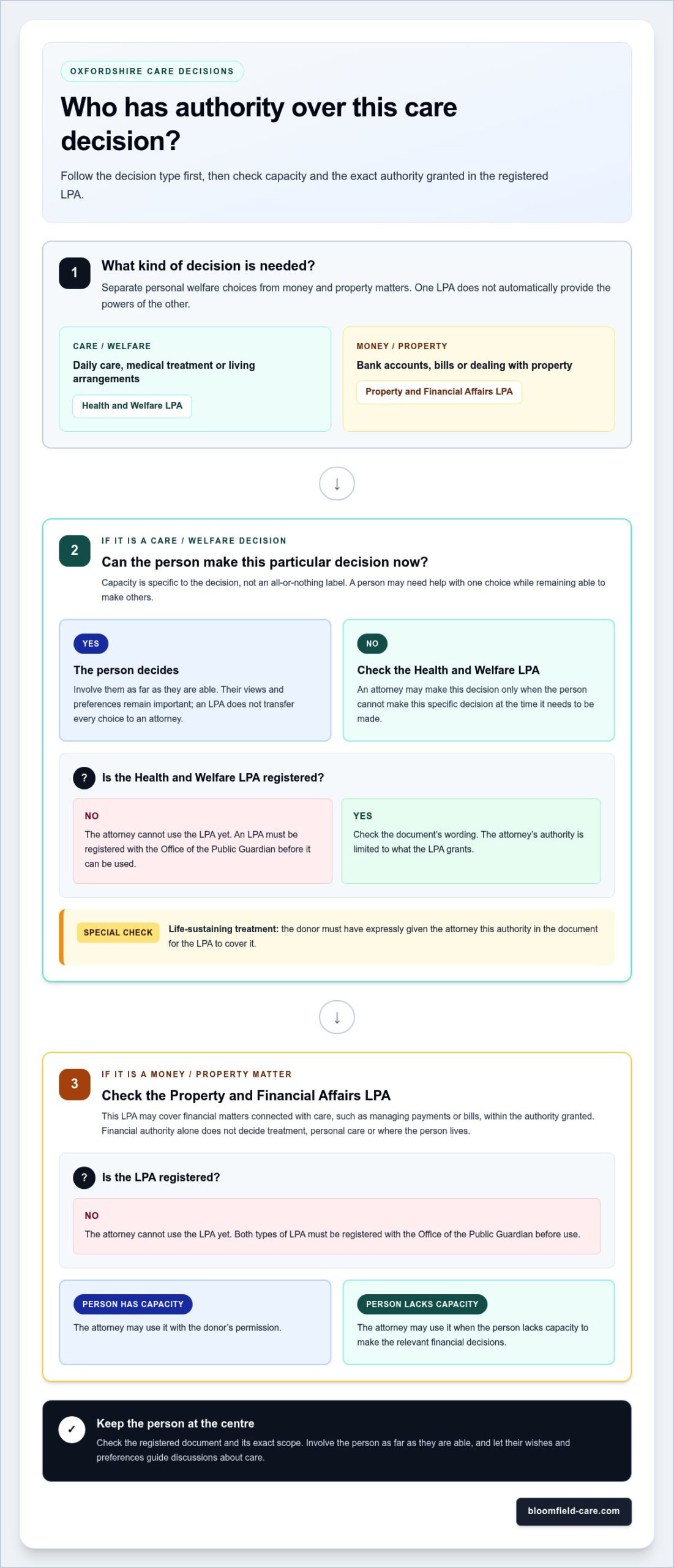
There are two types of Lasting Power of Attorney in England and Wales, and they cover different areas of a person’s life. For families thinking about power of attorney and care decisions in Oxfordshire, the key distinction is between authority over personal welfare and authority over money and property. A person may make one type or both, but one doesn’t automatically give an attorney the powers of the other.
| Health and Welfare LPA | Property and Financial Affairs LPA |
|---|---|
| Covers decisions such as daily care, medical treatment and living arrangements, including where the person lives. | Covers financial matters such as managing bank accounts, paying bills and dealing with property, within the authority granted. |
| Can be used only when the donor lacks capacity to make the particular decision. | Can be used after registration, with the donor’s permission while they have capacity, or when they lack capacity to make relevant financial decisions. |
Registration matters for both types: an LPA must be registered with the Office of the Public Guardian before an attorney can use it. The Official UK Government guidance on Lasting Power of Attorney explains the different LPAs and how they work.
When can a health and welfare attorney make decisions?
A health and welfare attorney may make a decision only if the donor can’t make that specific decision at the time it needs to be made. Capacity is decision-specific, not an all-or-nothing label, and a person’s ability can change. They might need help deciding about one aspect of care while remaining able to make other choices. If the LPA is to cover life-sustaining treatment, the donor must have expressly given the attorney that authority in the document.
Can a property and financial affairs LPA help arrange care?
It can help with the financial side of arrangements. For example, within the LPA’s scope, an attorney may manage payments or bills connected with care. That financial authority alone doesn’t grant power to decide the person’s treatment, personal care or living arrangements. Those are welfare matters, and may require a Health and Welfare LPA if the person lacks capacity for the decision.
Attorneys must act within the powers set out in the registered document and follow the legal duties that apply to their role. Checking the LPA’s wording can clarify who can do what and help prevent financial support from being confused with authority over care choices. If you’re exploring support at home, Oxfordshire home care support can be part of a plan shaped around the person’s routines and preferences.
Capacity, best interests, and the person’s wishes: resolving common LPA misunderstandings
Signing or registering an LPA doesn’t automatically take decision-making away from the person. The Mental Capacity Act 2005 is built around supporting people to make their own choices wherever possible. Its principles include presuming capacity, taking practical steps to help someone decide, recognising that an unwise choice doesn’t by itself prove incapacity, acting in the person’s best interests when they lack capacity, and choosing the less restrictive option where possible.
Capacity must be considered for the specific decision at the time it needs to be made, not assumed from a diagnosis or a general impression. Someone may be able to decide what to eat but need support with a more complex care choice. Their ability can also change, so a past assessment doesn’t automatically settle a later decision.
Does an attorney decide everything once an LPA is registered?
No. Registration makes an LPA available for use under its terms, but it doesn’t remove the donor’s right to decide while they have capacity for the particular matter. If they can make the choice, it remains theirs, even if relatives or the attorney disagree.
An attorney can act only within the authority granted by the relevant LPA and when the legal conditions for using it are met. A family disagreement doesn’t give an attorney extra powers. Where the person lacks capacity for a decision and the attorney has valid authority, the attorney must make that decision in the person’s best interests, rather than simply choosing what the family prefers.
What does acting in the person’s best interests mean?
It means considering the whole person, not just the immediate practical problem. Their current and past wishes, feelings, beliefs and values may all be relevant, alongside the circumstances of the decision. The person should be involved as much as possible. Where practicable and appropriate, the decision-maker should also consult people involved in their care or interested in their welfare, including family members or carers.
For example, if a person can’t decide whether to accept a particular care arrangement, their attorney should consider what the person has said about staying at home, familiar routines and the support they would find acceptable. A dementia diagnosis alone doesn’t settle capacity or dictate the outcome. Care conversations should make room for the person’s voice and preferences.
These principles help families understand power of attorney and care decisions in Oxfordshire without treating an LPA as blanket control. The Office of the Public Guardian oversees attorneys and can look into concerns about their conduct. The Court of Protection can deal with certain disputes or decisions, but ordinary family disagreement does not automatically mean an attorney has overriding authority. If concerns arise, focus first on the specific decision, the person’s capacity for it and the LPA’s terms.
Practical steps for coordinating care decisions with family and Oxfordshire support
Good coordination starts with clear information and a shared focus: what the person wants, what support they need and who has authority to make each decision. For families managing power of attorney and care decisions in Oxfordshire, a simple process can make conversations with relatives and care professionals more organised.
- Locate the registered LPA. Keep the document accessible and share relevant information with the people involved in planning.
- Clarify the attorney’s authority. Check which type of LPA is in place and what its terms cover.
- Involve the person. Ask about their priorities and support them to take part in choices they can make.
- Record preferences. With the person’s consent, note routines, communication preferences, important care information and any changes agreed.
How can an attorney prepare for a care-planning conversation?
Before meeting family or care professionals, gather the registered LPA and identify which decisions fall within the attorney’s authority. Ask the person what matters to them and make space for their views. It can help to separate an immediate concern, such as difficulty preparing meals, from longer-term planning and relatives’ preferences.
Useful notes might include the person’s preferred daily routine, how they like information explained, and relevant details about personal care or medication assistance. Share only information that is relevant, and seek the person’s consent where they can give it. If an adult social care assessment may be helpful, use Oxfordshire County Council’s official adult social care information to find the current route. Checking the council’s latest guidance avoids relying on outdated contact details or processes.
How can home care respect an attorney’s role and the person’s choices?
A home-care team can follow agreed care plans, support everyday preferences and share observations with the person and appropriate family members. For example, care professionals may notice that a familiar meal routine is becoming difficult or that a person communicates more comfortably in a quieter setting. These observations can inform a discussion, but they don’t replace the person’s choices or give the care team legal decision-making authority.
Respectful communication helps everyone understand what the person can decide, what the attorney is authorised to decide and how agreed support should be delivered. This is the purpose of person-centred care planning in Oxford: keeping the individual’s routines, dignity and preferences at the heart of practical support.
Bloomfield Care provides home care in Oxfordshire, with support shaped around the person’s needs and preferences.
Person-centred home care support in Oxfordshire
Legal arrangements help clarify who may make certain decisions, while a thoughtful care plan turns the person’s day-to-day needs and preferences into practical support. The two should work alongside each other, not compete. Care planning supports the person’s choices and any valid legal arrangements; it doesn’t replace either one.
At home, support might include personal care, medication assistance, meal preparation, companionship or specialist dementia care. The right approach depends on the individual. Someone who prefers to get dressed after breakfast, for example, may value support that fits around that routine rather than changing it unnecessarily. Familiar rhythms can help a person feel more comfortable and retain as much independence as possible.
What might an individualised home-care plan include?
A plan can record agreed routines, the practical support needed, communication preferences and other relevant information. It might note how someone likes to be offered choices, what helps them feel at ease during personal care, or which mealtimes and activities matter to them. With dementia support, clear and familiar approaches can help care feel more reassuring.
Needs and wishes may change, so the plan should be revisited as circumstances evolve. For example, a person may want help preparing meals while continuing to choose what they eat. In Oxfordshire, a family could work with the person and care team to adjust support around those preferences. Families exploring support at home may also find this guide to compassionate live-in care in Oxfordshire useful.
What can families do next in Oxfordshire?
Choose a calm time to talk about what matters to the person and what feels difficult in everyday life. Keep useful care information and relevant legal documents accessible to those involved, and share information appropriately, respecting the person’s privacy and wishes. If relatives have different views, returning to the person’s preferences can help keep the conversation focused on their wellbeing.
Home-based support can provide practical help while maintaining familiar surroundings. For broader local context, read about home care in Oxfordshire and Dorset.
A respectful care plan can bring everyday assistance, family communication and the person’s choices together.
Make the next care conversation a little clearer
Understanding power of attorney and care decisions in Oxfordshire starts with knowing which LPA applies and what authority it gives. Just as important, an attorney doesn’t automatically take over: the person should remain involved wherever they can make the decision, and their wishes should guide any decisions made on their behalf.
Clear communication between the person, their chosen attorney, family and care professionals can help turn preferences into thoughtful support. At home, that might include personal care, medication assistance, meal preparation, companionship or dementia care, shaped around familiar routines and the person’s dignity.
Bloomfield Care provides home care support across Oxfordshire and nearby communities, including Oxford, Abingdon, Wallingford, Newbury and Thatcham, as well as Dorset, Weymouth, Christchurch and Poole. Explore compassionate home care with Bloomfield Care to discuss support that helps someone live safely and independently in familiar surroundings.
Frequently Asked Questions
Can a power of attorney make care decisions in England?
Yes, an attorney may make certain care decisions if they have a registered Health and Welfare LPA and the person lacks capacity for that specific decision. The attorney must act within the document’s authority and make decisions in the person’s best interests, taking their wishes into account. A Property and Financial Affairs LPA covers money and property, not personal care or treatment decisions.
Does a Health and Welfare LPA take effect as soon as it is signed?
No. It must be registered with the Office of the Public Guardian before an attorney can use it. Even after registration, a Health and Welfare attorney can make a particular decision only when the donor lacks capacity to make that decision at the time. The donor continues to make decisions they’re able to make, so registration alone doesn’t transfer all decision-making to the attorney.
Can an attorney choose where someone receives care?
An attorney with valid authority under a Health and Welfare LPA may decide about living arrangements if the person lacks capacity to make that particular decision. They must consider the person’s wishes, feelings, beliefs and values, and act in their best interests. If the person can decide where they live, that choice remains theirs. The attorney’s authority depends on the registered LPA’s terms.
What happens if someone lacks capacity and has no power of attorney?
Without an LPA, a relative doesn’t automatically gain authority to make decisions. Under the Mental Capacity Act 2005, decisions for someone who lacks capacity must be made in their best interests by the relevant decision-maker. For a significant dispute or decision, the Court of Protection may become involved. Families can seek guidance from adult social care or a legal professional about the appropriate next step.
Can a Property and Financial Affairs LPA arrange someone’s care?
It can help with financial and practical arrangements within the attorney’s authority, such as managing payments for care or paying related bills. It doesn’t, by itself, give authority to decide someone’s treatment, personal care or living arrangements. Those are health and welfare matters. The attorney must follow the registered LPA’s terms and applicable legal duties, while respecting the person’s involvement and preferences.
How can families in Oxfordshire include an attorney in home-care planning?
With the person’s consent, share relevant LPA information with the care team and clarify which decisions the attorney is authorised to make. Record routines, communication preferences and important care details, then discuss changes with the person and appropriate family members. The same legal framework applies in Oxford, Abingdon, Wallingford, Newbury, Thatcham, Dorset, Weymouth, Christchurch and Poole, even as local support arrangements vary.
Can a care provider make decisions on behalf of an attorney?
No. A care provider doesn’t take over an attorney’s legal decision-making role. Care professionals can provide agreed support, listen to the person’s preferences and share relevant observations with appropriate people. If the person has capacity for a decision, their choice should guide the support provided. If they lack capacity, the attorney or other legally authorised decision-maker makes decisions within their authority, not the care team.