

If you’re managing complex medication regimes at home in Oxford, changing instructions, several medicines and uncertainty about who should do what can make a daily routine feel difficult. A safer routine starts with everyone understanding the agreed plan, while keeping the person involved in decisions about their care.
A clear, person-centred plan can make a complicated routine easier to follow. It should describe the support needed, who is responsible for each agreed task and how changes or concerns will be shared. Medication assistance can mean different things to different people, so discuss specific tasks with a care provider rather than assuming what a home care worker can do.
This guide explains how to organise medicine information and records, clarify responsibilities between the person, family, care provider and health professionals, and compare domiciliary visits with live-in care. It also covers when to seek advice from a GP, pharmacist or other clinician, so you can make informed choices while respecting the person’s dignity and independence at home.
Key Takeaways
- Managing complex medication regimes at home in Oxford starts with understanding the current medicines, routine and support the person wants.
- A written, person-centred plan can clarify who is responsible for each agreed task and how changes will be communicated.
- Compare self-management, family help, domiciliary care and live-in care in light of the person’s assessed needs, preferences and agreed responsibilities.
- Gather reliable medicine information and note routine difficulties before discussing support with an appropriate healthcare professional.
- Bloomfield Care provides medication assistance as part of its home care services. Discuss the specific tasks needed and confirm what the agency can support.
Managing complex medication regimes at home in Oxford: when extra support may help
Keeping track of several medicines takes coordination, particularly when they are due at different times or instructions change after an appointment. Even someone who manages well may find the routine demanding. The aim is not to label it unsafe, but to spot where better organisation or agreed support could make everyday life easier.
A complex medication regime is one in which several medicines or instructions take effort to coordinate. One medicine may need to be taken with food, another at a set time, and a prescription may change after a review. Packaging that is difficult to open, reduced dexterity, memory changes or difficulty reading or communicating instructions can add to the challenge. These factors alone do not mean someone cannot manage independently.
What can make a medication routine feel complex?
Look for specific points where the routine becomes difficult. Does the person need to check several labels to work out what is due? Are packets hard to handle, or written instructions difficult to follow? A prescription change can also leave the person or family unsure which information is current. Note what happens, when it happens and what might make the routine easier. Take those observations and reliable, up-to-date medicine information to a GP, pharmacist or other appropriate health professional for advice. The broader concept of medication therapy management also focuses on helping people understand and manage their medicines.
When might support at home be worth discussing?
Consider reviewing support if uncertainty keeps returning, usual routines are being missed or relatives are increasingly needed to keep track of what is due. These are reasons to start a conversation, not proof that the person can no longer manage. A brief record of the difficulties can help the person, family and relevant professionals discuss options based on what is actually happening.
Any support should reflect the person’s preferences, abilities and consent. They may want help organising information while continuing to manage their medicines themselves, or they may want to discuss a different level of assistance. Do not change a dose, timing or medicine based on guesswork. Ask a GP, pharmacist or other clinician to clarify instructions or advise on concerns. This section offers general information, not individual clinical advice or instructions to alter medicines.
How a safe medication support plan works at home
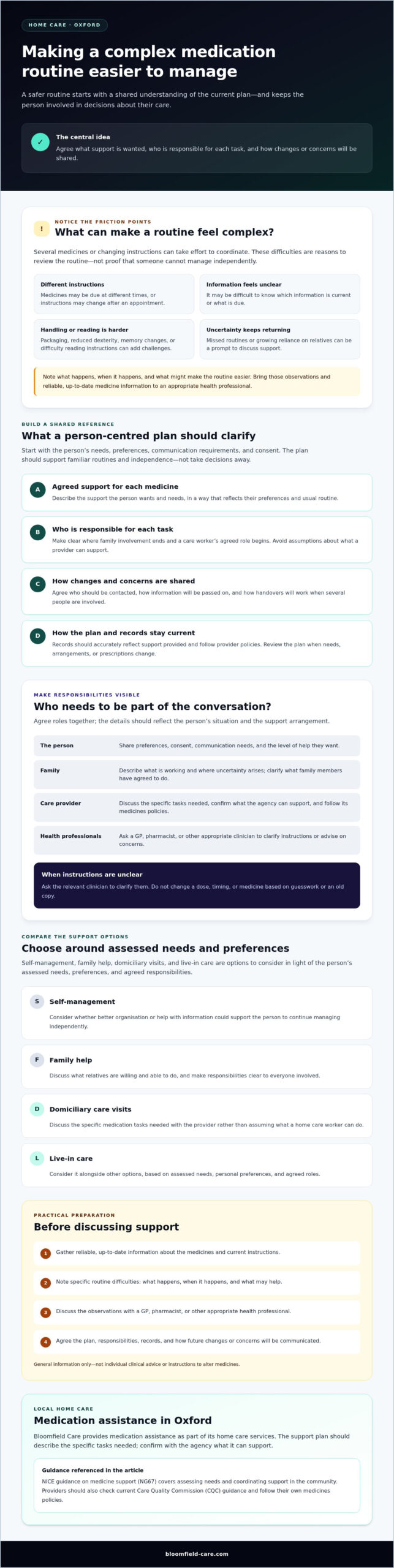
For managing complex medication regimes at home in Oxford, a written support plan gives the person, family and care provider a shared reference point. It should start with an assessment of the person’s needs, preferences, communication requirements and consent, then clarify the level of help they want and need. The plan should support familiar routines and independence, not take decisions away from the person.
During the assessment, families can explain what is working, where uncertainty arises and what matters to the person. For example, they might prefer information in a particular format or want a named family member contacted if a concern arises. The NICE guidelines for medicine support, set out in NG67, offer guidance on assessing needs and coordinating support in the community. Providers should also check current Care Quality Commission (CQC) guidance and follow their own medicines policies.
What should the assessment and written plan clarify?
A useful plan records the agreed support for each medicine, who is responsible for each task and how concerns or changes will be passed on. It should reflect the person’s preferences and usual routine, while making clear where family members’ involvement ends and a care worker’s agreed role begins. If several people are involved, discuss handovers so no one assumes someone else has completed a task.
Review the plan when the person’s needs or care arrangements change, or when a health professional updates a prescription. If instructions are unclear, the person or family should ask the relevant clinician to clarify them rather than relying on an old copy or informal messages.
How do records and staff competence support safer care?
Records should accurately reflect the support provided and follow the care provider’s policies. Clear records help the person, family and care team see what has happened and identify questions that need follow-up. Agree how unexpected events should be recorded and who should be informed, rather than relying on memory.
Care workers should only undertake tasks that have been agreed and for which they have suitable training and assessed competence. The support available depends on the provider and the person’s assessed needs, so confirm the details before care begins. Care workers do not prescribe medicines or independently change clinical instructions. Questions about a medicine or prescription should go to an appropriate health professional.
If you are considering help at home, you can discuss medication assistance with Bloomfield Care and confirm which specific tasks the agency can support.
Comparing medication support at home in Oxford: family, care workers and clinicians
There is no single arrangement that suits everyone. A person may manage most medicines independently, want a relative’s help with one part of the routine, or wish to discuss domiciliary care. The important thing is to agree who does what, guided by the person’s wishes and assessed needs. Involving a care provider does not automatically mean giving up independence. Support can be limited to agreed tasks and reviewed as circumstances change.
| Who is involved? | Possible role | What to clarify |
|---|---|---|
| Person taking the medicines | Manage their routine independently, with or without agreed aids or reminders. | What feels manageable, and where, if anywhere, would they like help? |
| Family or friends | Offer practical help if the person agrees, such as sharing relevant observations or helping keep information organised. | Which tasks has each person agreed to do, and how will they communicate? |
| Domiciliary care worker | Provide medication assistance only where it is within the provider’s policies, the person’s care plan and the worker’s competence. | Ask the provider exactly which tasks it can support. Don’t assume a task is included. |
| GP, pharmacist or other clinician | Advise on clinical questions, prescriptions, possible side effects and medicine changes. | Who should be contacted, and how should relevant concerns be shared? |
What support might family members and care workers provide?
Family help works best when the person wants it and everyone understands their role. Agree who will pass on information about a concern rather than relying on relatives to assume someone else has done so. If care workers are involved, ask the provider which tasks it can support and how those fit the written care plan. The boundaries may differ between providers and individuals.
For managing complex medication regimes at home in Oxford, a shared understanding can make the arrangement clearer without taking over tasks the person wants and is able to manage.
When should a GP, pharmacist or other clinician be involved?
Direct questions about whether a medicine is suitable, a possible side effect, a missed dose or a prescription change to an appropriate health professional. Relatives and care workers can share observations through the agreed communication route, but should not interpret clinical instructions or alter medicines themselves. If you are considering whether live-in care may suit broader support needs, read about live-in care in Oxfordshire and discuss what arrangement may fit the person’s circumstances.
How to organise medication support at home: a practical Oxford checklist
A few practical steps can make managing complex medication regimes at home in Oxford easier to discuss with family, a care provider and healthcare professionals. Start with reliable information, then agree responsibilities before arranging or changing support.
- List current medicines. Prepare an up-to-date list and check it against information confirmed by an appropriate health professional. Ask them to clarify anything that is unclear.
- Note routine challenges. Record when the person finds the routine difficult, what gets in the way and what already helps. Include their preferences and communication needs.
- Agree responsibilities. Ask the person who they want involved and make clear which tasks they, relatives and any care workers have agreed to do.
- Discuss and arrange support. Ask Oxford care providers about their assessment process, the medication tasks they can support, staff training and competence, record keeping, and how concerns or updates are communicated.
- Review the arrangement. Agree who to contact if instructions, care arrangements or the person’s needs change. Check that the written plan still reflects their wishes and assessed needs.
What information should families prepare before discussing support?
Alongside current medicine information, bring notes about the person’s usual routine, practical difficulties and questions. For example, explain if packaging is hard to manage or written instructions are difficult to follow. Ask the person who they would like involved in discussions, and agree how relevant updates should be shared. This keeps the conversation focused on their preferences rather than assumptions about what help they need.
How should the arrangement be reviewed over time?
Clarify who should be told if a prescription or support need changes, and how that update will reach everyone involved. If information is uncertain or a clinical decision is needed, contact the appropriate healthcare professional. Do not change a dose or medicine based on guesswork. For wider practical planning, compare care arrangements and read about the cost of home care in Oxfordshire.
If you are considering home care, contact Bloomfield Care to discuss medication assistance and confirm which specific tasks may be supported.
Discussing personalised medication assistance with Bloomfield Care in Oxford
Choosing support is a personal decision. Bloomfield Care provides domiciliary and live-in care in Oxford and wider Oxfordshire, including medication assistance and person-centred support. If you are managing complex medication regimes at home in Oxford, a conversation with a provider can help clarify whether the support you have in mind fits the person’s assessed needs and preferences.
Medication assistance can involve different tasks. What a provider can offer depends on its policies, the agreed care plan and staff competence. Describe the specific help being considered and ask whether the provider can support that task. Do not assume a task is included until it has been discussed and agreed.
What should Oxford families ask a home care provider?
Take a short list of questions into the discussion. This makes it easier to compare the proposed support with what the person wants and needs:
- How will you assess the person’s medication support needs, preferences and consent?
- How will agreed responsibilities and support for each medicine be recorded in the care plan?
- Which specific tasks can your staff undertake, and what tasks are outside their role?
- How do you confirm that staff have the appropriate training and competence for agreed tasks?
- How will the person, family and care team share updates or raise concerns?
- How can the support be reviewed if the person’s needs or wishes change?
Ask how the proposed arrangement can preserve the person’s independence. They may want to manage parts of the routine themselves and receive help only with agreed difficulties. The discussion should leave everyone clear about what support is planned and what remains the person’s choice.
How can a family take the next step with confidence?
Before arranging support, talk with the person and any family members they want involved. Note their priorities, questions and the practical help they would welcome. A discussion with Bloomfield Care can explore whether domiciliary or live-in care may suit the wider care needs. Confirm any proposed medication assistance individually rather than assuming it is available.
There is no need to settle every detail in one conversation. Take time to understand the assessment, responsibilities and communication arrangements, then consider whether they feel right for the person. To discuss individual home care needs, contact Bloomfield Care about home care support.
Take the next step towards a routine that feels manageable
Managing complex medication regimes at home in Oxford does not have to mean keeping every detail in your head. A written plan, clear records and agreed responsibilities can help the person, family and care provider understand what support is in place. The arrangement should reflect the person’s wishes and abilities, and can be reviewed if their needs or instructions change.
Take clinical questions, possible side effects and prescription changes to the appropriate health professional. When discussing care, be specific about the tasks involved and confirm what a provider can support before agreeing an arrangement.
Bloomfield Care offers domiciliary and live-in care in Oxford and wider Oxfordshire, including medication assistance. Its local coverage also includes areas such as Wallingford, Abingdon, Newbury and Thatcham, as well as Dorset, Weymouth, Christchurch and Poole. To explore whether home care could suit your circumstances, discuss home care support with Bloomfield Care and ask about the assessment and support options available.
A thoughtful plan and clear communication can make daily routines easier to understand while respecting the person’s dignity and independence at home.
Frequently Asked Questions
Can home care workers help with complex medication regimes?
A home care worker may provide medication assistance, but the exact tasks depend on the provider’s policies, the person’s assessed needs and the worker’s competence. Bloomfield Care lists medication assistance among its services. Before arranging care, describe the support needed and ask which tasks the agency can provide, how they will be agreed in the care plan and how they will be recorded. Do not assume every type of medication help is available.
What information should a medication support plan include?
A medication support plan should explain the person’s agreed needs and preferences, the support required for each medicine, who is responsible for each task and how concerns or changes will be shared. It should reflect the person’s consent and usual routine, not informal assumptions. Ask the provider how the plan is documented and reviewed, and contact an appropriate healthcare professional if medicine information or instructions need clarification.
Can a care worker change a dose if a medicine seems unsuitable?
No. A care worker should not independently change a dose, stop a medicine or make clinical decisions about whether it is suitable. If the person or care worker has a concern, follow the agreed communication process and contact an appropriate health professional, such as a GP or pharmacist. Share clear observations about what has happened, but do not alter the medicine or its instructions based on guesswork while waiting for advice.
How can families avoid confusion when several people support medicines?
Agree responsibilities with the person and everyone involved, including relatives and any care provider. Write down who is expected to do each agreed task, how support will be recorded and who should be contacted about concerns or changes. Use one reliable, up-to-date source of medicine information and make sure relevant updates reach the people involved. Clear roles help prevent duplicated effort or uncertainty about whether a task has been completed.
Does medication support at home reduce a person’s independence?
Not necessarily. Support can be tailored to the person’s preferences and assessed needs, with the aim of helping them maintain familiar routines and independence. They may choose to manage most medicines themselves and discuss help only with tasks they find difficult. Involve the person in decisions, agree what they want others to do and review the arrangement if their wishes or circumstances change.
When should we ask a GP or pharmacist about a medicine?
Ask a GP, pharmacist or other appropriate clinician if prescription instructions are unclear, a medicine changes, or you are concerned about a possible side effect or missed dose. Care workers and relatives can share observations, but should not interpret clinical instructions or make changes to medicines. Keep current medicine information available for the conversation, and use the agreed care communication route so relevant people know what guidance has been given.
How do I choose medication support for an older person in Oxford?
Start with the older person’s wishes, current routine and the specific tasks they may want help with. Ask providers how they assess needs, record responsibilities, confirm staff competence and communicate concerns. Bloomfield Care offers domiciliary and live-in care, including medication assistance, in Oxford and wider Oxfordshire. For local planning, confirm current coverage for the person’s address, including areas such as Abingdon, Wallingford, Newbury, Thatcham, Dorset, Weymouth, Christchurch or Poole.