

Imagine sitting at your kitchen table, pen in hand, feeling a wave of anxiety as you scan a twenty-page document filled with legal jargon. It’s supposed to be about your parent’s comfort and dignity, yet the fine print about notice periods and fee increases feels cold and overwhelming. We understand that choosing a provider is a profound act of trust, and the paperwork should reflect a partnership, not hide behind complexity. It’s completely natural to worry about being locked into a rigid agreement or discovering hidden costs that disrupt your family budget.
Understanding home care agency contracts in the UK shouldn’t be a source of dread. This 2026 guide will help you move forward with confidence, ensuring the support your loved one receives is transparent, fair, and deeply compassionate. We’ll explore how to align agreements with CQC standards, what to look for in fee structures, and how to ensure the contract protects the person-centred care your family deserves. You’ll gain the peace of mind that comes from knowing your home remains a sanctuary, supported by a team that values human connection and integrity above all else.
Key Takeaways
- Learn how the Service User Agreement acts as a blueprint for care, ensuring every detail aligns with CQC standards for safety and respect.
- Gain confidence in understanding home care agency contracts in the UK by identifying essential clauses regarding the scope of service and staff continuity.
- Discover the differences between hourly and live-in fee structures to ensure your family’s financial planning remains clear and predictable.
- Understand your rights regarding notice periods and termination, giving you the flexibility to adapt care as your loved one’s needs change.
- See how a partnership-driven approach removes jargon and hidden fees, creating a foundation of trust for families in Dorset and Oxfordshire.
The Foundation of Care: What to Expect in a UK Service User Agreement
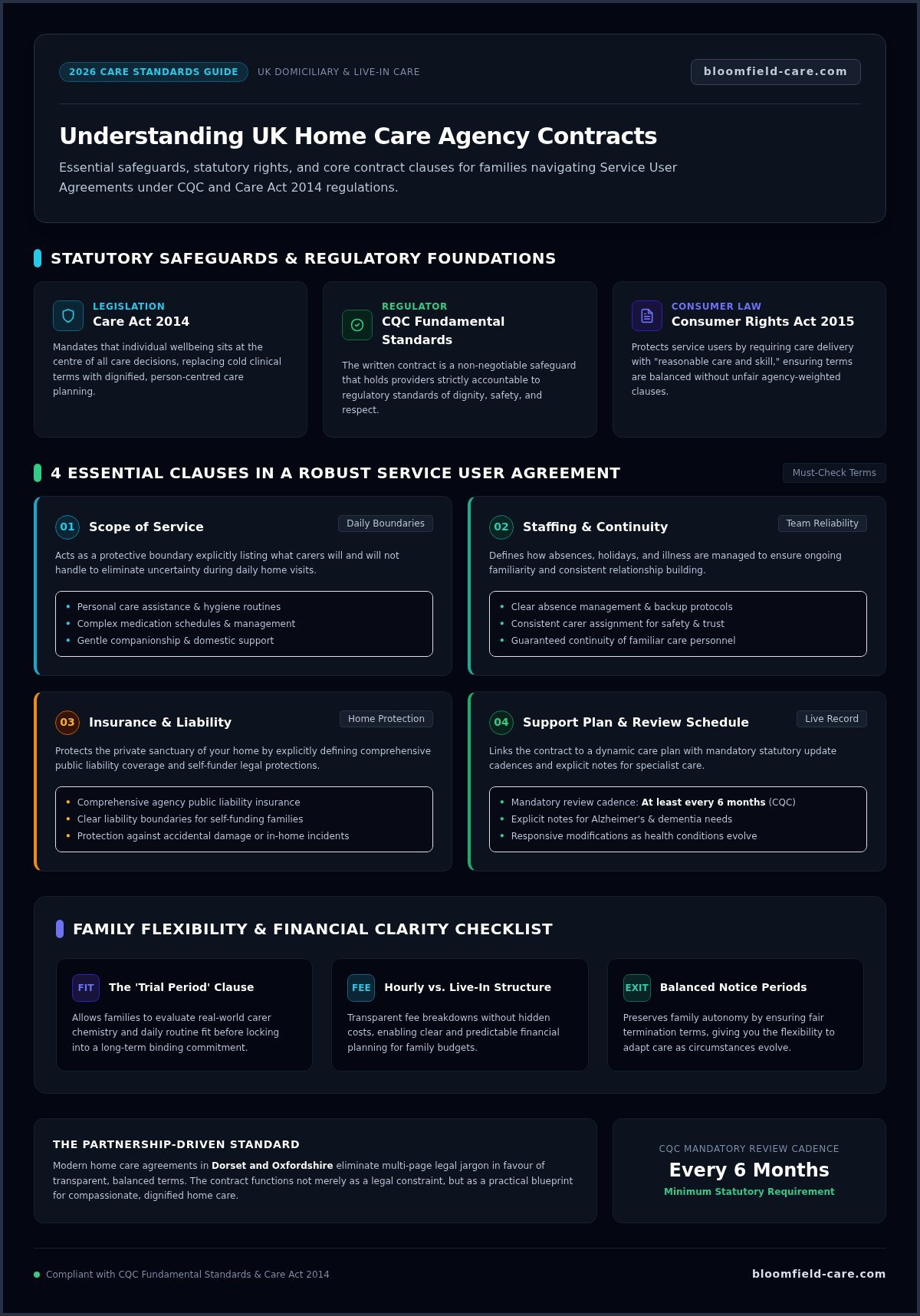
A Service User Agreement is more than just a formal document; it’s the heartbeat of the relationship between your family and a care provider. Essentially, it’s a legal contract that outlines the support provided to an individual in their own home. When you’re understanding home care agency contracts in the UK, it’s helpful to see this agreement as a promise of safety and quality. Since 2026 standards have evolved, these documents now focus heavily on the Care Act 2014, which ensures that wellbeing is at the centre of every decision.
The Care Quality Commission (CQC) plays a vital role here. They don’t just inspect the care itself; they oversee the standards that these contracts must meet. A written contract is a non-negotiable safeguard. It ensures that the provider is held accountable to the CQC’s fundamental standards, such as dignity and respect. Modern agreements have also moved away from cold, clinical terminology. Instead, they use person-centred language that treats your loved one as an individual with a voice, not just a set of tasks to be completed.
Why Transparency Protects Both Families and Carers
Clear expectations are the foundation of a peaceful home environment. A detailed contract should explicitly define what a carer will do, whether that’s assistance with personal care, managing complex medication schedules, or providing simple companionship. This clarity prevents the “grey areas” that often lead to stress for families. We recommend looking for a ‘trial period’ clause. This allows you to see how the partnership works in practice before committing to a long-term arrangement. It’s a gentle way to ensure the chemistry between the carer and your loved one is just right.
Legal Compliance: The Consumer Rights Act 2015
Home care is a service, and as a consumer, you’re protected by the Consumer Rights Act 2015. This legislation gives you the right to expect that care is delivered with ‘reasonable care and skill’. If an agency fails to meet the standards promised in their agreement, you have legal standing to seek a remedy. It’s also vital to check that the terms aren’t unfairly weighted in the agency’s favour. A fair contract respects your autonomy. It provides a balanced approach to notice periods and fees, ensuring you never feel trapped in a situation that isn’t working for your family.
Essential Clauses: Navigating the Legalities of UK Home Care
When you begin the journey of understanding home care agency contracts in the UK, the specific clauses within the document provide the most reassurance. A robust contract should clearly define the ‘Scope of Service’. This section acts as a protective boundary, detailing exactly what your carer will handle, from complex medication management to gentle companionship. It also protects your family by stating what tasks are not included, ensuring there are no surprises during daily visits. Staffing and continuity clauses are equally vital. They should outline how the agency manages absences and whether you’ll have a consistent team, which is essential for building a sense of safety and familiarity.
Your contract must also reference the insurance and liability protections in place. Since the private residence is a sanctuary, knowing that the agency holds comprehensive public liability insurance provides vital peace of mind. For those navigating these arrangements independently, NHS guidance on paying for your own care offers a helpful framework for understanding your financial and legal liabilities as a self-funder. Clarity here ensures that you aren’t left vulnerable if an accident occurs within the home.
Defining Personalised Support Plans
A legal agreement is only as effective as the care it facilitates. This is why a modern contract must link directly to person-centred care planning. Rather than a static document, this plan is a live record of your loved one’s preferences and health needs. Under CQC regulations, these plans require regular reviews at least every six months. If your family is managing specialist needs like Alzheimer’s or dementia care, these requirements should be explicitly noted to ensure the support remains responsive and dignified as circumstances change. You can always discuss a flexible live-in care arrangement if your needs begin to exceed hourly visits.
Data Protection and Confidentiality
Trust is built on the foundation of privacy. Your contract must detail compliance with UK GDPR and the Data Protection Act 2018. This ensures that sensitive health information is stored securely and shared only with those who truly need to know. For family members holding a registered Power of Attorney, the contract should clarify your rights to access these care records. This transparency allows you to stay informed about your parent’s wellbeing while maintaining their right to confidentiality. It’s a delicate balance that, when handled professionally, provides a sense of stability and respect for the individual’s autonomy.
Fee Structures and Financial Obligations in 2026
When you’re understanding home care agency contracts in the UK, the financial section is often where families feel the most pressure. It’s essential to know that transparency isn’t just a courtesy; it’s a legal requirement. Under Regulation 19 of the CQC Registration Regulations, every registered provider must give you a clear, written statement of their terms, conditions, and fee structures before any care begins. This protection ensures you aren’t met with unexpected bills during what is already a sensitive time. Gross fees represent the total cost of the care service before any local authority contributions or personal budget deductions are applied, while net fees are the final amount the individual pays directly from their own funds.
Modern contracts also need to be flexible enough to handle third-party funding. If your care is partially funded by a local authority, the agreement should clearly state how split payments are managed and who’s responsible for each portion. We typically see invoicing cycles that run every two or four weeks, often supported by direct debit to keep things simple for families. Clarity in these documents ensures that understanding home care agency contracts in the UK remains a straightforward process rather than a source of financial stress, allowing you to focus on the wellbeing of your loved one.
Hourly Domiciliary Care vs. Live-in Care Fees
The way you’re billed depends largely on the style of support you choose. Hourly domiciliary care is often subject to minimum call times, as many agencies require at least one hour per visit to ensure the care isn’t rushed and remains person-centred. In contrast, live-in care involves a fixed daily or weekly rate. These contracts are slightly more complex, as they must account for the carer’s mandatory breaks and food allowances. For a deeper look at regional variations, reviewing the cost of home care in Oxfordshire and Dorset can provide helpful context for your family’s budget.
Hidden Costs and Surcharges to Watch For
While the headline rate is important, the “fine print” surcharges can impact the total cost. Bank holidays are a prime example, where rates are typically charged at time-and-a-half or double time to reflect the dedication of the care team. You should also check how travel expenses are handled. If a carer uses their own vehicle for shopping trips or medical appointments, mileage is often billed as an extra. Finally, look at how the contract handles emergency cover. If you need last-minute changes or additional overnight support, it’s vital to know the costs upfront so your home remains a place of calm and stability.
Notice Periods and Termination: Your Rights to Change Care
Life is often unpredictable, and your family’s needs can change in an instant. A compassionate care agreement should reflect this reality, providing the flexibility you need to adapt without feeling trapped. When understanding home care agency contracts in the UK, you’ll find that a 28 day notice period is the industry standard. This timeframe allows the agency to manage their staff schedules fairly while giving your family enough time to arrange alternative support. However, many providers offer shorter notice periods in specific circumstances, such as a sudden change in health that requires a move to a residential setting.
You also have a statutory “cooling-off” period of 14 days if the contract was signed in your home. This legal safeguard is designed to give you peace of mind, allowing you to reflect on your decision without pressure. If you feel the care provided isn’t meeting the fundamental standards set by the CQC, you have the right to terminate for a breach of contract. A partnership built on trust means you should never feel forced to continue a service that doesn’t uphold the dignity and safety of your loved one. During a hospital stay, most contracts allow for a suspension of service rather than a full termination, keeping the familiar team ready for when your loved one returns to their sanctuary.
How to Safely End or Change a Care Arrangement
If you decide to move on, the process should be as gentle and stress-free as possible. It’s essential to put all requests to change or end care in writing to ensure there’s a clear record for both parties. This clarity helps manage the transition between agencies, ensuring there is never a gap in the support your loved one receives. Your provider should guide you through the final steps, including the settlement of the final invoice and the secure return of house keys or any equipment. We believe that ending a care relationship should be handled with the same respect and professionalism as the day it began.
The Robust Complaints Procedure
Every CQC-regulated provider is legally required to have a clear and accessible complaints policy. This isn’t just a piece of paperwork; it’s a vital tool for quality assurance and your loved one’s protection. If you’re ever unhappy with the quality of care, the first step is to follow the agency’s internal procedure. A dedicated provider will listen with patience and integrity, aiming to resolve the issue quickly. If the situation isn’t resolved to your satisfaction, you can escalate the matter to the Local Government and Social Care Ombudsman. This independent body provides an extra layer of security, ensuring your family’s voice is always heard and respected.
If you have questions about notice periods or need a contract that truly values flexibility, contact our friendly team for a transparent discussion.
The Bloomfield Care Approach: Transparency and Peace of Mind
At Bloomfield Care, we believe that the paperwork should be the simplest part of your journey. Since our founding in 2014, we’ve focused on removing the barriers of legal jargon to ensure families in Wallingford, Abingdon, and across the region feel empowered rather than overwhelmed. We know that understanding home care agency contracts in the UK can feel like a heavy burden when you’re already managing a loved one’s health. That’s why our agreements are written with clarity and heart, reflecting our commitment to dignity and respect. This transparency is the signature of our service, making understanding home care agency contracts in the UK a collaborative experience rather than a legal hurdle.
Every live-in care arrangement we create is built on a foundation of mutual trust. We don’t just provide a service; we enter into a partnership with your family. Our person-centred contracting approach means that the agreement isn’t a rigid, immovable object. It’s a flexible framework designed to evolve as your needs change. Whether you require a few hours of companionship or a more intensive level of support, the transition between hourly and live-in care is handled with grace and honesty, ensuring your family budget is always respected.
Serving Oxfordshire, Dorset, and West Berkshire
Our local expertise in areas like Wallingford, Newbury, Thatcham, Abingdon, and Oxford ensures that we’re always nearby when you need us. Being a community-focused provider means we’re directly accountable to the families we serve. We understand the specific CQC standards and local health landscapes of Oxfordshire, Dorset, and West Berkshire intimately. This proximity allows us to provide responsive support that a large corporate entity simply cannot match. Your home is a sanctuary, and our local teams work tirelessly to ensure it remains a place of comfort, safety, and familiar routines.
Taking the Next Step with Confidence
We never want you to feel rushed or pressured into a decision. Our process begins with a free care needs assessment, where we sit down with you in the comfort of your own home to discuss a bespoke agreement. We’ll walk you through the Service User Agreement step-by-step, explaining every clause in plain English. This ensures that all family members are completely comfortable with the terms before any care begins. We listen more than we speak, ensuring your loved one’s autonomy and lifestyle are always the priority. To begin this unhurried process, Contact Bloomfield Care today to discuss a transparent care plan tailored specifically for your family’s needs.
Securing Your Loved One’s Future with Clarity and Care
Securing a compassionate future for your family begins with a clear understanding home care agency contracts in the UK. You now have the tools to identify fair fee structures, recognize essential CQC safeguards, and ensure notice periods protect your loved one’s autonomy. These documents are more than just legal requirements; they’re a commitment to maintaining the private residence as a sanctuary of comfort and respect. By focusing on person-centred language and transparent terms, you ensure that care remains a supportive partnership rather than a source of stress.
Since 2014, we’ve focused on providing expert local care in Oxfordshire and Dorset that prioritizes the individual’s lifestyle and dignity. As a CQC regulated provider, we pride ourselves on a partnership-driven approach that replaces confusion with calm. You’re never alone in this journey. We’re here to guide you through every sensitive detail with grace and professionalism, providing the stability your family deserves. Our goal is to enhance life quality while ensuring the decision-making process feels unhurried and supportive.
If you’re ready to move forward with confidence, Request a Free Care Assessment and Contract Review to see how we can support your family with integrity and kindness. We look forward to helping you create a care plan that feels just right for your home.
Frequently Asked Questions
What is a Service User Agreement in home care?
A Service User Agreement is the formal legal contract that establishes the partnership between you and your care provider. It outlines the specific support to be delivered, the fee structure, and the rights of both parties. For families in Wallingford or Abingdon, this document provides the essential clarity needed to ensure care is delivered safely and with respect. It acts as a blueprint for professional support while protecting your loved one’s autonomy and dignity.
Can I change my home care contract if my needs increase?
Yes, your agreement is designed to be a flexible framework that evolves alongside your loved one’s health. If support requirements grow, such as moving from companionship visits to more intensive dementia care, the contract can be adjusted following a review. We pride ourselves on making the transition between hourly domiciliary care and live-in care as seamless as possible for families in Dorset and Oxfordshire, ensuring there’s never a gap in essential support.
How long is the typical notice period for a UK home care agency?
A notice period of 28 days is the standard requirement for most ongoing care arrangements. This window allows for professional handovers and ensures that staff schedules are managed fairly. However, when understanding home care agency contracts in the UK, you may find that shorter notice periods apply in urgent situations, such as a sudden hospital admission or a move to residential care. Always check your specific agreement for these compassionate clauses that offer flexibility during difficult times.
Are there extra charges for care on bank holidays in Oxfordshire?
Most agencies in Oxfordshire and West Berkshire apply higher rates for bank holiday visits. These are typically charged at time-and-a-half or double time to recognize the dedication of carers who work during these periods. It’s vital that these surcharges are clearly stated in your initial agreement so there are no surprises on your invoice. We believe in total transparency, ensuring you can plan your family’s care budget with complete confidence and peace of mind.
What happens to my care contract if I have to go into hospital?
If a hospital stay becomes necessary, your care contract usually transitions into a suspension of service phase. This means that regular visits are paused while your loved one receives medical treatment. For families in Weymouth or Poole, this arrangement keeps the familiar care team available for the return home. You should check your contract for any specific retainer fees that might apply to hold your preferred time slots during longer absences from the private residence.
Is the care plan part of the legal contract?
Yes, the care plan is an integral part of the legal relationship, often referenced directly within the Service User Agreement. While the contract covers the legal and financial terms, the care plan details the person-centred tasks and preferences that guide daily support. understanding home care agency contracts in the UK means recognizing that the care plan must be a live document, updated at least every six months to remain responsive to your loved one’s changing needs.
Do I have to pay for the carer’s travel time or mileage?
Most agencies include the carer’s travel time to your home within the standard hourly rate. However, if a carer uses their own vehicle to assist with shopping trips or medical appointments in Abingdon or Oxford, a mileage surcharge is often applied. These costs should be explicitly defined in your contract’s fee section. Clarity regarding travel expenses ensures that your family can enjoy the benefits of companionship and community access without worrying about hidden costs.
What is the role of the CQC in private home care contracts?
The Care Quality Commission (CQC) acts as the independent regulator of health and social care in England. Their role is to ensure that every provider meets fundamental standards of safety, dignity, and respect. While they don’t sign your contract, they inspect agencies to ensure that Service User Agreements are fair, transparent, and legally compliant. Choosing a CQC regulated provider like Bloomfield Care, founded in 2014, gives your family the reassurance that your contract aligns with national quality standards.