

Imagine sitting at a kitchen table in Newbury, surrounded by bank statements, wondering if your mother’s savings will suddenly vanish into a care budget. You might be weighing the trade-offs of council funded care vs private care costs in Newbury, feeling the weight of a decision that impacts her comfort and your family’s future. It’s a heavy moment, and it’s completely natural to feel overwhelmed by the “means test” or anxious about whether local authority support can truly provide the warmth she needs. You aren’t alone in this search for clarity.
This 2026 guide provides a clear framework to navigate West Berkshire’s capital limits, including the current £23,250 threshold, without the usual stress. We’ll help you compare the practical differences between local authority contracts and the bespoke comfort of private domiciliary or live-in care. Our goal is to provide the peace of mind that comes from knowing your loved one is safe and respected in the sanctuary of their own home, empowered by a plan that balances cost with genuine quality.
Key Takeaways
- Understand the 2026 West Berkshire financial thresholds and how the “means test” determines eligibility for local authority support.
- Compare the hidden differences between council funded care vs private care costs in Newbury, focusing on the value of companionship over task-based visits.
- Learn why your family home is typically protected from capital assessments when you choose to receive domiciliary or live-in care.
- Discover the step-by-step process for arranging a care needs assessment with West Berkshire Council to ensure your loved one receives the right level of help.
Understanding the Care Funding Landscape in Newbury
Understanding the distinction between healthcare and social care is often the first hurdle for families in West Berkshire. While the NHS provides medical support free of charge, social care in England is typically means-tested and managed by local authorities. West Berkshire Council acts as the primary commissioning body for those who qualify for support, but the landscape is changing. With the National Living Wage rising to £12.71 in April 2026, the “funding gap” between what the council can pay and the actual cost of providing high-quality care has widened. This leaves many families at a crossroads, weighing the benefits of council funded care vs private care costs in Newbury to ensure their loved ones receive more than just basic assistance.
Choosing between state-funded and private care isn’t merely a financial transaction. It’s a deeply personal decision about the environment in which a parent or spouse will spend their days. We believe that every individual deserves to feel empowered rather than managed. While the council provides a vital safety net, the constraints of public budgets often mean that care is delivered in short, task-based windows. For families who value dignity and unhurried support, exploring the private market often reveals a more compassionate path forward.
The Legal Framework: The Care Act in West Berkshire
The Care Act 2014 dictates how West Berkshire Council must support its residents. Every individual has the right to a Care Needs Assessment, which identifies the specific challenges they face in daily life. This assessment is the essential first step, regardless of whether you plan to self-fund or seek council support. The national eligibility criteria in West Berkshire focus on whether a person’s needs arise from a physical or mental impairment and if this results in them being unable to achieve two or more specified outcomes that significantly impact their wellbeing.
Newbury’s Local Care Market in 2026
Newbury currently faces a complex care market where the demand for support often exceeds the availability of residential beds. Because of this, more families are choosing live-in care as a way to preserve the sanctuary of the home while ensuring professional safety. Local cost-of-living factors in Berkshire mean that agency rates can vary significantly, often reflecting the level of specialized dementia or Alzheimer’s expertise provided. When comparing council funded care vs private care costs in Newbury, it’s clear that the state-funded route often prioritizes essential tasks, whereas private care focuses on the holistic wellness and autonomy of the individual. This distinction is vital for those who value continuity and a person-centered approach over a rotating schedule of different carers.
The Financial Thresholds: Understanding the West Berkshire Means Test
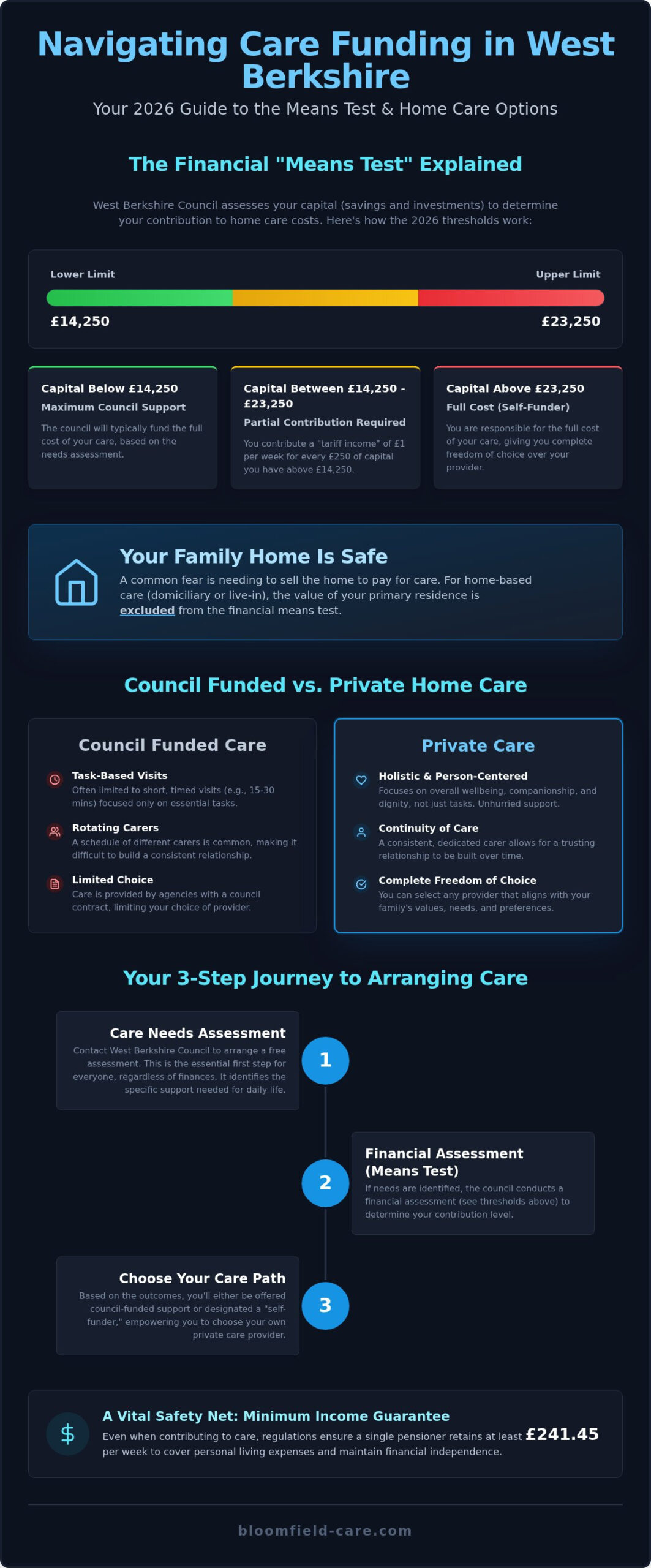
The financial assessment, often called the means test, can feel like an intrusion into a lifetime of hard work and careful saving. It is the process West Berkshire Council uses to decide how much you should contribute toward your support. For home-based care in 2026, this assessment looks at both your weekly income and your capital, such as savings and investments. If your assets fall below the lower capital limit of £14,250, the council will typically provide the maximum support. However, those with assets between £14,250 and £23,250 are expected to pay a “tariff income” of £1 per week for every £250 of savings. It is a complex calculation, but its purpose is to ensure that everyone receives the help they need, regardless of their financial standing.
When comparing council funded care vs private care costs in Newbury, families often find themselves in a “funding gap.” If your capital exceeds the upper threshold of £23,250, you are considered a “self-funder” and must meet the full cost of your care. This is often where the choice becomes most significant. Self-funders have the freedom to choose any provider, ensuring that the care matches their personal values and lifestyle requirements rather than being limited to council-commissioned contracts. Even for those receiving support, West Berkshire ensures a Minimum Income Guarantee of £241.45 per week for single pensioners, protecting a small portion of income for daily living expenses and maintaining a sense of independence.
The Property Myth: Keeping the Family Home
One of the most persistent anxieties we encounter is the fear that the family home must be sold to pay for care. It is vital to clarify that when you receive care in your own home, the value of your primary residence is typically excluded from the means test. This is a profound relief for many, as it allows the home to remain a sanctuary and a family asset. This ruleset differs significantly from the assessment for moving into a care home, where property value is often included. Choosing domiciliary or live-in care is a strategic way to preserve your surroundings and your legacy while receiving the professional assistance you deserve.
Direct Payments: The Bridge to Private Care
West Berkshire Council’s Direct Payment scheme offers a helpful middle ground for families who qualify for some funding but desire the excellence of a private provider. Instead of the council arranging a service for you, they provide the funds directly to you. You can then use this “contribution” to hire an agency of your choice. This provides the autonomy to bridge the gap between basic council funded care vs private care costs in Newbury, allowing you to top up the budget to secure a higher tier of personalized support. It empowers you to remain in control of who enters your home and how your time is spent. If you feel uncertain about how these thresholds apply to your specific situation, our team is always here to act as a trusted advisor for your family.
Council vs Private Home Care: A Direct Comparison
While the financial thresholds provide a clear line in the sand, the day-to-day experience of receiving support is where the differences between council funded care vs private care costs in Newbury become most apparent. Council-commissioned care is often designed around efficiency and meeting basic physical needs. In contrast, private care focuses on the quality of the hour spent together. This distinction is particularly vital when dealing with specialist conditions like dementia or Alzheimer’s, where a familiar face and a calm, unhurried presence can prevent the distress often triggered by a rotating team of strangers.
The reality of a council contract often involves multiple carers visiting throughout the week, sometimes at varying times depending on local demand. For a person living in Newbury who values their routine, this lack of predictability can be unsettling. Private care allows you to choose a carer whose personality and interests align with your own, turning a service into a genuine relationship. When evaluating the cost of home care, it’s important to look beyond the hourly rate and consider the value of this emotional stability and companionship.
The “Task-Based” vs “Person-Centred” Debate
Council care is frequently “task-based,” meaning the carer arrives with a checklist: wash, dress, feed, and leave. This often results in 15-minute “check-ins” that can feel clinical and rushed. For many elderly residents in Newbury, these brief interactions are their only social contact, and the “stopwatch” approach can leave them feeling like a burden rather than a respected individual. At Bloomfield Care, we champion a person-centred approach where the goal is holistic wellbeing. We don’t just see a list of chores; we see a person who might want to share a cup of tea, discuss the morning news, or take a gentle stroll in their garden, ensuring their mental health is nurtured alongside their physical safety.
Flexibility and Responsiveness
Health needs can change overnight. A private agency can often adapt a care plan within hours, adding extra visits or transitioning to live-in care as circumstances evolve. Council-managed plans are subject to bureaucratic reviews and budgetary approvals that can cause significant delays during critical moments. This responsiveness is a cornerstone of private support, providing a sense of security for the whole family. Continuity of care is the single most important factor in client satisfaction because it fosters the trust and familiarity necessary for true emotional wellbeing. By choosing a private path, you ensure that your loved one’s care is dictated by their needs, not by the administrative capacity of a local authority.
How to Arrange a Care Needs Assessment in Newbury
The journey toward professional support often begins at Market Street in Newbury. To initiate a Care Needs Assessment, you should contact the West Berkshire Adult Social Care team at 01635 503050. This is a free service available to every resident, regardless of their financial situation. It serves as the essential foundation for understanding how much help is required to maintain safety and dignity at home. Once you’ve made contact, the council will schedule a visit from a social worker or occupational therapist to discuss your daily life and any specific challenges you face.
Preparing for this visit requires a shift in perspective. It’s natural to want to put on a brave face, but for the assessment to be accurate, the assessor needs to see the “bad days” too. Documenting struggles with medication management, meal preparation, or mobility ensures that no “hidden” needs are overlooked. If you are weighing the benefits of council funded care vs private care costs in Newbury, this assessment is your evidence base. It defines the “personal budget” the council might allocate, which you can then compare against the bespoke excellence of a private provider.
Preparing Your Home for the Assessment
The role of family members during this interview is vital. You act as the voice for the nuances that a loved one might forget to mention. Is there a risk of falls at night? Does a dementia diagnosis mean they need constant reassurance rather than just help with dressing? Highlighting these emotive details transforms a clinical checklist into a person-centered plan. By identifying every area where the private residence as a sanctuary is being challenged, you ensure the resulting care plan is robust and respectful. We recommend having a list of specific examples of daily struggles ready to share during the visit.
Navigating the West Berkshire Council Portal
After the visit, you’ll receive an outcome letter and a follow-up financial assessment. If you disagree with the results, you have the right to appeal or request a review. Effective communication with social workers is key; be clear, concise, and persistent. For those who feel unheard, local advocacy services in Newbury and Thatcham can provide a supportive partner to navigate the bureaucracy. Once the plan is agreed upon, you must decide between a council-managed service or receiving Direct Payments. Choosing Direct Payments allows you to bridge the gap between basic support and the highly personalized assistance of a dedicated agency. If you’re ready to explore how a tailored plan can enhance your family’s quality of life, you can contact Bloomfield Care for a friendly, no-obligation conversation today.
Why Bloomfield Care Offers Unrivalled Peace of Mind
Choosing between council funded care vs private care costs in Newbury is ultimately a decision about the quality of life your loved one will enjoy every single day. At Bloomfield Care, we recognize that this transition is one of the most significant moments a family can face. Since our founding in 2014, we’ve served the Newbury community as a trusted advisor for families who seek a deeper level of connection than a standard local authority contract typically allows. We understand that the move to professional support involves emotional hurdles as much as financial ones, and we’re here to guide you through every step with patience and integrity. Our approach is rooted in the belief that care should be unhurried, respectful, and entirely person-centred, ensuring that the support provided feels like a natural part of daily life rather than a clinical intervention.
The Sanctuary of Home: Our Philosophy
We view the private residence as a sanctuary, a place where memories live and independence should be celebrated. Our live-in care and domiciliary care services are designed to honour this environment by providing a level of stability that residential homes often cannot match. Our carers don’t just perform tasks; they become a supportive extension of your family, fostering mental well-being and comprehensive wellness alongside physical safety. Whether we’re providing specialist Alzheimer’s expertise or gentle companionship, our focus remains on enhancing the individual’s lifestyle rather than just managing it. This commitment to autonomy ensures that our clients feel empowered and respected in the comfort of their familiar surroundings, protected by a team that values human connection above all else.
Next Steps for Newbury Families
Navigating the complexities of West Berkshire’s care landscape can feel overwhelming, but you don’t have to walk this path alone. We invite you to book a free, no-obligation consultation with our local team, where we prioritize listening to your concerns and understanding your unique family dynamics. During a Bloomfield Care assessment, we work alongside you to create a bespoke plan that addresses specific health needs while maintaining the sanctity of your home environment. We guide you through sensitive topics with grace and clarity, never rushing the decision-making process. If you’re ready to discover a partnership that values kindness, professionalism, and the dignity of the individual, speak with our Newbury care advisors today. We’re here to provide the stability and heart-led support your family deserves.
Securing Your Loved One’s Future in Newbury
Finding the right path for a family member requires both practical knowledge and emotional reassurance. You now have a clearer understanding of the West Berkshire capital limits and the essential steps to arrange a formal assessment. Whether you’re navigating the upper threshold of savings or exploring the autonomy of direct payments, the goal remains the same: ensuring your loved one feels safe, respected, and truly at home. Deciding between council funded care vs private care costs in Newbury is about choosing a future where dignity isn’t just a standard; it’s a daily reality.
As a CQC Regulated Provider with specialist dementia support and deep local Newbury and Thatcham expertise, we’re here to help you bridge the gap between basic assistance and exceptional care. We’ll listen to your story and help you create a plan that honours your family’s unique needs. You don’t have to manage these complexities alone. Book a Free Care Assessment with our Newbury Team today and take the first step toward lasting peace of mind. Your family’s comfort is our greatest priority, and we’re ready to support you with kindness and professional excellence.
Frequently Asked Questions
How much does private home care cost in Newbury compared to council care?
Private care rates in West Berkshire reflect a higher level of personalization compared to the standard rates for council funded care vs private care costs in Newbury. While council fees average around £25 per hour nationally, private providers in Berkshire often range between £20 and £34 depending on the complexity of needs. Private care offers the flexibility of longer visits, which is essential for companionship and unhurried support that preserves your dignity.
Does West Berkshire Council pay for live-in care?
The council can contribute toward live-in care if it is determined to be the most appropriate way to meet your assessed needs. This is often managed through a personal budget or Direct Payments. While the council provides a set amount based on their standard rates, many families choose to use these funds as a contribution toward a private provider to ensure a higher level of continuity and specialist expertise in the home.
What is the capital limit for care funding in England for 2026?
For the 2026/27 financial year, the upper capital limit remains £23,250. If your savings and assets exceed this amount, you are responsible for the full cost of your care. The lower capital limit is £14,250. Individuals with assets below this threshold receive maximum support, while those in between pay a tariff income toward their care. These limits are a primary factor when families weigh council funded care vs private care costs in Newbury.
Can I top up council-funded care with my own money in Newbury?
You can use your own resources to enhance the care you receive, especially when using Direct Payments. This “top-up” allows you to choose a provider that offers more than the basic council-commissioned service, such as longer visits or specific specialist dementia care. It provides the freedom to bridge the gap between state-funded minimums and the bespoke, unhurried support that many families in Newbury prefer for their loved ones to maintain their independence.
How long does it take to get a care assessment from West Berkshire Council?
The timeline for a Care Needs Assessment can vary depending on the urgency of the situation and current demand at Market Street. Typically, you can expect a visit within four to six weeks of your initial request. However, if there is a significant safety risk or a hospital discharge involved, the process is usually expedited. It’s helpful to have your documentation ready to ensure the social worker has a clear picture of your daily struggles.
Will the council sell my house to pay for my home care?
Your primary residence is typically excluded from the financial assessment when you are receiving care in your own home. This is a key benefit of choosing domiciliary or live-in care over moving into a residential facility. Your home remains your sanctuary and a protected family asset. The council only includes property value in the means test if you are moving permanently into a care home setting, which provides significant peace of mind.
Can I use Direct Payments to hire Bloomfield Care?
You can absolutely use your Direct Payments to hire Bloomfield Care. This scheme is designed to give you autonomy and control over who provides your support. By choosing us, you benefit from our specialist dementia expertise and person-centred planning. Many Newbury families find this the most effective way to combine council funding with the high-quality, compassionate service that a dedicated private agency provides for their specific needs and lifestyle.
What happens if my savings run out while I am paying for private care?
If your capital falls toward the £23,250 threshold, you should contact West Berkshire Adult Social Care for a new financial assessment. The council may then begin contributing toward your care costs, provided your needs still meet their eligibility criteria. It’s important to plan this transition in advance to ensure continuity. We often act as a trusted advisor for families in this situation, helping them navigate the shift from self-funding to council support smoothly.