
Keeping Mum at home in Dorset might actually cost less than you think. For many families quietly researching live in care costs Dorset, the assumption is that a care home is the inevitable, affordable option. It rarely is. And yet the complexity of weekly rates, agency types, and funding thresholds can make home care feel impossibly difficult to plan for, even when your heart is already set on it.
That uncertainty is completely understandable. You’re weighing up managed agencies against introductory ones, wondering whether the £23,250 council savings threshold applies to your situation, and perhaps worrying about finding a truly reliable carer in a more rural part of the county. These are real, legitimate concerns, and they deserve honest answers rather than vague reassurances.
This guide is here to give you exactly that. You’ll find a clear breakdown of what live-in care genuinely costs across Dorset in 2026, plain-English guidance on benefits like Attendance Allowance, and a straightforward comparison with residential care home fees in areas like Weymouth, so you can make a decision with confidence rather than guesswork.
Key Takeaways
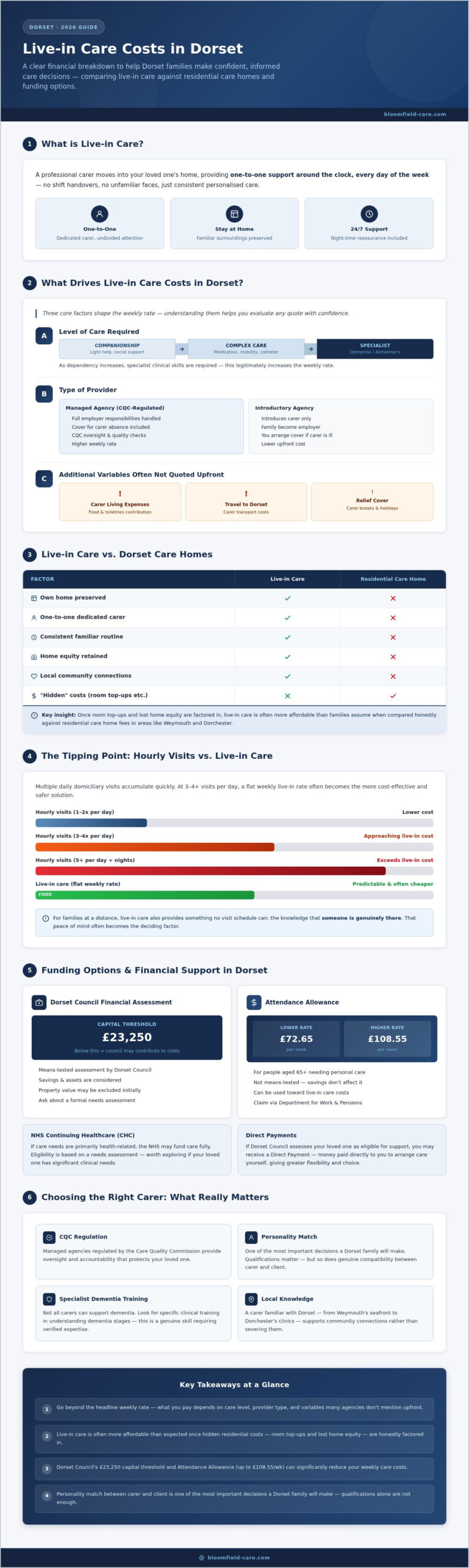
- Understanding live in care costs Dorset requires looking beyond the headline weekly rate — this guide breaks down exactly what you’re paying for, from CQC-regulated managed services to specialist dementia support.
- Live-in care is often more affordable than families expect when compared honestly against residential care home fees, once hidden costs like room top-ups and lost home equity are factored in.
- Dorset Council’s financial assessment process and the £23,250 capital threshold can significantly affect what funding support you’re entitled to — and this guide explains both in plain English.
- Benefits like Attendance Allowance may help offset care costs, and knowing how to access them could make a meaningful difference to your weekly budget.
- Choosing the right carer is about far more than qualifications — you’ll discover why the personality match between carer and client is one of the most important decisions a Dorset family will make.
What is Live-in Care and Why Choose it in Dorset?
Live-in care means exactly what it says. A professional carer moves into your loved one’s home, providing one-to-one support around the clock, every day of the week. There’s no shift handover at 5pm, no unfamiliar face arriving on a Tuesday because the regular carer is off. Just consistent, personalised support built entirely around the person who needs it, within the home they already know and love.
That continuity matters enormously. Person-centred care, as it’s known in the sector, isn’t a marketing phrase. It’s the practical commitment to shaping every aspect of support around an individual’s routines, preferences, and personality rather than fitting them into a standardised schedule. For older people in Dorset, that distinction can genuinely transform quality of life.
The Local Dorset Context: Care in Your Community
There’s something quietly powerful about staying connected to the places that have shaped a person’s life. For someone who’s walked the seafront at Weymouth for forty years, or attended the same GP surgery in Dorchester for decades, those threads of familiarity aren’t trivial. They’re anchoring. A live-in carer based locally understands the geography, knows which community groups meet in Christchurch on a Thursday, and can support those connections rather than sever them. The mental well-being benefits of familiar coastal air, recognisable faces, and a sense of belonging to a community are real, and they’re consistently undervalued when families compare care options on a spreadsheet.
Practical logistics matter too. A carer who knows Poole’s road layout, or understands the parking situation near a Dorchester clinic, can make the difference between a smooth medical appointment and an exhausting one.
Live-in Care vs. Hourly Domiciliary Visits
Many families begin with hourly domiciliary visits and find them genuinely helpful. But there’s a tipping point. When someone needs support more than three or four times a day, when nighttime reassurance becomes necessary, or when the gaps between visits start to feel unsafe, a single live-in carer often becomes both the more appropriate and the more cost-effective solution. Multiple daily call-out charges accumulate quickly; a flat weekly rate for live-in care can compare more favourably than families initially expect, which is something this guide explores in detail when examining live in care costs Dorset.
For family members living at a distance, whether in London or simply the other side of the county, there’s also something that a visit schedule simply can’t provide: the knowledge that someone is genuinely there. That peace of mind isn’t a luxury. For many families researching live in care costs Dorset, it becomes the deciding factor.
Breaking Down Live-in Care Costs in Dorset for 2026
One of the most common frustrations families encounter is receiving a quote with no real explanation of what sits behind the number. A weekly rate tells you very little on its own. What actually shapes live in care costs Dorset families are researching comes down to three things: the level of care required, the type of provider you choose, and a handful of additional variables that many agencies don’t mention upfront.
It’s worth being clear from the outset: this guide won’t quote a specific weekly price as though it applies universally, because it doesn’t. Care needs vary enormously, and any provider quoting a flat rate before understanding your loved one’s situation should prompt caution. What we can do is give you an honest framework for understanding what drives costs up or down, so you can evaluate any quote you receive with confidence.
Standard vs. Specialist Care Rates
Companionship-led care, where a carer provides social support, light household help, and general assistance to someone who is largely independent, sits at the lower end of the pricing spectrum. As dependency increases, so does the required skill level of the carer, and therefore the cost. Someone who needs support with complex medication management, catheter care, or significant mobility assistance requires a carer with demonstrably higher clinical competency.
Specialist support for conditions like dementia or Alzheimer’s disease carries a further premium, and rightly so. Understanding dementia stages is a genuine clinical skill, not something any carer can offer without specific training. A carer supporting someone with advanced dementia needs to manage behavioural changes, communication difficulties, and safety risks that simply don’t arise in standard care arrangements. That expertise has a value, and families should be wary of providers who don’t reflect it in their pricing.
One pricing advantage that catches many families by surprise is couples care. When two people in the same household both need support, a single live-in carer can often meet both sets of needs simultaneously. The cost saving compared to two separate care arrangements is substantial, making live-in care particularly compelling for older couples who want to remain together at home.
Managed Agencies vs. Introductory Platforms
This is the distinction that most care comparison websites gloss over, and it’s arguably the most important one you’ll encounter.
Introductory platforms connect families directly with self-employed carers. The headline weekly rate is typically lower. But that lower number comes with significant responsibilities for the family: handling payroll, managing tax and National Insurance contributions, arranging emergency cover if the carer is ill, and navigating employment law if things go wrong. For families already under considerable emotional pressure, that administrative burden can be overwhelming.
A fully managed agency like Bloomfield Care operates differently. The agency recruits, vets, trains, and employs the carer directly. Payroll, insurance, and emergency cover are handled entirely by the provider. If a carer is unexpectedly unavailable, the agency arranges a replacement; the family doesn’t have to scramble.
CQC regulation isn’t an optional extra. It’s the independent assurance that a provider meets nationally defined standards for safety, effectiveness, and quality of care. Choosing a non-regulated provider removes that external accountability entirely, leaving families with no formal recourse if standards fall short.
There are also costs that don’t always appear in the initial quote. Bank holiday premiums, carer travel expenses, and additional charges for particularly complex care packages are worth asking about directly before committing. A reputable provider will answer those questions clearly and without hesitation. If you’d like to understand exactly what a managed care arrangement would look like for your family’s situation, speaking with Bloomfield Care’s team is a straightforward place to start.
Understanding live in care costs Dorset families face means looking at the full picture, not just the weekly headline figure. The right question isn’t simply “how much does it cost?” It’s “what am I actually getting for that cost, and who is accountable if something goes wrong?”
Live-in Care vs. Dorset Care Homes: A Financial Comparison
The assumption that a care home is the affordable default is one of the most persistent misconceptions families encounter. When you look at the full financial picture rather than just the headline weekly rate, live-in care frequently holds its own, and sometimes comes out ahead in ways that genuinely surprise people.
A ‘Good’ rated residential care home in Dorset typically carries a substantial weekly fee, and that figure rarely tells the whole story. Room top-ups are common, where the standard fee covers only a basic room and families pay additional amounts for a preferred location within the facility, enhanced furnishings, or simply a room with a garden view. Activities, specialist dietary requirements, and personal care sundries can all attract separate charges that accumulate quietly over months. When families tally the true annual cost of residential care, the comparison with live in care costs Dorset begins to look very different from what the initial quote suggested.
Then there’s the question of property. Entering a care home typically triggers a local authority financial assessment that includes the value of the family home as a capital asset. For many Dorset families, that means the prospect of selling a property that has been in the family for decades, often under time pressure and rarely at the best price. Choosing live-in care, by contrast, generally means the home remains occupied and is therefore excluded from the capital assessment for as long as a spouse or dependent relative continues to live there. That single distinction can protect hundreds of thousands of pounds in family wealth.
The Couples Advantage
For couples where both partners need support, the financial case for staying at home becomes particularly compelling. Two care home placements mean two sets of weekly fees, two room top-ups, and the painful reality of separation after a lifetime together. A single live-in carer supporting both people in their shared home can meet both sets of needs simultaneously, at a fraction of the combined residential cost. The emotional arithmetic is equally clear: couples who remain together at home consistently report higher wellbeing than those separated by institutional placement.
One-to-One Attention vs. Staff-to-Resident Ratios
Value isn’t just a financial calculation. In a residential setting, a single member of staff may be responsible for twenty or more residents simultaneously. A live-in carer has one focus: your loved one. That dedicated attention isn’t a luxury; research consistently links personalised, responsive care with fewer falls, reduced hospital admissions, and slower functional decline. For a deeper exploration of how these two models compare across quality as well as cost, Bloomfield Care’s guide to home or care home sets out the full picture.
The Qualitative Value of Home
Some of what matters most resists being put into a spreadsheet. The Dorset garden that someone has tended for thirty years. The cat that sleeps at the foot of the bed. The neighbour who calls in on a Wednesday. These aren’t sentimental footnotes; they’re the fabric of a person’s identity, and research into cognitive ageing consistently shows that familiar environments, routines, and meaningful relationships slow decline in ways that clinical intervention alone cannot replicate.
Professionals in the sector use the term ‘transfer trauma’ to describe the disorientation and distress that can follow a move into residential care, particularly for people living with dementia. For some individuals, that transition accelerates deterioration noticeably. Staying at home, within a known environment with a consistent carer, removes that risk entirely. When families are genuinely weighing live in care costs Dorset against residential fees, that qualitative dimension deserves a place in the conversation alongside every financial figure.
Funding Options and Financial Support in Dorset
Funding live-in care needn’t feel like navigating a bureaucratic maze alone. There are genuine sources of financial support available to Dorset families, and understanding how they fit together can meaningfully reduce what you pay from your own pocket. The challenge is that most of this information is scattered across government websites written in language that assumes a degree of familiarity most families simply don’t have. What follows is a plain-English guide to the options that matter most.
Local Authority Support in Dorset
The starting point for any publicly funded care is a care needs assessment from Dorset Council. This is a legal right, not a favour, and requesting one costs nothing. The assessment determines whether your loved one’s needs meet the threshold for council support, and it opens the door to everything that follows. You can find guidance on how to request a care needs assessment and what to expect from the process.
If the assessment confirms eligible needs, a financial assessment follows. Dorset Council applies the nationally set capital threshold of £23,250. If your loved one’s savings and assets fall below this figure, the council contributes to care costs on a sliding scale. Above that threshold, care is self-funded until savings reduce to the lower limit. It’s worth noting that the family home is generally excluded from this calculation while a spouse or dependent relative continues to live there, which is a significant protection many families aren’t aware of.
For homeowners who don’t have liquid savings but whose property value would otherwise place them above the threshold, Dorset Council offers a deferred payment scheme. This allows care costs to be met now and recovered from the property’s value later, typically upon sale, rather than forcing an immediate sale under pressure.
Where the council does contribute, Direct Payments offer an alternative to a council-arranged care package. The council pays an agreed sum directly to the family, who then commission their own care. This gives considerably more control over which provider you choose and how support is structured around your loved one’s specific routines.
Non-Means-Tested Benefits
Attendance Allowance is available to anyone over 67 who needs help with personal care or supervision due to illness or disability, regardless of income or savings. It doesn’t matter whether your loved one has significant assets; eligibility is based entirely on care need, not financial circumstance. In 2026, it’s paid at two rates depending on the level of need, and it can be used freely toward live-in care costs. Many families who could be claiming it simply haven’t applied.
NHS Continuing Healthcare (CHC) is a separate, fully funded package available when someone’s primary need is assessed as a health need rather than a social care need. It’s not easy to qualify for, but when it applies, the NHS meets the full cost of care. If your loved one has complex or rapidly changing health needs, requesting a CHC assessment is genuinely worth pursuing.
Private Funding Strategies
For families funding care privately, two options are worth brief consideration. Equity release allows homeowners to access property wealth without selling, though it carries long-term implications that require independent financial advice. Immediate needs annuities, sometimes called care fees annuities, involve a lump sum payment in exchange for a guaranteed income stream specifically to cover care costs for life. Both are specialist financial products and should only be explored with a regulated financial adviser experienced in later-life planning.
Family contribution models, where adult children contribute collectively to a parent’s care costs, can make live in care costs Dorset families face considerably more manageable when structured thoughtfully and transparently from the outset.
Understanding which combination of funding routes applies to your situation is one of the most valuable conversations you can have early in the process. Speak with Bloomfield Care’s team to explore how funding options might work alongside a managed live-in care arrangement for your family.
The Bloomfield Care Difference: Value Beyond the Price Tag
Numbers matter when you’re researching live in care costs Dorset, but they’re never the whole story. The weekly rate tells you what you’ll pay. It doesn’t tell you whether the carer sitting in your mother’s kitchen on a Monday morning will make her laugh, remember how she takes her tea, or understand why the afternoon walk along the seafront matters so much to her sense of self. That’s where the real difference lies.
Bloomfield Care’s approach begins with listening. Not a checklist, not a rapid assessment designed to slot someone into a pre-existing package. A genuine, unhurried conversation about who your loved one is, what their days look like, and what a good life means to them specifically. That distinction shapes everything that follows.
Excellence in Managed Care
As a CQC-regulated managed service, Bloomfield Care handles every aspect of the care arrangement: recruitment, vetting, training, payroll, and emergency cover. Families don’t carry that administrative weight. Every carer is selected through a rigorous process that goes well beyond qualifications, because clinical competence matters, but so does temperament, patience, and the ability to build a genuine connection with someone in their own home.
Specialist support for dementia and Alzheimer’s is a core part of what Bloomfield Care offers, not an add-on. Carers working with clients living with cognitive decline receive continuous professional development, not a one-time training module. That ongoing investment in expertise is what separates a truly specialist live-in care service from a general care agency that happens to accept dementia clients.
The team’s local presence across Dorset, including Weymouth, Christchurch, and Poole, means care managers understand the geography, the community, and the practical realities of life in this part of the county. That local knowledge isn’t incidental. It’s what allows a care plan to include the Thursday group in Christchurch, the familiar GP surgery in Dorchester, and the coastal walk that anchors someone’s week.
Starting Your Care Journey
A Bloomfield Care assessment is a conversation, not an interrogation. You’ll talk through your loved one’s current needs, their daily routines, their preferences, and any concerns the family holds. From that, a bespoke care plan is built, one that’s designed to evolve as needs change rather than remain static.
Families aren’t left to manage the process alone once care begins. Care managers remain actively involved and accessible throughout, providing a consistent point of contact for any questions, adjustments, or concerns that arise. That ongoing relationship is what makes the difference between a care arrangement that works on paper and one that genuinely works in practice.
If you’re ready to explore what live in care costs Dorset families are facing, and what the right support might look like for yours, the next step is simply a conversation. Reach out to Bloomfield Care’s team to arrange a free, no-obligation care consultation at a time that suits you.
Take the Next Step Towards Care That Feels Like Home
Understanding live in care costs Dorset families face is rarely straightforward, but it doesn’t have to be overwhelming. The key points to carry forward are simple: live-in care is often more affordable than residential alternatives once the full picture is considered, meaningful funding support exists through Dorset Council and non-means-tested benefits like Attendance Allowance, and the quality of care your loved one receives matters just as much as the weekly figure.
Bloomfield Care brings together everything that matters most: CQC-regulated managed care, specialist dementia support, and compassionate local carers who genuinely understand life in Dorset. The right carer, matched thoughtfully to your loved one, can make an extraordinary difference to their daily life and your peace of mind.
You don’t need to have all the answers before reaching out. A conversation is enough to start. Request a free care consultation with Bloomfield Care’s Dorset team and discover what truly personalised support looks like for your family. The right help is closer than you think.
Frequently Asked Questions About Live-in Care Costs in Dorset
What is the average weekly cost of live-in care in Dorset for 2026?
Live in care costs Dorset families encounter vary considerably depending on the level of support needed, the type of provider chosen, and whether specialist care such as dementia support is required. Companionship-led care sits at the lower end of the range, while complex clinical care commands a higher rate. No honest provider can quote a single universal figure before understanding your loved one’s specific needs, and any that do should prompt caution.
What matters more than a headline number is understanding what’s included. A fully managed, CQC-regulated service covers payroll, emergency cover, and ongoing carer management within the weekly rate. An introductory platform may quote less upfront but leave significant hidden costs and administrative responsibilities with the family.
Does Dorset Council pay for live-in care at home?
Yes, Dorset Council can contribute to live-in care costs if your loved one’s needs meet the eligibility threshold following a care needs assessment. That assessment is a legal right and costs nothing to request. A financial assessment then determines the level of council contribution based on your loved one’s capital, with the nationally set threshold currently at £23,250.
If eligible, Direct Payments allow the council to pay an agreed sum directly to the family, giving you the freedom to choose your own provider rather than accepting a council-arranged package. The family home is generally excluded from the capital assessment while a spouse or dependent relative continues to live there, which is a protection worth understanding early.
Is live-in care cheaper than a residential care home in Weymouth?
It often is, once you look beyond the headline weekly rate. Residential care home fees in Dorset frequently carry room top-ups, activity charges, and personal care sundries that accumulate significantly over time. Live-in care costs Dorset families face are typically a flat, transparent weekly rate covering one-to-one support around the clock.
For couples, the comparison shifts even more decisively. Two residential placements mean two full sets of fees and the painful reality of separation. A single live-in carer supporting both people at home can meet both sets of needs at a fraction of that combined cost, while keeping a couple together in the home they know.
Can I get Attendance Allowance to help with live-in care costs?
Yes. Attendance Allowance is available to anyone over 67 who needs help with personal care or supervision due to illness or disability. Crucially, it’s not means-tested: eligibility is based entirely on care need, not savings or income. It’s paid at two rates depending on the level of need, and the money can be used freely toward any care costs, including live-in care.
Many families who qualify simply haven’t applied. If your loved one needs help during the day, supervision at night, or both, it’s genuinely worth pursuing. A care manager can help you understand whether your loved one’s situation is likely to meet the criteria before you apply.
Do I have to pay for my live-in carer’s food and utilities?
In most arrangements, yes. A live-in carer lives in your loved one’s home, so it’s standard practice for the household to cover the carer’s food and a contribution toward utilities. The specifics vary by provider and should be set out clearly in your care agreement before anything is signed.
With a fully managed agency like Bloomfield Care, these practical details are discussed openly during the assessment process so there are no surprises later. It’s a reasonable and modest additional cost in the context of the full arrangement, and reputable providers will always be transparent about it upfront.
What happens if my live-in carer needs a break or gets ill?
With a fully managed agency, the provider arranges cover. That’s one of the most important practical distinctions between a managed service and an introductory platform. If your carer is unwell or needs scheduled respite, the agency sources and deploys a replacement; the family doesn’t have to scramble to find someone at short notice.
Carers in live-in arrangements typically work on a rotation, often six weeks on followed by two weeks off, with a relief carer stepping in during that period. A good agency introduces the relief carer in advance so your loved one isn’t meeting a stranger unexpectedly. That continuity of familiarity matters enormously, particularly for someone living with dementia.
Do I need a spare room for a live-in carer in Dorset?
Yes. A live-in carer needs their own bedroom within the home. It doesn’t need to be large or elaborately furnished, but it does need to be a private, dedicated space where the carer can rest properly during their off-duty hours. A carer who can’t rest adequately won’t be able to provide safe, attentive care, so this is a genuine practical requirement rather than a comfort preference.
During the initial assessment, a care manager will discuss the home’s layout to ensure the arrangement is workable. Most standard homes with a spare room are entirely suitable, and the team will raise any practical considerations with you honestly at that stage.
How do I start the process of getting live-in care with Bloomfield Care?
The first step is simply a conversation. Bloomfield Care’s team will arrange a free, no-obligation care consultation at a time that suits you, either at home or by phone. There’s no checklist to complete beforehand and no pressure to make a decision on the day. The conversation is unhurried and focused entirely on understanding your loved one’s situation, their daily routines, their preferences, and any concerns your family holds.
From that initial discussion, a bespoke care plan is built and a carer is matched thoughtfully to your loved one’s personality and needs. You can reach Bloomfield Care’s Dorset team through the website to arrange that first conversation whenever you’re ready.