Private Home Care: Bespoke Support at Home (2026)
What if the most effective way to ensure your loved one’s safety wasn’t moving them into a facility, but rather bringing the highest standard of professional support directly to their front door? It’s a common fear that age or illness inevitably leads to the loss of your sanctuary, yet the reality of private home care services is far more empowering. Many families struggle with the confusion of choosing between different types of assistance while worrying about the safety of a relative living alone. You want them to feel secure, but you also want them to remain exactly where they feel most like themselves.
We understand that seeking help is a deeply personal decision rooted in love and the desire for excellence. In this article, you’ll discover how private home care services provide the professional support, safety, and companionship needed to maintain independence in the home you love. We’ll explore the benefits of bespoke care plans that adapt as your needs change, ensuring a managed environment that feels like a home, not a clinical setting. We’ll also look at the 2026 regulatory updates and the shift toward digital social care records, providing the clarity you need to make an informed, compassionate choice for your family’s future.
Key Takeaways
- Learn how private home care services prioritise your autonomy by transforming your residence into a safe, managed sanctuary rather than a clinical environment.
- Understand the essential differences between scheduled domiciliary visits for daily tasks and the 24/7 peace of mind provided by dedicated live-in care.
- Discover why private support offers greater consistency and flexibility, allowing you to choose the specific times and personality of your regular carers.
- Gain practical steps for evaluating providers in Dorset and Oxfordshire by checking CQC ratings and assessing their local community presence.
- Explore how a person-centred philosophy ensures you remain the lead in your own care journey, supported by a compassionate, family-oriented system.
What are Private Home Care Services and How Do They Work?
Understanding home care begins with recognising that a house is more than just four walls; it’s a repository of memories and a foundation for independence. Private home care services offer professional, person-centred support delivered directly within your own residence. Unlike institutional settings, this model prioritises your safety and autonomy while ensuring you remain the lead in your own care journey. For the family, this transition often brings a profound sense of relief. The anxiety of a loved one living alone is replaced by the reassurance that professional eyes are looking out for their safety and well-being.
In 2026, families are increasingly choosing home-based support over residential facilities. With the official scrapping of the lifetime care cap in 2024, many people find that investing in a private provider offers a level of consistency that local authority support often struggles to match. When you choose a private service, you’re opting for a dedicated partnership. You gain the ability to choose your carer’s personality and the specific timing of your visits. This stability is particularly important as the CQC increases its inspection activity through 2026, making the choice of a well-led provider a cornerstone of family peace of mind. The core philosophy isn’t merely to manage age-related decline, but to actively enhance your quality of life through meaningful human connection.
The Emotional Benefits of Staying at Home
The sense of “place” is a powerful contributor to mental well-being. For those living with dementia, the familiarity of a well-loved kitchen or the view from a favourite armchair provides a grounding influence that clinical environments cannot replicate. Staying at home allows you to maintain vital social connections within your local community, whether that’s a regular chat with neighbours in Wallingford or attending a familiar group in Abingdon. It preserves your identity, ensuring that your personal history remains the backdrop of your daily life rather than being replaced by a generic routine.
Who Can Benefit from Private Support?
Our support is as unique as the individuals we serve. Many people find that a small amount of assistance makes a world of difference in their daily routine, while others require more intensive support. Common groups who benefit include:
- Seniors: Those who need a little extra help with domestic tasks, meal preparation, or mobility to stay safe and confident at home.
- Hospital Discharge: Individuals recovering from surgery or illness who require temporary support to regain their strength and independence.
- Complex Needs: Families seeking long-term live-in care for conditions like Alzheimer’s, where a 24-hour presence provides total peace of mind and specialised assistance.
Exploring the Different Types of Private Care at Home
Every individual’s journey is unique, which is why private home care services are designed to be fluid and responsive. You might start with a few hours of help each week and find that, as time passes, a more consistent presence becomes necessary. Understanding the various types of home health care services available allows you to build a support system that evolves alongside your requirements. This flexibility ensures that you never feel rushed into a decision, but rather supported as your circumstances change.
While visiting care focuses on specific tasks at set times, live-in care provides a dedicated professional who resides in your home. This model offers 24/7 peace of mind for families, especially when a loved one lives far away. For those who find the evening hours particularly difficult, overnight care offers specific support for those prone to wandering or anxiety. Alternatively, companionship care focuses purely on emotional well-being, helping you stay engaged with hobbies and social circles that keep life vibrant and fulfilling.
Hourly Domiciliary Care: Flexibility for Daily Life
Hourly visits are the bedrock of many support plans. These can scale from a quick 30-minute check-in to several hours throughout the day, depending on your routine. Carers assist with “Activities of Daily Living” (ADLs), which include essential tasks like dressing, grooming, and medication management. This model is perfect for maintaining a routine without feeling overwhelmed by a constant presence. A prime example of this tailored approach is bespoke domiciliary care in Weymouth, where support is adjusted to fit the individual’s lifestyle perfectly.
Specialist Condition-Led Support
Certain health journeys require a more specialised touch. Dementia and Alzheimer’s care involve more than just safety; it’s about adapting the environment to reduce confusion and frustration. Our carers are trained to handle these progressive conditions with immense dignity, ensuring the person remains at the heart of the care. Palliative care is another vital service, providing compassionate end-of-life support within the sanctuary of home. It’s about comfort, respect, and ensuring every moment is handled with grace. If you’re unsure which level of support is right for your family, discussing your specific needs with a local branch can help clarify the best path forward.
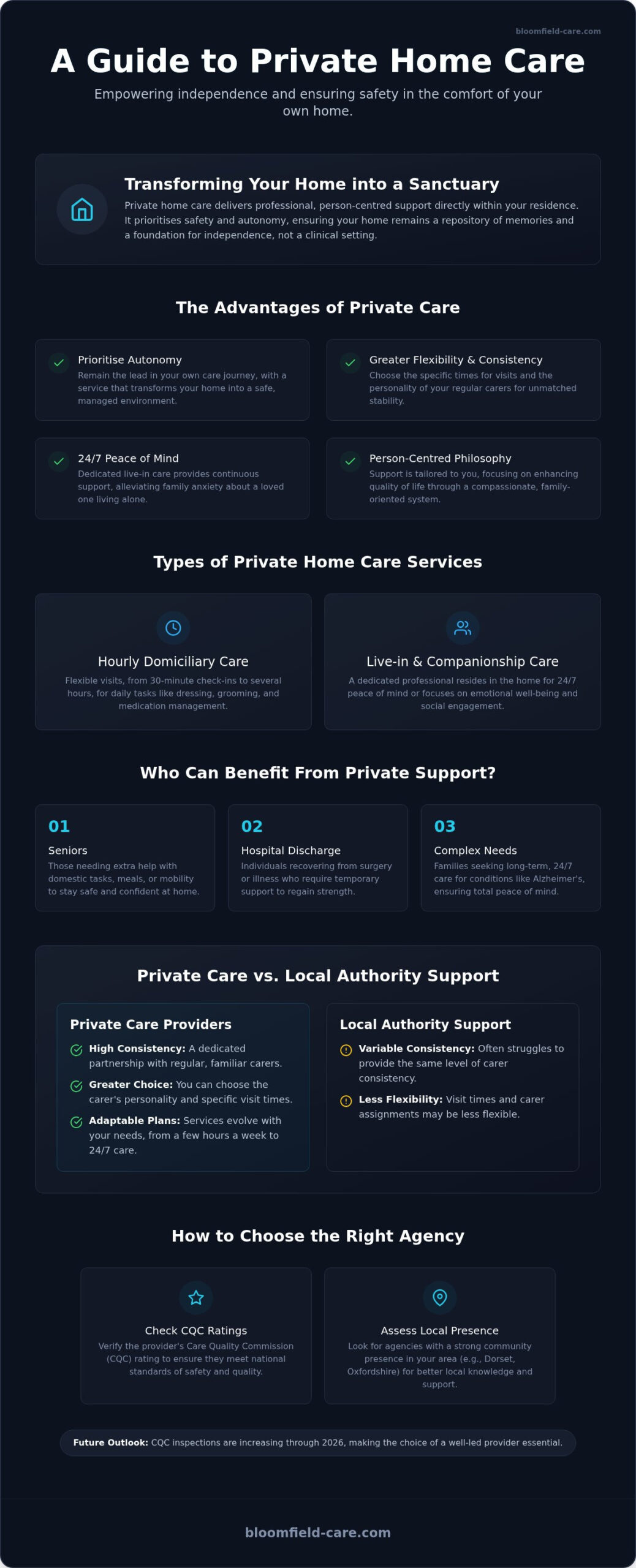
Private Care vs. Local Authority Support: Key Differences
Choosing between council-funded support and private home care services is a significant milestone for any family. While the NHS guide to social care and support provides a foundation for understanding the system, the practical experience of care varies greatly between these two paths. Local authority support is often stretched; it’s designed to meet basic clinical needs, which sometimes results in a “task-based” approach where different carers visit at varying times. In contrast, private providers focus on the continuity of the relationship. This means the same compassionate face arrives at your door, allowing for a deep bond of trust to form between the carer and the individual.
Speed is another critical differentiator. Council assessments can take weeks or even months to finalise, which is difficult when a situation becomes urgent. Private agencies can often implement a support plan within 24 to 48 hours, providing immediate relief. Beyond speed, there’s the standard of care itself. Private agencies frequently aim to exceed CQC minimum requirements to maintain their reputation for excellence, ensuring that safety and leadership remain at the forefront of every visit. You aren’t just a number in a system; you’re a partner in a bespoke support network.
The Value of Bespoke Care Planning
We believe that care should never be a “one-size-fits-all” solution. A person-centred approach means your plan reflects your specific preferences, from how you like your tea to the time you prefer to wake up. We involve the whole family in this decision-making process, ensuring everyone feels heard and supported. This bespoke nature also allows for instant adjustments. If health needs fluctuate, your care level can scale up or down without the need for a lengthy reassessment from a local authority officer.
Understanding the Financial Investment
While council-funded care is strictly means-tested, opting for private support is often seen as a preventative investment. By having consistent, high-quality assistance at home, many individuals avoid the sudden crisis that leads to expensive residential care. When you balance hourly rates against the high fixed costs of a care home, the value of staying in your own sanctuary becomes clear. To understand how this fits into your budget, we suggest reading The Cost of Home Care in Oxfordshire and Dorset for a detailed look at the 2026 landscape. This clarity helps you make a choice based on long-term wellness rather than just immediate logistics.
How to Choose the Right Home Care Agency in Oxfordshire and Dorset
Selecting a provider is more than a logistical exercise; it’s a significant emotional transition for the whole family. You’re looking for a team that treats your sanctuary with the same respect you do. When evaluating private home care services, start by examining the Care Quality Commission (CQC) rating. This provides an objective measure of safety and leadership. However, ratings only tell part of the story. You should also assess the agency’s local roots. Does the provider have physical branches in Oxford, Newbury, or Poole? Local knowledge ensures that the people managing the care actually understand the community and the local healthcare landscape.
Consider these five steps to find the right fit for your family:
- Step 1: Verify current CQC ratings to ensure high standards of safety and well-led service.
- Step 2: Assess local knowledge. Check if the agency has established branches in your specific area, such as Dorset or West Berkshire.
- Step 3: Inquire about recruitment. Ask how they select and train their carers to maintain professional excellence.
- Step 4: Request an assessment. A free care needs assessment allows you to gauge the agency’s empathy and person-centred approach.
- Step 5: Review specialist capabilities. Ensure they have the expertise to manage progressive conditions with dignity and skill.
The Importance of Local Presence
A local manager in Dorset or West Berkshire provides a level of oversight a national call centre simply can’t match. They understand the logistical challenges of reaching clients in rural areas and have established relationships with local GPs and pharmacies. This ensures that medication changes or health updates are handled with a sense of urgency and familiarity. When a manager is part of the same community, the accountability is greater and the support feels more personal. It’s about building a partnership that feels like a family-oriented support system rather than a corporate transaction.
Questions to Ask During Your Initial Consultation
During your initial meeting, don’t hesitate to ask probing questions. Ask how they match carers to clients based on personality, not just availability. Inquire about their protocols for when a regular carer is unwell to ensure your routine remains undisturbed. Most importantly, ask how they handle escalating needs and specific dementia stages. A high-quality agency will guide you through these sensitive topics with grace and clarity, never rushing your decision-making process. To begin your journey with a team that truly listens, book a person-centred care assessment with your local branch today.
Bespoke Support with Bloomfield Care: The Human Connection
At Bloomfield Care, we believe that the best support is built on a foundation of genuine human connection. Our private home care services are designed around a person-centred philosophy where you are always the lead in your own care journey. We don’t just manage tasks; we foster relationships that respect the sanctity of your lifestyle. This approach ensures that the professional safety we provide never feels clinical, but instead blends seamlessly with the warmth of your domestic environment. It’s about providing the stability you need to remain in the home you love, surrounded by the things that make you who you are.
Our teams are rooted in the communities they serve. With dedicated branches in Wallingford, Weymouth, and across Oxfordshire and Dorset, we provide a level of local accountability that national providers often miss. The Bloomfield Difference lies in our carers. They are individuals who stay, listen, and truly care about your well-being. This family-oriented support system provides a sense of profound reassurance, knowing that help is always nearby and delivered by someone who knows your name and your preferences. We bridge the gap between high-level medical safety and the gentle heart of a domestic environment.
Our Commitment to Professional Excellence
Excellence in care requires continuous growth and a dedication to quality. Our team undergoes ongoing training in specialist areas, including Alzheimer’s and Parkinson’s, to ensure we can meet even the most complex needs with skill and patience. We maintain strict clinical governance to guarantee that every client remains safe and respected in their own home. Transparency is vital for family peace of mind. We prioritise regular updates and open communication, keeping your loved ones informed every step of the way without ever compromising your dignity.
Taking the First Step Toward Peace of Mind
We understand that the transition from independent living to supported living can feel daunting. That’s why we’ve made the process of requesting a care assessment as simple and unhurried as possible. It’s a conversation, not a clinical intake. We listen more than we speak, helping you explore how our support can enhance your quality of life while maintaining your autonomy. If you’re still weighing up your options, reading our guide on Bloomfield Care Home or Care at Home? can help your family finalise the choice that feels right for your future. We’re here to guide you through this sensitive time with grace, clarity, and genuine kindness.
Embracing Independence with Confidence
Choosing the right support is a journey of love and foresight. Private home care services offer more than just assistance; they provide the continuity and safety needed to keep your sanctuary exactly as it should be. By focusing on person-centred plans and local expertise, you ensure that care feels like a natural extension of your family rather than a clinical interruption. Whether you require help with daily tasks or specialised dementia support, the priority remains your autonomy and well-being.
Bloomfield Care stands ready to be your trusted advisor. As a CQC regulated provider with local branches across Oxfordshire and Dorset, we bridge the gap between professional excellence and domestic warmth. Our team listens to your story and adapts as your needs evolve, ensuring you never feel rushed or overlooked. Take the first step toward lasting peace of mind. Request a Compassionate Care Assessment Today and discover how we can support your lifestyle with integrity and kindness. You don’t have to navigate these decisions alone; we’re here to walk alongside you.
Frequently Asked Questions
What is the difference between home care and domiciliary care?
Home care and domiciliary care are terms often used interchangeably to describe professional support delivered in your own residence. While “home care” is the more common phrase, “domiciliary care” is the clinical term used by providers and regulators. Both focus on maintaining your independence through assistance with daily tasks like washing, dressing, and household management. Our private home care services ensure that whichever term you use, the quality of person-centred support remains the priority.
Can I choose my own carer with a private service?
Choosing your own carer is a cornerstone of our person-centred philosophy. We believe that a strong human connection is essential for effective support, so we carefully match our professionals to your personality, interests, and specific needs. If you feel the match isn’t quite right, we’ll listen to your feedback and introduce a different team member. This level of choice is a key benefit of private support, ensuring you always feel comfortable in your sanctuary.
How quickly can private home care services start in Oxfordshire?
In Oxfordshire and Dorset, we can often begin providing support within 24 to 48 hours of your initial inquiry. This rapid response is a significant advantage over local authority assessments, which can sometimes take weeks to process. We understand that care needs can arise suddenly, perhaps following a hospital discharge or a change in family circumstances. Our local branch managers prioritise quick, efficient assessments to ensure your loved one is safe and supported without unnecessary delays.
Is private home care more expensive than a care home?
Private home care is frequently a more cost-effective alternative to residential facilities, particularly when you only require specific hours of support. By staying at home, you avoid the high fixed overheads associated with care home buildings and staffing. For couples, the savings are even more significant, as the cost of a single live-in carer is often much lower than two separate care home fees. It’s an investment in your autonomy and long-term well-being.
Do private carers help with medication and meal preparation?
Assistance with medication and meal preparation is a fundamental part of the support we provide. Our carers are trained to help with medication prompts and administration, ensuring your health remains a priority. They also prepare nutritious, home-cooked meals tailored to your dietary preferences and requirements. This helps maintain your physical health while taking the stress out of daily domestic routines, allowing you to focus on enjoying your time and hobbies at home.
What happens if my needs change over time?
Flexibility is at the heart of our service, and your care plan will evolve alongside your needs. We conduct regular reviews to ensure the level of assistance remains appropriate. If your health fluctuates or you require more intensive support, we can quickly scale your visits or transition to 24-hour live-in care. You’re never locked into a rigid schedule; our goal is to provide a bespoke support system that adapts to your life and ensures your continued safety.
Are your carers trained to handle specialist dementia care?
Specialist dementia and Alzheimer’s support is a core area of expertise for our team. We provide ongoing, specialised training to our carers so they can handle the unique challenges of progressive memory conditions with patience and dignity. This includes techniques for reducing confusion and creating a calming environment within your residence. Our focus is on enhancing quality of life and maintaining familiarity, which is vital for the mental well-being of those living with memory loss.
How do you ensure the safety and security of clients in their own homes?
Safety is our highest priority, and we employ several layers of protection to ensure your security. As a CQC-regulated provider, we adhere to strict standards of clinical governance and leadership. Every carer undergoes a rigorous recruitment process, including enhanced background checks and professional references. We also use Digital Social Care Records to share real-time updates with families, ensuring that every visit is logged and any concerns are addressed immediately by our local branch managers.