Overnight Care Costs Oxfordshire: 2026 Support Guide
Imagine lying in bed with your ears strained for the sound of a footfall or a door opening, unable to sleep because you’re worried your loved one might wander or fall. This nightly vigil is deeply draining, and it’s a reality for many families across Abingdon and Wallingford. Finding clear information on overnight care costs Oxfordshire is the first step toward reclaiming your own rest while ensuring your family member stays safe in the sanctuary of their home.
We understand that you want the best for your family, but constant sleep deprivation makes it difficult to provide the patient, loving care they deserve. This guide offers a transparent look at the support available in 2026, helping you distinguish between different levels of professional assistance. We’ll show you how tailored night-time support can prevent a crisis move into residential care, allowing your loved one to keep their independence and dignity.
You’ll learn the essential differences between waking nights and sleep-ins, alongside a breakdown of the 2026 local council funding thresholds and eligibility criteria. Our aim is to provide the clarity you need to make an informed, confident decision for your family’s well-being and peace of mind.
Key Takeaways
- Identify the signs that signal a need for night-time support, such as wandering or confusion, to ensure your loved one remains safe and comfortable.
- Learn the difference between waking nights and sleep-ins to choose the right level of professional presence for your family member’s medical needs.
- Understand the landscape of overnight care costs Oxfordshire in 2026, including how location and care complexity influence your budget requirements.
- Navigate local funding options and financial assessments to discover what support might be available to help manage the costs of home-based care.
- Discover how a person-centred approach preserves dignity and independence, maintaining your home as a peaceful sanctuary throughout the night.
Understanding Overnight Care at Home in Oxfordshire
Overnight care is a dedicated professional presence that ensures safety and comfort within the familiar walls of your own home. It allows the private residence to remain a sanctuary, even when health challenges become more complex. For many families, exploring overnight care costs Oxfordshire is born from a desire to maintain a loved one’s independence while acknowledging that the night-time hours have become a source of anxiety. Whether it’s managing a tendency to wander or providing gentle reassurance during moments of confusion, a professional carer provides the stability needed for everyone to rest.
Within the broader framework of Social care in England, night-time support is increasingly recognised as a vital preventative measure. It isn’t just about reacting to a fall; it’s about active monitoring and emotional support. A carer’s role involves everything from medication assistance to being a calming presence that preserves mental well-being. By keeping the environment consistent, we help reduce the distress often caused by the disorientation of a hospital or residential setting. Understanding the landscape of overnight care costs Oxfordshire helps families plan for a future where their loved one remains at home.
When is it Time to Consider Night-time Support?
Recognising the right moment to seek help is a deeply personal process. Often, families in Oxford and Abingdon notice a shift known as “sundowning,” where confusion and agitation increase as the sun sets. This can lead to unsafe behaviours like leaving the house or attempting to cook in the middle of the night. If you find yourself waking at every sound, caregiver exhaustion can quickly impact your own health and the quality of your relationship with your loved one. Additionally, post-hospital discharge often requires a period of intensive night-time monitoring to ensure a safe recovery and prevent readmission.
The Benefits of Professional Night Care vs. Family Support
While family care is rooted in love, professional support brings a level of clinical observation that is difficult for tired relatives to maintain. A trained carer can spot subtle changes in health or breathing patterns that might otherwise go unnoticed. Choosing a CQC-regulated provider ensures that high standards of safety and professionalism are always met. Most importantly, professional assistance preserves the dignity of the individual. Tasks like toileting or personal care are handled with a gentle, professional distance that allows the family bond to remain focused on companionship rather than clinical needs.
- Continuous Monitoring: Active observation to prevent falls and wandering.
- Medication Management: Timely assistance with evening or night-time prescriptions.
- Emotional Reassurance: A friendly, familiar face to alleviate night-time fears.
Waking Nights vs. Sleep-ins: Choosing the Right Support
Choosing between a waking night and a sleep-in is one of the most important decisions a family will make. It’s about matching the rhythm of the night with the specific health requirements of your loved one. While both options provide a professional presence, the level of activity varies significantly. This decision directly influences overnight care costs Oxfordshire, making it essential to understand which service provides the right balance of safety and value for your specific situation.
Integrating night support with your existing daytime domiciliary care creates a seamless 24-hour safety net. Many families start with daytime visits and find that as health needs change, adding a night carer ensures the home remains a safe sanctuary around the clock. This integrated approach prevents gaps in support, ensuring that transitions from evening routines to sleep are handled with the same familiar faces and gentle care.
What is a Waking Night?
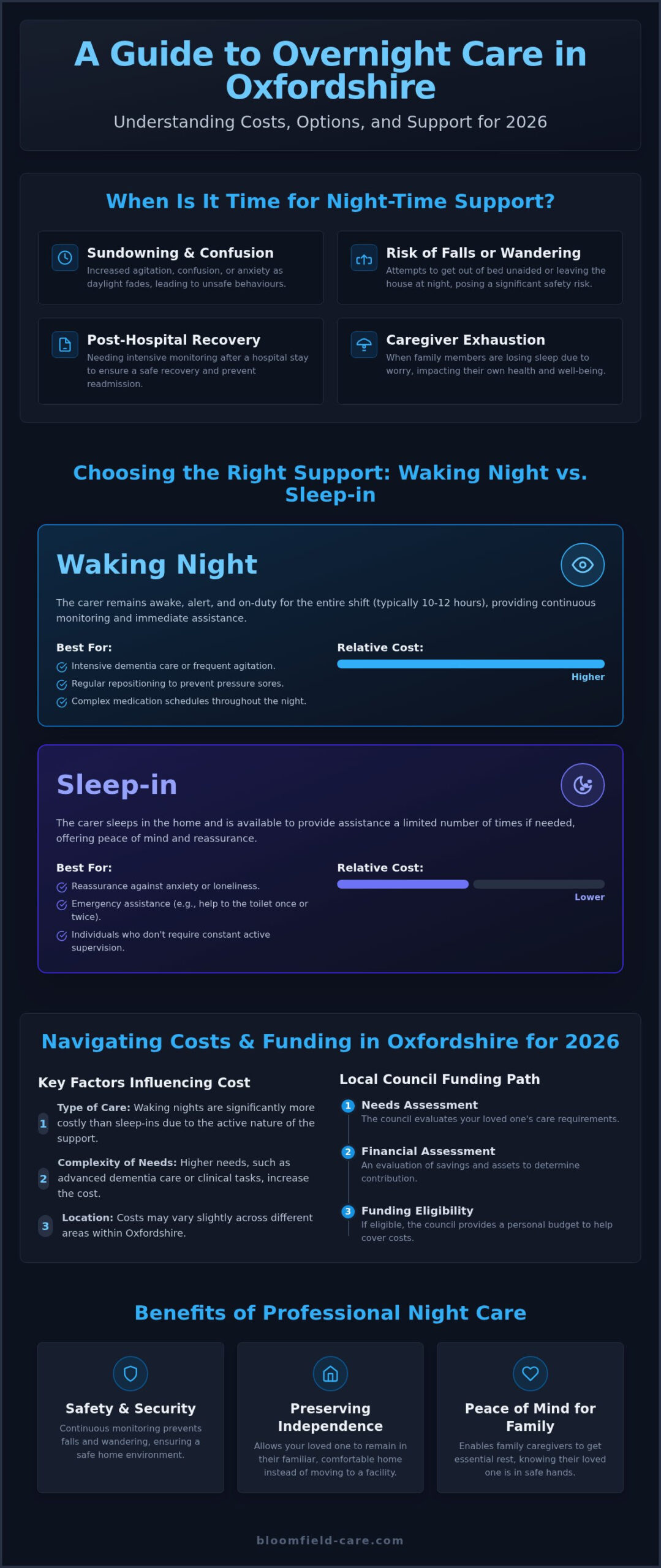
In a waking night service, the carer stays awake and alert for the entire shift, typically lasting between 10 and 12 hours. They don’t sleep. Instead, they provide continuous monitoring and are ready to assist at a moment’s notice. This is particularly vital for individuals requiring intensive dementia care, where confusion or agitation might occur frequently throughout the night. If your loved one needs regular medication, help with repositioning to prevent pressure sores, or frequent assistance with personal care, a waking night is the safest choice.
What is a Sleep-in Service?
A sleep-in service offers a reassuring presence for those who feel anxious being alone but generally sleep through the night. The carer is provided with a separate room and is available to be woken up to two times if assistance is needed. It’s a cost-effective way to ensure someone is on hand for emergencies without the higher fees associated with an active waking shift. If you’re exploring how to manage overnight care costs Oxfordshire, a sleep-in can be an excellent entry point for someone who is physically stable but needs the peace of mind that help is nearby.
As care needs evolve, you might find that a sleep-in service eventually needs to transition into a waking night. This often happens if the frequency of night-time disturbances increases or if medical conditions become more complex. Understanding NHS funding for social care can help you navigate these transitions as they arise. If you’re unsure which level of support is right for your situation, our team can help you assess your needs through a person-centred care plan.
Calculating Overnight Care Costs in Oxfordshire for 2026
Planning for the future requires a clear and honest understanding of the financial landscape. When families evaluate overnight care costs Oxfordshire, they’re often comparing the price of staying at home against the rising fees of local residential care. In our region, residential care home costs currently average between £1,200 and £1,800 per week. By contrast, targeted night-time support allows your loved one to remain in their own sanctuary, surrounded by familiar comforts, which is often a more sustainable and emotionally supportive long-term solution.
Several factors influence the final price of care, including whether you live in the heart of Oxford city or a more rural village. The complexity of medical needs and the frequency of support also play a role. Viewing the cost of home care as an investment in independence helps families see beyond the immediate monthly bill to the lifelong benefit of autonomy and dignity.
Average 2026 Price Benchmarks in Oxfordshire
To help families budget, Oxfordshire County Council provides ceiling rates that serve as a helpful baseline for the sector. For waking nights, where a carer is active and alert throughout the shift, the benchmark hourly rate for 2026 is approximately £30.87. Sleep-in services are structured differently, typically involving a fixed nightly fee rather than an hourly charge, which often makes them a more accessible option for those who only need occasional assistance. According to the 2026/27 Council commissioning guidelines, the sleep-in rate is a set payment of £84.97 per night for a carer to be present in the home and available to assist with a limited number of disturbances.
Value Beyond the Price Tag
The true value of professional night care isn’t just found in the daily rate; it’s found in the “crisis prevention” it provides. Understanding the nuances of overnight care costs Oxfordshire helps families see that this support is a proactive choice that reduces the risk of falls and wandering. These incidents are leading causes of expensive and distressing hospital readmissions. At Bloomfield, we focus on meticulous caregiver matching to ensure stability and reduce staff turnover, providing your loved one with a familiar, trusted face every night. This continuity doesn’t just improve safety; it fosters a deep sense of peace for the entire family, knowing that professional help is always at hand.
Funding Options and Financial Support for Night Care
Identifying the right financial support is often the most overwhelming part of planning for home assistance. While overnight care costs Oxfordshire can seem like a significant commitment, many families find that a combination of state benefits and local authority support makes staying at home a viable reality. It’s about finding the right balance to protect the sanctuary of your home while honouring your budget. By understanding the available pathways, you can ensure your loved one receives the dignity and safety they deserve without unnecessary financial strain.
Navigating these options requires patience, but you don’t have to do it alone. Whether you’re exploring support for the first time or your needs have recently changed, there are several structured routes to help manage the investment in professional night-time care. Understanding these systems helps transform a period of uncertainty into a clear, manageable plan for the future.
Local Authority Support in Oxfordshire
The gateway to state-funded assistance is the Care Needs Assessment provided by Oxfordshire County Council. This evaluation determines the level of support required and is followed by a financial assessment. In 2026, the upper capital threshold for council-funded support remains at £23,250. If your loved one’s assets and savings are above this amount, they’ll likely be expected to self-fund their care. Even as a self-funder, you can request Direct Payments, which give you the autonomy to choose a private provider like Bloomfield Care while using council-allocated funds to bridge any gaps in cost.
Benefit Entitlements for Seniors
Many families overlook non-means-tested benefits that can significantly offset overnight care costs Oxfordshire. Attendance Allowance is a primary resource for those over state pension age who need help with personal care or supervision during the night. Because it isn’t based on income or savings, it’s accessible to many seniors. These funds can be applied directly toward live in care or targeted overnight visits. For those under 66, the Personal Independence Payment (PIP) serves a similar purpose, providing essential financial breathing room for families seeking professional support.
NHS Continuing Healthcare (CHC) is another vital avenue, specifically for individuals with a “primary health need.” This is a package of care that is fully funded by the NHS, regardless of the individual’s financial situation. It’s often applicable for those with complex, long-term health conditions that require active monitoring throughout the night. If you’re feeling overwhelmed by the complexity of these applications, our team can guide you through the local funding landscape and help you understand how to apply these resources to your person-centred care plan.
Compassionate Night Care: The Bloomfield Care Difference
At Bloomfield Care, we believe that the night shouldn’t be a time of fear or isolation. While understanding overnight care costs Oxfordshire is a practical necessity for any family, the true value of our service lies in the profound reassurance we bring into your home. We view every private residence as a sanctuary, a place where memories are held and where comfort should be absolute. Our philosophy is rooted in providing unhurried, person-centred support that respects the individual’s lifestyle and personal history, ensuring they feel empowered rather than patronised.
Our selection process for night-time carers is incredibly rigorous. We look for more than just technical proficiency; we seek out individuals with a natural capacity for empathy, patience, and integrity. These are the dedicated professionals who will be a reassuring presence in the quietest hours, offering a listening ear and emotional support alongside their professional duties. This focus on high-quality matching ensures that your loved one isn’t just “managed” through the night but is truly cared for with heart and kindness. By choosing a partner who listens more than they speak, you’re investing in a service that values human connection above all else.
Our Approach to Person-Centred Night Care
Every person has a unique evening rhythm and set of habits. Some prefer a quiet cup of tea before bed, while others find comfort in a specific radio programme or a particular way of arranging their pillows. We create a bespoke night-time routine that mirrors these preferences exactly. Our carers don’t just perform clinical tasks; they provide companionship that alleviates the loneliness that can often accompany night-time wakefulness. Regular reviews ensure that as needs evolve, our care plans remain a perfect fit for your loved one’s autonomy and mental well-being.
Local Support in Wallingford, Abingdon, and Beyond
Since our founding in 2014, we’ve built deep roots in the Oxfordshire community. Whether you’re in Wallingford, Abingdon, or the surrounding villages, our local presence allows for seamless coordination between our day and night teams. This total continuity is vital for providing a stable environment, especially for those living with dementia or Alzheimer’s. We ensure that the transition from daytime domiciliary care to overnight support is handled with grace, maintaining a steady rhythm that keeps families informed and reassured. Planning for overnight care costs Oxfordshire becomes much simpler when you have a trusted advisor who understands the local landscape and prioritises the sanctity of the individual’s lifestyle.
Request a free care assessment with Bloomfield Care today to discover how we can help your loved one stay safe and comfortable in the home they love.
Securing Your Loved One’s Night-time Peace of Mind
Deciding on professional night-time support is a profound act of love that preserves the sanctuary of your home. You’ve now seen how to distinguish between waking nights and sleep-ins, and how to navigate the landscape of overnight care costs Oxfordshire using local 2026 benchmarks. Whether you’re applying for Attendance Allowance or exploring council funding, the goal is always the same: ensuring dignity, safety, and a restful night for the whole family.
At Bloomfield Care, we’ve been local Oxfordshire experts since 2014. As a CQC regulated provider, we specialise in dementia support that focuses on the individual’s unique rhythm. We’re here to listen and guide you through every step of this journey, ensuring that the transition to professional support feels natural and reassuring. Our person-centred approach means we don’t just manage needs; we enhance the quality of life for those we serve.
Book a Compassionate Care Assessment with Bloomfield Care today to create a bespoke plan that honours your loved one’s independence. You don’t have to face the night alone; professional help is just a conversation away, providing the stability your family needs to thrive.
Frequently Asked Questions
How much does a waking night carer cost in Oxfordshire?
While specific rates vary depending on the provider and the complexity of needs, the 2026 Oxfordshire County Council benchmark for waking night support is approximately £30.87 per hour. This rate reflects the active, alert nature of the role where the carer stays awake for the entire shift. Private agency fees may differ, but these local benchmarks help families understand the typical landscape of overnight care costs Oxfordshire when planning their budgets.
What is the difference between a sleep-in and a waking night?
The primary difference lies in the carer’s activity level and sleep requirements during the shift. During a sleep-in, the carer is provided with a separate room and is available to assist with up to two disturbances per night. In contrast, a waking night requires the carer to remain awake and alert for the full 10 to 12 hours. This ensures continuous monitoring for individuals with complex medical needs or those who experience frequent confusion.
Does Attendance Allowance cover the cost of overnight care?
Attendance Allowance is a non-means-tested benefit that provides a significant financial contribution toward the cost of any care services. It’s designed to help with the extra costs of having a health condition that requires supervision or personal assistance. While it might not cover the full overnight care costs Oxfordshire, it’s a vital resource that helps many families maintain their loved one’s independence and safety in their own home.
Can I have overnight care for just a few nights a week?
Yes, overnight care is highly flexible and can be tailored to your family’s specific requirements. Many people choose support for just two or three nights a week to provide respite for family members or to cover periods of increased vulnerability. This person-centred approach ensures that you only pay for the assistance you truly need, keeping your home a sanctuary while providing the safety and reassurance your loved one deserves.
Is overnight care cheaper than moving into a care home in Oxford?
For many families, targeted overnight care is more cost-effective than residential placement, especially when combined with daytime support. Residential care in Oxfordshire can cost between £1,200 and £1,800 per week in 2026. By choosing home-based support, you avoid the high overheads of a facility while ensuring your loved one remains in a familiar, comfortable environment that supports their mental well-being, autonomy, and long-term dignity.
What happens if my loved one needs help more than twice during a sleep-in?
If a sleep-in carer is regularly woken more than twice per night, it’s usually a sign that care needs have evolved. In these instances, we recommend transitioning to a waking night service to ensure both the client’s safety and the carer’s well-being. Regular reviews of your care plan allow us to identify these shifts early, ensuring that the level of support always matches the individual’s current health and safety requirements.
How do you choose the right carer for my parent’s night-time needs?
We use a meticulous matching process that considers both clinical requirements and personality. For night-time support, we look for carers who are naturally calm, patient, and empathetic. We take the time to understand your parent’s evening routines and preferences, ensuring the carer is someone they feel comfortable with. This focus on human connection helps maintain a sense of security and trust during the quiet hours of the night.
Can overnight care be arranged at short notice in Abingdon or Wallingford?
While we always recommend planning ahead, we understand that health crises can happen unexpectedly. Our local presence in Abingdon and Wallingford allows us to respond quickly to urgent requests, such as an unexpected hospital discharge or a sudden change in a loved one’s condition. We’ll work closely with your family to assess the situation and put a safe, compassionate care plan in place as swiftly as possible.