Memory Care at Home in Oxford: A Compassionate Guide for Families (2026)
What if the most effective environment for managing dementia isn’t a clinical ward, but the very hallway where your loved one has walked for thirty years? For many families, the fear of a midnight wandering episode or a kitchen accident makes a residential move feel like an unavoidable conclusion. You likely feel the weight of caregiver burnout and the constant worry that your parent’s home is no longer the safe haven it once was. It’s a deeply personal struggle, and it’s okay to feel that the balance between safety and familiarity is slipping away.
This guide demonstrates how specialist memory care at home Oxford services provide a compassionate way to maintain that vital sense of sanctuary without compromising on professional standards. You’ll learn how tailored support preserves dignity and independence while addressing the specific challenges of 2026 care requirements, such as the CQC’s focus on responsive, person-centered safety. We’ll clarify the differences between standard domiciliary care and expert memory assistance, providing a clear roadmap for the logistics involved in keeping your loved one safely in the heart of Oxfordshire.
Key Takeaways
- Understand how specialist memory care at home Oxford prioritizes your loved one’s unique identity and routines over a clinical, one-size-fits-all approach.
- Discover how to adapt support seamlessly as dementia progresses, moving from gentle companionship to more intensive personal care without leaving familiar surroundings.
- Learn why the sanctuary of home can be a safer and more empowering choice than a residential facility through specific, dementia-friendly environment modifications.
- Identify the key differences between standard elderly care and the specialized cognitive support required to manage complex symptoms like wandering or confusion.
- Gain clarity on how to partner with a dedicated advisor to create a person-centered plan that focuses on well-being and long-term stability in Oxfordshire.
Understanding Specialist Memory Care at Home in Oxford
Specialist memory care is a bespoke, person-centred approach to cognitive support that prioritises the individual over the diagnosis. It’s a philosophy of care that recognizes how deeply our identities are tied to our surroundings. For many families, memory care at home Oxford has become the preferred choice because it allows a loved one to remain in their “sanctuary,” surrounded by the sights, sounds, and scents that have defined their lives for decades. Understanding Dementia caregiving involves recognizing that support goes beyond physical assistance; it’s a holistic commitment to cognitive wellness and emotional stability.
The preference for home-based support in Oxfordshire is growing as we look toward the end of 2026, when estimates suggest close to 1.1 million people in the UK will be living with dementia. Families are realizing that residential facilities, while safe, often lack the personal history found in a private residence. Maintaining familiar sensory cues, like the specific chime of a grandfather clock or the view of a well-tended garden, can act as vital anchors for someone experiencing cognitive decline. These domestic details help reduce the disorientation that often triggers distress, providing a level of comfort that a clinical setting simply cannot replicate.
What makes memory care different from standard home care?
While standard domiciliary care focuses on practical tasks like meal preparation or mobility, specialist memory support employs specific techniques to engage the mind. Carers use reminiscence therapy to bridge the gap between the past and present, using old photographs or music to stimulate positive memories. This specialized approach is particularly effective in managing “sundowning,” a period of increased confusion and anxiety that often occurs in the late afternoon. By establishing consistent, unhurried routines, carers can create a predictable environment that calms the nervous system. Specialist memory care is a blend of clinical safety and emotional familiarity.
- Reminiscence Therapy: Using personal history to foster connection and reduce isolation.
- Sensory Engagement: Activities tailored to the individual’s specific likes and cognitive abilities.
- Behavioural Support: Identifying the “why” behind challenging moments to provide gentle redirection.
Recognising the need for professional support in Oxfordshire
Many families reach a “tipping point” where the love and dedication of a family member are no longer enough to ensure safety. This moment often arrives when wandering becomes a concern or when the primary caregiver begins to experience profound exhaustion. In Oxford, navigating the local support landscape can feel overwhelming, but professional carers bridge the gap between medical requirements and daily living. They provide the professional reassurance that you aren’t alone, allowing you to return to the role of a son, daughter, or spouse while the complexities of dementia care are managed by experts who value the sanctity of your home environment.
The Evolution of Dementia Support: Adapting as Needs Change
Dementia is a journey that rarely moves in a straight line. Because the condition is progressive, the support your family requires today will likely look different in six months or a year. Successful memory care at home Oxford depends on a partnership where we listen to your story and adapt our approach as the landscape shifts. This partnership-driven model ensures that your loved one isn’t just “managed,” but is actively supported by a team that understands their history and anticipates their future needs. By building a flexible care plan from the start, we provide a sense of stability that helps alleviate the anxiety often associated with changing health requirements.
From companionship to specialist live-in care
In the early stages of a diagnosis, support often begins with social engagement. This might involve simple companionship, medication reminders, or help with light household tasks to keep things running smoothly. However, as the condition moves into mid-to-late stages, the “tipping point” often necessitates a move toward compassionate live-in care. This transition is handled with extreme gentleness to minimise distress. We follow the core principles found in the NHS social care and support guide, ensuring that every adjustment to the care routine prioritises the individual’s dignity and personal choice. Continuity is our goal; we want the person providing care to feel like a trusted extension of your family.
Maintaining cognitive engagement and familiar routines
Staying connected to the local community is a powerful tool for cognitive wellness. Our carers don’t just stay inside the home; they integrate with the client’s existing lifestyle in Oxford. This might include a peaceful afternoon walk through University Parks or a visit to a familiar local shop to maintain a sense of normalcy. Understanding dementia stages allows us to set realistic, rewarding goals for these outings. We focus on what is possible, using familiar Oxford landmarks as sensory anchors to stimulate memory and provide comfort. If you’re beginning to notice that daily tasks are becoming more challenging for your parent, starting a conversation about specialist dementia care early can help you plan for a future that remains rooted in the comfort of home.
Effective memory care at home Oxford isn’t about replacing the family’s role. It’s about providing the professional reinforcement that allows you to focus on being a supportive relative again. Whether it’s through hourly visits or full-time support, we ensure the care evolves at the same pace as the individual, providing a seamless safety net that grows stronger as time goes on.
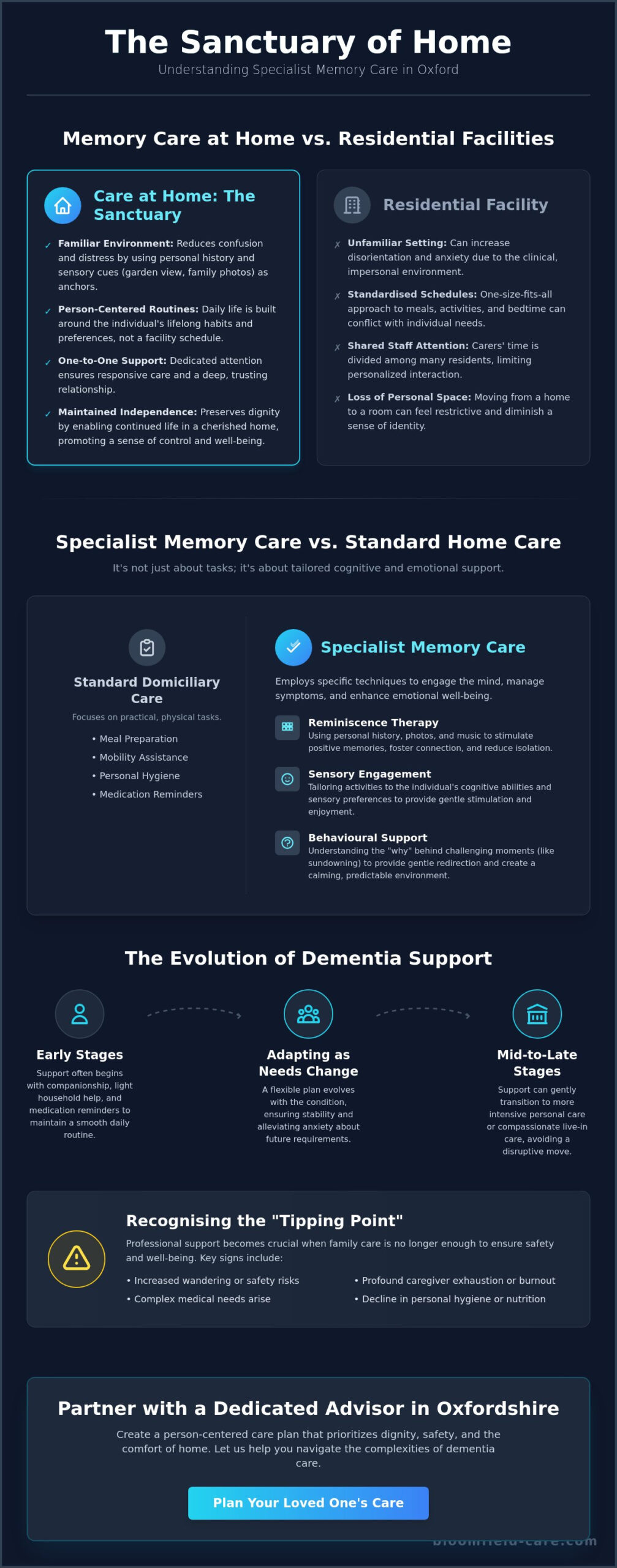
Memory Care at Home vs. Residential Care Homes in Oxford
Choosing between the safety of a residential facility and the comfort of home is often the most difficult decision a family faces. While residential homes offer a structured environment, they can sometimes feel clinical and detached from a person’s unique life story. In contrast, memory care at home Oxford focuses on preserving the sanctuary of the private residence. This approach ensures that safety isn’t achieved through locked wards, but through dedicated, one-to-one attention that respects the individual’s history and lifestyle. Many families worry that a home setting isn’t as secure as a care home, but with professional reinforcement, the home can be modified to provide a level of safety that actually exceeds a communal facility where staff must divide their attention between many residents.
Why the ‘Sanctuary’ of home matters for dementia
Staying in a familiar neighbourhood like North Oxford or Headington provides a profound psychological benefit that a new environment cannot replicate. When a person with dementia walks through their own front door or looks out at their own garden, they’re engaging with environmental memory. These familiar surroundings act as a cognitive anchor for those with memory loss, providing silent cues that reduce confusion and agitation. Keeping a beloved pet, tending to familiar rosebushes, or simply having personal mementos within reach serves as a powerful therapeutic tool. This continuity of environment helps maintain a sense of self that can easily be lost in the transition to a new, unfamiliar care home setting.
Comparing costs and quality of life in Oxfordshire
When looking at the value proposition of different care models, the one-to-one ratio of home care is a significant advantage. In a residential home, a single carer might be responsible for several residents at once, often leading to a one-size-fits-all schedule. Home-based support flips this dynamic, ensuring your loved one receives undivided attention that adapts to their specific rhythm. While you explore the cost of home care in Oxfordshire, it’s helpful to consider the intangible value of personal autonomy. Being able to choose when to wake up, what to eat, and who to spend time with isn’t just a luxury; it’s a fundamental part of maintaining mental well-being as the condition progresses.
By choosing memory care at home Oxford, you’re investing in a lifestyle that prioritises the individual’s spirit as much as their physical safety. This model of care allows for a level of customisation that is impossible in a communal setting, ensuring that the care plan grows and changes alongside your loved one’s needs while they remain exactly where they feel most secure.
Creating a Safe and Supportive Home Environment
Transforming a private residence into a safe haven for someone with dementia doesn’t mean stripping away the personality of the home. The goal of memory care at home Oxford is to create a space where safety and comfort coexist. Many families feel anxious that their loved one’s house is full of hidden hazards, from steep stairs to confusing layouts. By making subtle, thoughtful adjustments, you can preserve the “homely” feel while significantly reducing the risk of accidents. A professional assessment is often the first step in this process, as expert carers can identify risks that family members might overlook after years of living in the same space. This proactive approach provides the emotional peace of mind you need, knowing that your loved one is protected within their own sanctuary.
Practical environmental adjustments for dementia safety
Simple changes often have the most profound impact on daily life. Improving lighting is essential, as shadows can be misinterpreted as obstacles, leading to anxiety or falls. Using high-contrast flooring helps individuals distinguish between different rooms, while clear, simple signage on doors can reduce the frustration of searching for the bathroom or kitchen. In 2026, technology-enhanced care is playing a larger role in home safety. Standards now frequently include the use of non-intrusive assistive technology, such as fall detection devices and remote health monitoring, which provide an extra layer of security without feeling clinical. A dedicated carer assists in maintaining this hazard-free environment, ensuring that the home remains a place of rest rather than a source of confusion.
- Lighting: Increasing brightness in hallways and bathrooms to eliminate dark corners.
- Flooring: Removing rugs that present trip hazards and ensuring a clear path between rooms.
- Visual Cues: Using labels or transparent cupboard doors to help with orientation.
Navigating local Oxford resources and community support
Living with dementia in Oxfordshire means you’re part of a supportive local network. From the resources provided by Oxfordshire County Council to the various dementia cafes found across the city, there are numerous ways to stay connected. Building a multidisciplinary support network is vital for long-term stability. This includes accessing respite care in Oxfordshire, which allows family caregivers the time they need to recharge while ensuring their loved one remains in a safe, professional environment. These community links, combined with expert memory care at home Oxford, create a comprehensive safety net that enhances quality of life for the entire family.
If you’re feeling overwhelmed by the logistics of modifying your home or managing daily routines, reaching out for a professional consultation can provide the clarity you need. You don’t have to navigate these changes alone. Exploring specialist dementia care options today can help you create a sustainable, safe, and joyful environment for your loved one’s future.
The Bloomfield Approach to Memory Care in Oxford
Bloomfield Care stands as a dedicated partner for families across the city, acting as a trusted advisor during times of profound change. We believe that memory care at home Oxford is a deeply personal choice, and our philosophy is built on the foundation of dignity, respect, and reassurance. Every care plan we develop is unhurried and person-centered, focusing on the individual’s autonomy rather than just their diagnosis. We see our role as protecting the sanctity of the private residence while providing the professional safety net necessary for long-term well-being. Our approach is never patronizing; instead, it’s designed to empower your loved one to live with as much independence as possible.
Our person-centered philosophy and dedicated carers
Finding the right support shouldn’t feel like a corporate transaction. We pride ourselves on a rigorous selection and training process that prioritises empathy and integrity alongside healthcare excellence. Our carers are specialists in dementia and Alzheimer care, receiving ongoing development to stay at the forefront of 2026 standards. The Bloomfield “signature” is our unique ability to blend professional safety with the warmth of a domestic environment. We match our carers to clients based on shared interests and personality traits, ensuring that companionship feels genuine and meaningful. Whether it’s through hourly domiciliary care or more intensive support, we listen more than we speak, adapting our approach to the specific nuances of your family dynamic.
This partnership-driven model means we’re constantly learning from you and your loved one. We understand that routines are the bedrock of stability for those with memory loss. By maintaining these rhythms, we reduce the anxiety that often leads to distress. Our carers aren’t just there to manage tasks; they’re there to foster mental well-being and a sense of self-sufficiency. This dedication to excellence ensures that every interaction is rooted in kindness and patience, providing the stability your family needs to navigate the complexities of dementia with grace.
Taking the first step: Your care assessment
Moving forward begins with an open, honest conversation about your needs and aspirations. During a care assessment in Oxford, we visit you at home to understand the daily routines and environmental cues that matter most to your loved one. We involve your family in every decision, ensuring that the transition to professional support is as smooth and empowering as possible. This process is designed to alleviate anxiety, providing a clear roadmap for the logistics of care in Oxfordshire. We believe in transparency and partnership, never rushing your decision-making process. Our goal is to enhance life quality, allowing your loved one to thrive in the place they love most.
Speak with our compassionate team about memory care in Oxford today to discover how we can support your family’s journey.
Embracing a Future Rooted in Comfort and Familiarity
Choosing to keep a loved one in their own home is an act of profound love and dedication. As we have explored, the familiar sights and sounds of a private residence serve as a vital anchor, helping to reduce the confusion and anxiety often associated with dementia. By choosing memory care at home Oxford, you aren’t just managing a condition; you’re preserving a person’s identity and dignity within the sanctuary they’ve built over a lifetime. Whether you’re starting with gentle companionship or require specialist live-in support, the right care evolves with you, providing a seamless safety net for every stage of the journey.
At Bloomfield Care, we’re a family-owned provider committed to a person-centred philosophy that prioritises human connection above all else. As a CQC regulated provider, we ensure that our specialist dementia trained carers deliver professional safety with the heart of a domestic environment. You don’t have to navigate these complex decisions alone. We’re here to listen and guide you toward a solution that brings peace of mind to your entire family. Book a Compassionate Care Assessment in Oxford today to take the first step toward a more supportive future. Your loved one’s sanctuary is worth protecting, and we’re honoured to help you do so.
Frequently Asked Questions
Is memory care at home safe for someone who wanders?
Yes, memory care at home Oxford is a safe and effective option for those who wander when supported by dedicated one-to-one attention. Carers focus on identifying the specific triggers for wandering and use gentle redirection rather than restrictive measures. We also assist with implementing non-intrusive safety measures, such as door sensors or fall detectors, ensuring your loved one remains secure within their familiar environment without losing their sense of freedom.
How does memory care at home differ from a residential care home in Oxford?
The primary difference lies in the level of individual attention and the preservation of a person’s “sanctuary.” In a residential home, staff must divide their time between many residents, whereas home care provides a dedicated professional focused solely on your loved one’s unique needs. Staying at home allows for the continuation of personal routines, the presence of pets, and the comfort of long-held memories, which are often lost in communal settings.
Can home care help with late-stage Alzheimer’s or dementia?
Specialist home care is fully equipped to support individuals through late-stage Alzheimer’s and dementia. Through live-in care, a trained professional resides in the home to provide continuous support with personal care, mobility, and emotional wellness. This ensures that even as needs become more complex, your loved one can remain in a place of peace while receiving the professional safety they require to live with dignity and comfort.
How much does memory care at home cost in Oxfordshire?
The cost of memory care depends entirely on the specific level of support required and whether you choose hourly visits or live-in assistance. Each care plan is customized to the individual’s needs, meaning costs reflect the complexity of the support provided. We recommend checking with Oxfordshire County Council for a care needs assessment to see if you qualify for local funding, or contacting a provider for a private assessment.
What local Oxford support is available for families living with dementia?
Families in Oxford can access a variety of resources, including the Oxfordshire County Council’s social care services and local dementia cafes. Organizations like Age UK Oxfordshire provide valuable guidance on navigating the local care system. Building a support network often involves a combination of professional care services and community-based groups, ensuring that both the individual and their family caregivers have the emotional reinforcement they need to thrive.
How do you choose the right carer for someone with memory loss?
Choosing the right carer involves looking for a blend of specialist dementia training and a genuine personality match. We believe that a successful partnership is built on shared interests and compatibility, which helps foster trust and connection. It’s important to select a professional who values dignity and respect, ensuring they feel like a natural extension of your family rather than a visiting clinician in a clinical role.
What happens if my loved one’s needs increase suddenly?
Care plans are designed to be flexible and responsive to sudden changes in health or behavior. If your loved one’s needs increase, we work closely with your family to adjust the level of support, which might involve increasing domiciliary visits or transitioning to full-time live-in care. This unhurried approach ensures that any changes are handled with grace, minimizing distress for the individual while maintaining their safety and continuity of care.
Do you provide respite care for families in Oxford?
Yes, we provide respite care to give family caregivers the necessary time to rest and recharge. Caring for a loved one with memory loss is rewarding but can be physically and emotionally demanding. Our respite services ensure that your relative continues to receive high-quality memory care at home Oxford in a safe environment, allowing you to step away with the reassurance that their routines are being expertly maintained.