How Much is Domiciliary Care Per Hour? A 2026 UK Cost Guide
Imagine sitting at the kitchen table, looking at a stack of notes and trying to balance the deep desire to keep your father in his own home with the practical reality of a monthly budget. It is a conversation filled with love, yet often clouded by the pressing question: how much is domiciliary care per hour in 2026? You aren’t alone in feeling that the search for support is a delicate walk between ensuring high-quality care and managing financial sustainability. The worry about hidden costs or the confusion between private and council funding can make an already emotional time feel even more taxing.
We’re here to offer you a clear path forward, replacing anxiety with a transparent framework for your home care investment. This guide provides the clarity you need to move forward with confidence, ensuring your loved one feels safe and respected in the sanctuary of their own residence. We’ll explore the various factors that influence hourly rates, explain the £23,250 capital threshold for council support in England, and highlight benefits like Attendance Allowance. By understanding these options, you can build a sustainable plan that prioritizes dignity, wellness, and the comfort of familiar surroundings.
Key Takeaways
- Understand the 2026 UK price ranges for professional support to help you plan a sustainable budget for care in the comfort of your own sanctuary.
- Discover exactly how much is domiciliary care per hour by exploring how geographic location and specific needs, such as Alzheimer’s care, influence the final rate.
- Clarify your eligibility for funding by learning how the latest capital thresholds and local authority assessments impact your family’s contribution.
- Compare the flexibility of hourly visits against the fixed costs of care homes to determine the most cost-effective path for maintaining independence.
- Learn to identify high-quality care by looking beyond the hourly rate to prioritize clinical oversight, staff continuity, and the overall well-being of your loved one.
Understanding Domiciliary Care Costs per Hour in 2026
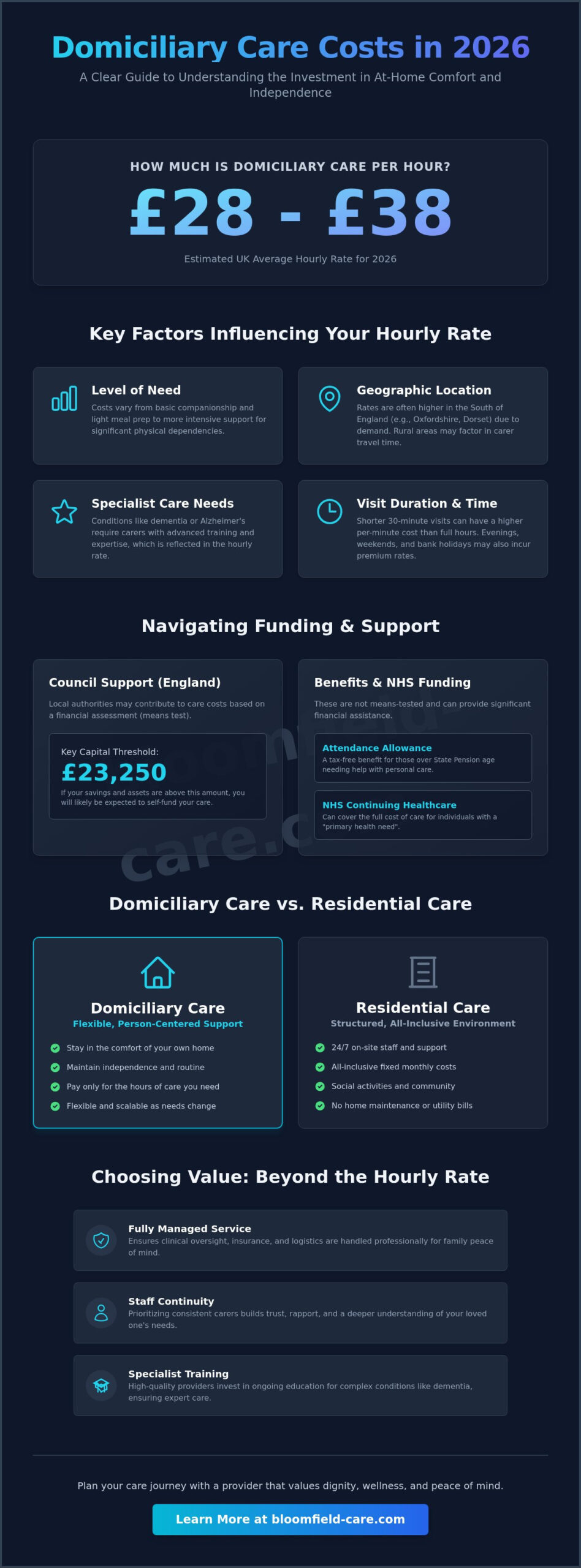
Domiciliary care represents a compassionate choice for those who wish to remain in the comfort of their own home. This person-centered support treats your private residence as a sanctuary, focusing on dignity and independence. When families begin exploring their options, the most pressing question is usually: how much is domiciliary care per hour? For 2026, the estimated UK average range is between £28 and £38 per hour. This hourly model offers immense flexibility. It allows you to scale support up or down as needs change, making it a gentle way to start a care journey without the immediate commitment of a residential move.
Choosing a provider involves understanding the difference between an introductory agency and a fully managed service like Bloomfield Care. An introductory agency acts as a matchmaker, leaving the ongoing management and insurance of the carer to the family. In contrast, a fully managed service takes on the responsibility of clinical oversight, specialist training for dementia care, and consistent quality checks. This professional safety net provides a profound sense of reassurance for families who want to focus on their relationship rather than administrative logistics. You can learn more about the structure of domiciliary care in the UK to see how these professional standards protect individuals and their families.
The 2026 Economic Impact on Care Rates
The pricing for home visits reflects broader economic shifts that have shaped the care sector this year. The National Living Wage has increased, which is a vital step in ensuring that the compassionate professionals who enter your home are paid fairly for their expertise. High-quality staff retention depends on this stability. Additionally, the cost of fuel and vehicle maintenance impacts rates, particularly in sprawling counties like Dorset or Oxfordshire where carers must travel between visits. Providing a sustainable wage isn’t just about logistics; it’s about valuing the human connection and excellence that defines modern companionship and elderly care.
Regional Variations: Oxfordshire vs. Dorset
Where you live plays a significant role in determining the final cost of care. In the South of England, high demand often leads to higher premiums compared to other regions. For instance, rates in urban Oxford may differ from those in coastal areas like Weymouth or the more rural parts of Dorset. Local expertise is crucial here. Providers who understand the specific community integration needs of Oxfordshire or the logistics of the Dorset coastline can offer more reliable schedules. While urban centers might have more available carers, rural travel times can influence the hourly rate to ensure that carers aren’t rushed. This allows them to provide the attentive, unhurried support your loved one deserves in their familiar environment.
Key Factors That Influence Your Hourly Care Rate
When you begin to calculate how much is domiciliary care per hour, it’s helpful to realize that the rate reflects the specific depth of support your loved one requires. A visit focused on gentle companionship or light meal preparation involves different logistics than support for someone with significant physical dependencies. For those with a primary health need, it’s worth exploring NHS continuing healthcare. This funding can cover the full cost of care, providing a vital financial safety net for families managing complex medical situations at home.
Geographic location remains a practical influence on pricing. In sprawling counties like Dorset, the time a carer spends traveling between private residences is a necessary part of the service structure. You may also find that shorter 30-minute visits carry a higher “per minute” cost compared to a full hour. This occurs because the travel and administrative overhead remains constant regardless of the visit length. Choosing a managed service ensures that these logistics, alongside specialist training and professional insurance, are handled with excellence. This structure provides the stability and clinical oversight necessary to maintain your home as a safe sanctuary.
Specialist Care Needs: Dementia and Alzheimer’s
Providing support through different dementia stages requires a deeply person-centered approach and advanced professional training. Specialist dementia care is about more than just presence; it involves a high level of preparation and the ability to adapt to changing needs with patience and grace. Because these conditions often require more intensive clinical oversight, the hourly rate may reflect the additional expertise involved. Consistency is the most important element here. Having the same familiar face visit each day reduces client anxiety and builds a foundation of trust that enhances mental well-being.
Timing: Weekends, Bank Holidays, and Nights
The rhythm of your care schedule also impacts the overall investment. Standard rates usually apply during weekday hours, while Saturday and Sunday visits typically command a premium to honor the dedication of the care team. For those requiring support during the quiet hours, families can choose between “sleep-in” nights and “waking nights.” A sleep-in involves a fixed fee, provided the carer is only needed occasionally. However, a waking night is charged at an hourly rate because the professional remains alert and active throughout the night. Balancing your schedule across the week can help you manage costs while ensuring continuous safety. If you are unsure which level of support is right for your family, speaking with a dedicated caregiver can help you find a sustainable path forward.
How to Fund Home Care: Council Support and Benefits
Financing a loved one’s support is often the most sensitive part of the journey. It requires a balance of practical planning and emotional resilience. The first step for most families is the Local Authority Financial Assessment. This process looks at both the individual’s care needs and their financial situation to determine if the council will contribute toward their support. In 2026, the capital threshold in England is £23,250. If your loved one has savings or assets above this amount, they will likely be responsible for self-funding their care. For families in Oxfordshire and Dorset, understanding this limit is essential when calculating how much is domiciliary care per hour and planning for the long term.
If you qualify for council support, you aren’t restricted to the providers the local authority chooses. You can request “Direct Payments,” which gives you the autonomy to receive the funding directly into a dedicated account. This allows you to choose a care provider that aligns with your family’s values and specific requirements for companionship or elderly care. In some cases, families choose “third-party top-ups.” This is where a family member pays the difference between the council’s standard rate and the cost of a preferred, high-quality service. For those who find their assets sit above the threshold, reviewing NHS guidance on home care costs can provide a helpful starting point for self-funders.
Non-Means-Tested Support: Attendance Allowance
One of the most helpful forms of support is Attendance Allowance. This benefit is unique because it isn’t based on what you have in the bank; it’s based entirely on the level of support you need. If your loved one is over State Pension Age and requires assistance with personal care or supervision to stay safe, they may be eligible. For the 2026/27 period, the lower rate is £76.70 per week, while the higher rate is £114.60 per week. These funds are paid directly to the individual and can significantly help manage the cost of home care, ensuring that professional support remains a sustainable choice for your family.
NHS Continuing Healthcare (CHC) Funding
For individuals with a “primary health need,” the NHS may cover the full cost of their care through a package called NHS Continuing Healthcare. This isn’t limited to specific diagnoses but rather the complexity, intensity, and unpredictability of the person’s health requirements. The assessment process is thorough and involves a multi-disciplinary team, with the final decision made by the local Integrated Care Board (ICB). If eligible, the NHS funds 100% of the care, whether it’s provided in a care home or as domiciliary care within your own residence. This route ensures that those with significant clinical needs receive excellence in service without the burden of financial strain.
Comparing Hourly Home Care vs. Residential Care Homes
Choosing the right path for a loved one is a profound decision that balances emotional well-being with financial reality. While residential homes offer a fixed cost environment, they often require a significant lifestyle change and the loss of one’s familiar sanctuary. Domiciliary care offers a scalable alternative where you only pay for the time you actually need. When considering how much is domiciliary care per hour, remember that this investment secures one-to-one attention. This level of personalized focus is rarely possible in a facility where staff must divide their time among many residents. Staying at home also offers hidden savings, as it often removes the immediate pressure to sell a family property to fund residential fees.
The “tipping point” between hourly visits and other options usually depends on the intensity of support required. For many, a few hours of help each day is the perfect balance, maintaining independence while ensuring safety. However, if your family is looking at more than six hours of support daily, the math begins to shift. At an average rate of £32 per hour, eight hours of daily care would cost over £1,700 per week. In these instances, transitioning to a different model of support may offer better value while still keeping your loved one in the comfort of their own home. You can speak with our team to explore which schedule best fits your current circumstances.
Is Hourly Care Right for You?
Hourly care is exceptionally cost-effective for low to medium support needs, such as 10 to 15 hours of assistance per week. This might include help with morning routines, meal preparation, or simple companionship to brighten the day. It is also an excellent tool for respite care, giving family caregivers a much-needed opportunity to rest and recharge. By starting with just a few hours, you prevent the “all or nothing” stress of a move to a facility, allowing your loved one to adapt to professional support at their own pace.
Transitioning to Live-in Care
When 24/7 needs arise, live-in care often becomes the more economical and reassuring choice. Standard live-in fees in 2026 generally start between £900 and £1,400 per week, which is significantly lower than the cost of paying for 24 individual hours of visiting care. Beyond the financial benefits, the peace of mind that comes with a constant, familiar presence in the home is invaluable. It ensures that help is always at hand, fostering a sense of stability and profound safety that enhances the individual’s quality of life without the upheaval of leaving their private residence.
Choosing Value: Why the Hourly Rate is Only Part of the Story
When families ask how much is domiciliary care per hour, the conversation naturally begins with the bottom line. However, the true value of care lies in the stability and excellence provided to your loved one within their own home. Opting for the lowest possible rate often comes with hidden compromises, such as high staff turnover or a lack of continuity. For an individual receiving dementia care, seeing a different face every day can be distressing and confusing. Investing in a managed service ensures that the professionals entering your private sanctuary are well-compensated, highly trained, and deeply supported. This creates a foundation of trust where the carer becomes a familiar, reassuring presence rather than a revolving door of strangers.
Your investment covers far more than just a person’s time. It includes rigorous clinical oversight, specialist training for complex conditions, and the administrative strength needed to manage daily logistics. The Bloomfield Care philosophy views dignity and independence as the primary metrics of success. We believe that elderly care should empower the individual, helping them maintain their autonomy and mental well-being for as long as possible. By choosing a provider that prioritizes these values, you’re choosing a sustainable lifestyle choice that enhances life quality rather than just managing it. It’s about finding a partner who listens and respects the sanctity of your family’s routine.
The Importance of CQC Regulation
Choosing a CQC-regulated agency provides an essential safety net that introductory agencies simply cannot offer. This regulation means that the service is regularly inspected for safety, effectiveness, and compassion by an independent body. Professional management also takes the weight off the family’s shoulders during emergencies. If a carer is unwell or needs time off, a managed provider handles the replacement seamlessly. This ensures your loved one is never left without support. This commitment to professional safety is at the heart of our bespoke domiciliary care in Weymouth and the surrounding areas, providing stability you can rely on.
Your Next Steps with Bloomfield Care
Starting this journey doesn’t have to feel overwhelming or rushed. Our process begins with a gentle, unhurried home care assessment in your local area. We take the time to listen to your story, understanding not just the physical requirements but the personality and preferences of the individual. This allows us to match carers based on shared interests and temperament, ensuring a natural bond forms from the very first visit. We’ll guide you through the complexities of how much is domiciliary care per hour for your specific needs, helping you find a compassionate and sustainable solution that honors your loved one’s lifestyle with grace and integrity.
Planning a Path of Dignity and Comfort
Navigating the question of how much is domiciliary care per hour is a significant step toward ensuring your loved one remains in their cherished home sanctuary. We’ve explored how hourly support offers the flexibility to scale care as needs evolve. It provides a cost-effective alternative to residential settings for many families. Whether you are utilizing Attendance Allowance or personal savings, the focus remains on the human connection and quality of life that professional companionship provides.
As a CQC Regulated Provider with local branches across Oxfordshire and Dorset, we’re dedicated to delivering excellence through our specialist dementia trained staff. We understand that every family’s journey is unique and deserves a partnership built on integrity and kindness. You don’t have to face these decisions alone. We’re here to listen and provide the stability your family needs. Request a Compassionate Care Assessment Today to discover how we can support your loved one’s autonomy and well-being. Your peace of mind is within reach, and we look forward to helping you create a plan that honors your loved one’s independence.
Frequently Asked Questions
Is domiciliary care cheaper than a care home?
Domiciliary care is typically more economical than a residential home for individuals who require low to medium levels of support. While care homes involve a fixed, high weekly cost that covers accommodation and 24 hour staffing, home visits allow you to pay only for the specific hours you need. This scalable approach helps preserve your financial resources while keeping your loved one in the comfort of their familiar sanctuary.
Does the hourly rate for care increase on weekends?
Most providers apply a premium rate for visits on Saturdays, Sundays, and bank holidays to fairly compensate the dedicated professionals who work during these times. These adjustments reflect the commitment required to maintain a consistent and reliable service throughout the week. When you ask how much is domiciliary care per hour, it’s helpful to request a clear breakdown of weekday versus weekend pricing to help your family build a sustainable budget.
Will the council pay for my hourly home care?
Local authorities may contribute toward your costs if your capital and assets fall below the £23,250 threshold in England. A financial assessment will determine if you’re eligible for full or partial funding based on your savings and care needs. If your assets are above this limit, you’ll likely be responsible for self funding your care, though you’re still entitled to a free needs assessment to help plan your support.
What is the minimum number of hours I can book for home care?
The minimum booking varies between providers, but many agencies require at least 30 or 60 minutes per visit to ensure the support provided is unhurried and person centered. Shorter visits often carry a higher cost per minute because the travel time and administrative overhead for the carer remains the same. This structure ensures that your loved one receives the attentive, high quality assistance they deserve.
Are there hidden costs like travel or admin fees in the hourly rate?
Professional managed services usually include travel time, insurance, and clinical oversight within their standard hourly rate. It’s important to ask for a transparent pricing framework during your initial consultation to ensure there aren’t unexpected charges for administration or carer matching. While some introductory agencies might appear cheaper initially, they often add separate fees that can make the total investment higher than a fully managed service.
Can I use Attendance Allowance to pay for domiciliary care?
You can certainly use Attendance Allowance to help manage the costs of staying independent at home. This benefit isn’t based on your savings, so it’s available regardless of your bank balance if you’re over State Pension Age and have care needs. For the 2026/27 period, the higher rate is £114.60 per week, which provides a significant contribution toward professional companionship or elderly care in your private residence.
How often do hourly care rates increase?
Care rates are typically reviewed once a year, often in April to coincide with changes to the National Living Wage and the cost of living. These adjustments are necessary to ensure that the compassionate people who support your family receive a fair and sustainable wage. A trusted provider will always discuss these changes with you well in advance, providing the stability and clarity you need to manage your long term care plan.
What happens if my carer is sick or on holiday?
A fully managed service takes on the responsibility of finding a suitable replacement if your regular carer is unwell or away. They’ll match you with another professional who is already familiar with your care plan, ensuring that your routine isn’t disrupted. This professional safety net provides a profound sense of reassurance, as it means your loved one is never left without the essential support they rely on for their well being.