How Care Agencies Vet and Train Their Carers: What Families Should Know
What helps show that a carer is ready to support someone you love at home: thorough background checks, relevant training, or the way the agency supports them once care begins? Understanding how care agencies vet and train their carers means looking beyond reassuring promises. Recruitment checks matter, but ongoing supervision helps carers apply their learning in safe, respectful and person-centred ways.
It’s natural to want clear answers before inviting someone into a family member’s home. You may want to know whether references have been checked, whether a carer can support personal or specialist needs, and what happens if concerns arise. A good conversation with an agency should leave you informed about its processes, not simply reassured by general claims.
This article explains the checks, induction and training you can ask about, as well as the role of supervision and competency reviews. It also offers practical questions to help you assess whether a carer’s experience suits your loved one’s needs, routines and preferences. With a clearer view of these safeguards, you can discuss care options while keeping dignity, independence and familiarity at the heart of the decision.
Key Takeaways
- Learn how care agencies vet and train their carers, and why no single check proves that someone is suitable for every role.
- Ask how induction, ongoing learning and practical competency checks prepare carers for the needs of the person they’ll support.
- Compare agencies by how clearly they explain their checks, specialist learning, supervision and process for raising concerns.
- Look for respectful communication, consent, reliability and attention to familiar routines as signs of thoughtful care.
- Explore whether Bloomfield Care’s domiciliary, live-in and specialist dementia care could suit your loved one’s needs and preferences.
How care agencies vet their carers before home visits
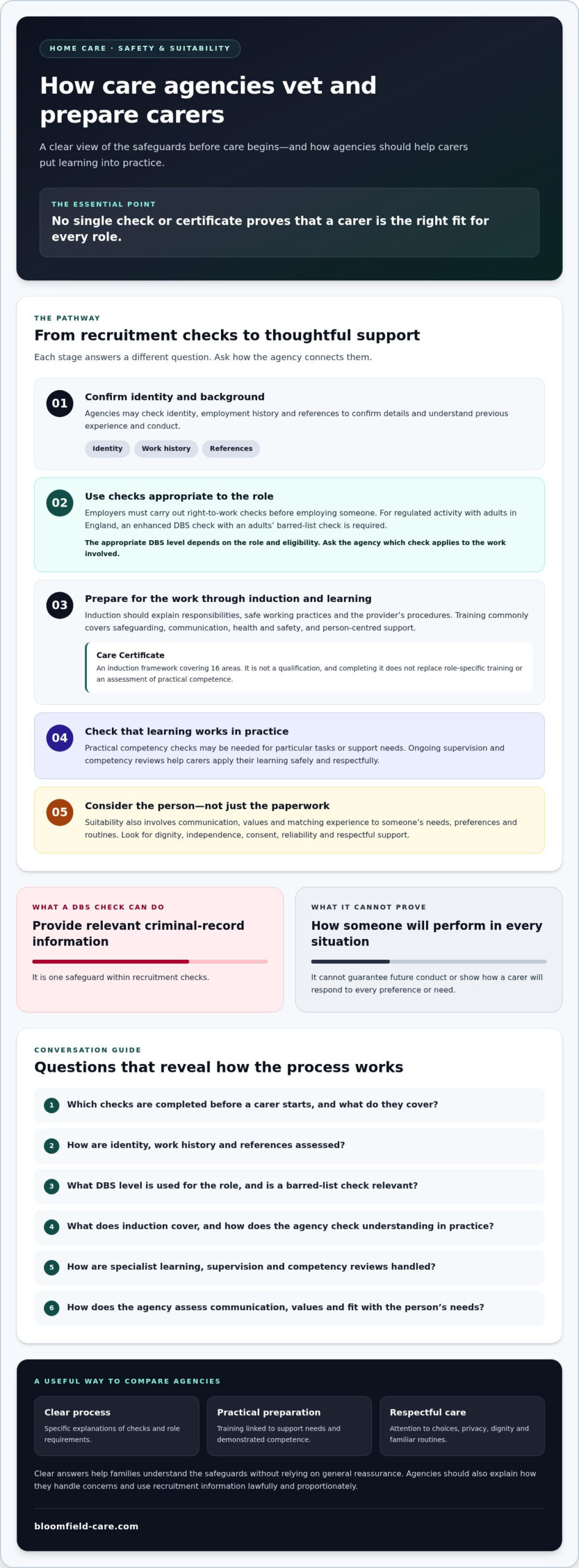
Inviting a carer into someone’s home is a personal decision. Families deserve clear information about how an agency checks a candidate’s identity, history and suitability before care begins. Vetting combines pre-employment checks with assessments. No single certificate can prove that a carer will be the right match.
Home care, also known as domiciliary care, takes place in a person’s own home. You can read a general overview of home care in the United Kingdom, including the role of regulators such as the Care Quality Commission in England. Recruitment processes can vary between providers and roles, so ask an agency to explain its current procedures rather than relying on broad claims.
What checks might a care agency carry out?
Agencies may check identity, employment history and references to confirm a candidate’s details and learn about their experience and conduct in previous roles. These checks are most useful when considered together. A reference can provide context about someone’s work, while an interview or suitability assessment can help the agency understand how they approach respectful support.
For roles involving regulated activity with adults in England, an enhanced DBS check with a check of the adults’ barred list is required. The appropriate level depends on the role and eligibility, so families can ask which check applies to the work the carer will do. Employers must also carry out right-to-work checks before employing someone. This is general information, not legal advice; an agency should be able to explain how it follows current official guidance.
What can a DBS check tell a family?
A DBS check can provide relevant criminal-record information, but it can’t show how a carer will communicate, respond to someone’s preferences or perform in every situation. A DBS check is one safeguard, not a complete assessment of a carer’s suitability or a guarantee of future conduct.
Agencies should handle personal information lawfully and proportionately, and explain what information they use in recruitment decisions. You don’t need to ask for private details about an individual’s record. Instead, ask how the agency considers suitability beyond criminal-record information and how it matches a carer’s experience to a person’s needs.
- Which checks are completed before a carer starts, and what do they cover?
- How are identity, work history and references assessed?
- What DBS level is used for the role, and is a barred-list check relevant?
- How does the agency assess communication, values and suitability for the person receiving care?
Clear, specific answers help you understand how care agencies vet and train their carers, including what happens after recruitment to prepare carers for thoughtful support.
How care-worker induction and training prepare carers for the role
Pre-employment checks help an agency understand who a candidate is; induction and training prepare them for the work itself. Induction should explain the carer’s responsibilities, safe working practices and the provider’s procedures. Learning needs to continue, with practical competency checks where a task or a person’s support needs require them. A course certificate alone can’t show how someone will apply their learning in a particular home.
Ask what the agency’s training covers and how it checks that carers understand and can use what they learn. Common areas include safeguarding, communication, health and safety, and person-centred support. These topics should help carers protect someone’s wellbeing while respecting their choices, privacy and familiar routines. The Care Quality Commission (CQC) regulates health and social care in England, and its guidance can help families understand the standards providers are assessed against.
What does the Care Certificate cover?
The Care Certificate is an induction framework that supports the knowledge and behaviours expected of new health and social care workers. Its current standards, updated in March 2025, cover 16 areas, including a standard on learning disability and autism awareness. It isn’t a qualification. Completing the framework also doesn’t replace role-specific training or an assessment that a carer can carry out particular duties safely.
Ask whether the agency uses the Care Certificate, how it supports new carers through it, and how it checks understanding in practice. A clear answer should distinguish completing learning from demonstrating competence.
How should training reflect a person’s care needs?
Training is most useful when it relates to the person receiving care. Training should match the person’s needs, because good support depends on applying knowledge with respect for their routines, preferences and choices. For someone living with dementia, relevant learning may help a carer communicate calmly, provide reassurance and maintain familiar routines. Ask how this learning is reflected in the person’s agreed care plan.
Medication support also calls for care and clear boundaries. Ask what training a carer receives, how their competence is checked for the support they’ll provide, and how they’re expected to follow the care plan and the agency’s procedures. Don’t assume that a general course automatically prepares someone for every medication-related task.
Training shouldn’t stop after induction. Ask how the provider identifies when refresher learning or further training is needed, including when a person’s needs change. These questions help you understand how care agencies vet and train their carers beyond recruitment and initial learning. Families considering care at home can also discuss care needs with Bloomfield Care and ask how support could reflect an individual’s needs and routines.
How to compare care agencies’ vetting, training and supervision
A checklist is useful, but the quality of an agency’s answers matters more than the number of items it can name. A DBS check or training certificate alone can’t establish the quality of care someone will receive. Ask for practical examples of how checks, learning and ongoing support relate to the person’s needs. The linked text of the Domiciliary Care Agencies Regulations can provide background, but ask the agency how it follows the current requirements that apply to its service.
| Area | Questions to ask | What a clear answer should explain |
|---|---|---|
| Checks | Which checks are completed before a carer starts, and how are references assessed? | What the process covers, without disclosing another person’s private information. |
| Induction | What does induction cover, and how is completion reviewed? | How new carers learn the provider’s procedures and expectations. |
| Specialist learning | How is learning matched to dementia or other specific support needs? | How training relates to the person’s care plan and routines. |
| Supervision | How do carers receive feedback after care begins? | Who provides support and how learning needs are identified. |
| Concerns | Who should we contact, and how are concerns followed up? | How to raise an issue and what communication to expect next. |
Questions to ask about recruitment and training
Listen for specific explanations rather than broad assurances. “We check references” tells you less than an answer explaining how the agency verifies work history and considers reference information. Ask how induction, practical competency and role-specific learning are recorded and reviewed. You’re not expected to inspect confidential staff records; the aim is to understand the process and who is responsible for it.
What ongoing supervision should families ask about?
Training and supervision should continue as care develops. Ask how carers receive guidance and feedback, and how the agency responds when a person’s needs, routines or preferences change. If a carer’s responsibilities change, find out how the agency checks that their preparation suits the revised role. Discuss how updates are shared with the family and how continuity is approached, without assuming the same carer will always be available.
Clear answers help you understand how care agencies vet and train their carers as an ongoing process, not just a series of recruitment checks. If you’re exploring home support in Dorset, read more about bespoke domiciliary care in Weymouth and consider what to ask about an arrangement that respects the person’s preferences.
How to tell whether training is put into practice during care
Training matters most when it shapes everyday support. Families can observe how a carer communicates, respects choices and follows the person’s agreed routines. No single visit tells the whole story, but noticing patterns and listening to the person receiving care can help you assess whether support feels respectful and consistent.
Signs that support respects dignity and independence
Consider these four areas during and after visits:
- Respectful communication: Does the carer speak directly to the person, listen patiently and explain what they’re doing?
- Consent and choice: Do they ask permission and offer choices, rather than taking over tasks the person can manage themselves?
- Reliability: Does support happen as agreed, and are changes communicated clearly?
- Familiar routines: Does the carer follow the person’s preferences around daily habits, privacy and how they like things done?
These details matter because someone’s home is a private, familiar space. A considerate carer supports independence while taking the person’s comfort and wishes seriously. Where possible, ask the person how they feel about the support. Their comfort and feedback are central, even if they express them differently from family members.
A care plan can turn preferences and support needs into practical guidance for carers. Clear updates or handovers can also help prevent important information, such as a change in routine or communication preference, from being overlooked. Ask how carers access relevant guidance and how updates are shared, without making assumptions about an individual carer’s performance.
What should families do if they have a concern?
If something doesn’t match what was agreed, raise it respectfully with the agency through its stated process. Share specific details, such as what happened, when it happened and how it affected the person. This gives the agency a clearer basis for understanding the concern and explaining appropriate follow-up.
You can also ask how carers receive supervision and feedback, and how practical competency is assessed for the support they provide. These are reasonable questions about the agency’s processes, not accusations against a particular carer. If there’s an urgent safety concern, raise it promptly with the appropriate services.
Understanding how care agencies vet and train their carers is only part of assessing care; it also matters how support feels in practice. If you’re considering care at home, discuss your care needs with Bloomfield Care and explain the routines and preferences that matter to your loved one.
Choosing a home-care agency: discuss the process and the personal fit
Good safeguards matter, but choosing an agency also means considering how it listens and responds. Clear explanations about checks, training, supervision and handling concerns help you understand the process. Notice the quality of the conversation too: does the agency take time to understand the person, answer questions directly and respect their preferences?
Match the agency’s support to the person, not just the checklist
A useful discussion starts with the person’s everyday life, not only a list of tasks. Consider the routines they value, how they prefer to communicate, what they can do independently and where support may help. Include any relevant dementia or Alzheimer’s needs. The aim is to explore support that fits the person, rather than expecting them to adapt to a standard arrangement.
Bloomfield Care provides home-based support, including domiciliary care, live-in care and specialist dementia care. Its branches cover areas including Dorset, Oxfordshire and West Berkshire. Families in Wallingford, Newbury, Thatcham, Abingdon, Oxford, Weymouth, Christchurch and Poole can ask about current availability and whether the support they’re considering is suitable. If live-in support may be appropriate, explore live-in care in Oxfordshire, Dorset and West Berkshire.
A conversation about needs can help clarify which options may fit. If you’re considering a short-term arrangement, explain that too and ask what support may be appropriate, without assuming every provider offers the same options.
What to discuss before taking the next step
Before making a decision, prepare questions about how the agency understands someone’s needs and turns them into a care plan. Ask how important updates are shared, who to contact with a concern, and how the agency reviews support if routines or needs change. Specific answers can help you assess whether the provider’s approach matches what matters to your family.
Involve the person receiving care as much as they wish and are able. They may want to lead the conversation, share particular preferences or simply listen while someone they trust asks questions. Their choices and comfort should remain central.
Understanding how care agencies vet and train their carers helps you ask informed questions, but personal fit matters too. Bloomfield Care welcomes families to discuss their needs and explore whether local domiciliary, live-in or specialist dementia care may be relevant. You don’t need to decide everything at once. Start with an open conversation about what would help your loved one feel comfortable, respected and supported at home.
Take the next step with confidence
Choosing care involves more than a checklist. Understanding how care agencies vet and train their carers helps you ask clear questions about recruitment checks, induction, specialist learning and ongoing supervision. Then consider how those processes translate into support that respects the person’s choices, dignity and familiar routines.
Look for specific, straightforward answers, and make space for the person receiving care to share what matters to them. A thoughtful conversation can help you explore whether the support and personal approach feel right for your family, without rushing a decision.
Bloomfield Care provides home-based domiciliary and live-in support, including specialist dementia care. Its local branches cover areas including Wallingford, Newbury, Thatcham, Abingdon, Oxford, Dorset, Weymouth, Christchurch and Poole. Ask about current availability when discussing your needs.
Talk with Bloomfield Care about support that feels right for your family. Start with a conversation about the care, routines and preferences that matter to your loved one.
Frequently Asked Questions
What checks should a care agency carry out before a carer starts work?
Ask the agency to explain its recruitment checks. These may include confirming identity, reviewing employment history and references, checking the person’s right to work, and arranging the DBS check appropriate to the role. Requirements can depend on the work involved, so don’t assume every check applies in exactly the same way to every position. These safeguards don’t predict future conduct; ask how the agency also assesses suitability, training and ongoing supervision.
Is a DBS check enough to show that a carer is safe?
No. A DBS check is one safeguard, not a guarantee of how someone will behave or provide care. Ask what other checks the agency carries out, when they’re completed and how it assesses a candidate’s suitability. It’s also useful to understand how carers receive training and oversight after they start. A provider should explain its process clearly, without suggesting that a certificate alone proves the quality of care.
What training should a home carer have?
Training should prepare a carer for their role and the needs of the people they support. Ask about induction and learning in areas such as safeguarding, communication, health and safety, and person-centred care. If the care plan includes specific needs, ask what relevant learning is provided and how practical competence is assessed. You can also ask how the agency identifies when refresher training or further learning may be appropriate.
Does the Care Certificate qualify someone as a care worker?
No. The Care Certificate is an induction framework that supports essential knowledge and practice for people new to health and social care; it isn’t a standalone qualification. Its 16 standards were updated in March 2025. Ask how the agency uses the framework, checks understanding and assesses practical competence. Completion alone doesn’t show whether someone is prepared for every task or for the individual needs of a particular person.
How can I compare care agencies’ training and supervision?
Ask each agency the same questions about recruitment checks, induction, specialist learning and supervision. Compare how clearly it explains its process, who supports carers after they start and how the agency adapts when care needs change. Ask how the care plan is reviewed and who you can contact with concerns. Understanding how care agencies vet and train their carers means considering ongoing support as well as initial checks and certificates.
What should I do if a carer does not follow the care plan?
If there’s no immediate emergency, contact the agency using its stated process and give clear details about what happened, when it occurred and how it differed from the agreed support. Ask what follow-up is appropriate and whether the care plan or communication needs reviewing. If someone may be in immediate danger, seek urgent help from the appropriate emergency services. For other reporting routes, check current official guidance for your area.
Can families ask to meet or discuss a carer before care begins?
Yes, you can ask the agency how carers are introduced and whether a conversation or meeting can be arranged. The person receiving care should be involved as much as they wish and are able. Use the discussion to share routines, preferences and communication needs, and ask how continuity is approached. Bloomfield Care supports people at home in areas including Wallingford, Newbury, Thatcham, Abingdon, Oxford, Dorset, Weymouth, Christchurch and Poole; check current availability directly.