Compassionate Live-in Dementia Care in Dorset: 2026 Guide
Imagine your father sitting in his favourite armchair in Dorchester, watching the garden birds while enjoying a familiar cup of tea, exactly as he has for thirty years. For many families across the county, the thought of losing these small, sacred moments to a clinical facility is heartbreaking. Choosing live-in dementia care Dorset means your loved one doesn’t have to say goodbye to the home they love or the local routines that define them. It transforms the private residence into a safe sanctuary where professional support meets the warmth of a familiar, cherished environment.
You likely feel the heavy weight of caregiver burnout and the quiet anxiety that comes with night-time wandering or complex Dorset Council funding rules. It’s natural to feel torn between ensuring their safety and wanting to protect their dignity. This 2026 guide is here to show you that a beautiful middle ground exists, one where your loved one remains independent and you finally find lasting peace of mind. We’ll explore how person-centred planning works, clarify the latest capital thresholds for 2026, and explain how specialist live-in support provides the stability and heart your family deserves.
Key Takeaways
- Learn how specialist support allows your loved one to maintain their familiar routines while ensuring 24/7 safety and comfort in their own home.
- Understand the benefits of 1:1 care ratios compared to residential settings, focusing on the preservation of dignity and highly personalised attention.
- Discover why live-in dementia care Dorset is a sustainable alternative to care homes, providing fixed weekly rates for clear financial planning.
- Navigate the 2026 funding landscape with a step-by-step guide to requesting a Care Needs Assessment and accessing Attendance Allowance.
- See how structured daily routines and expert medication management can significantly reduce the anxiety and confusion often associated with dementia.
Understanding the Need for Specialist Dementia Support in Dorset
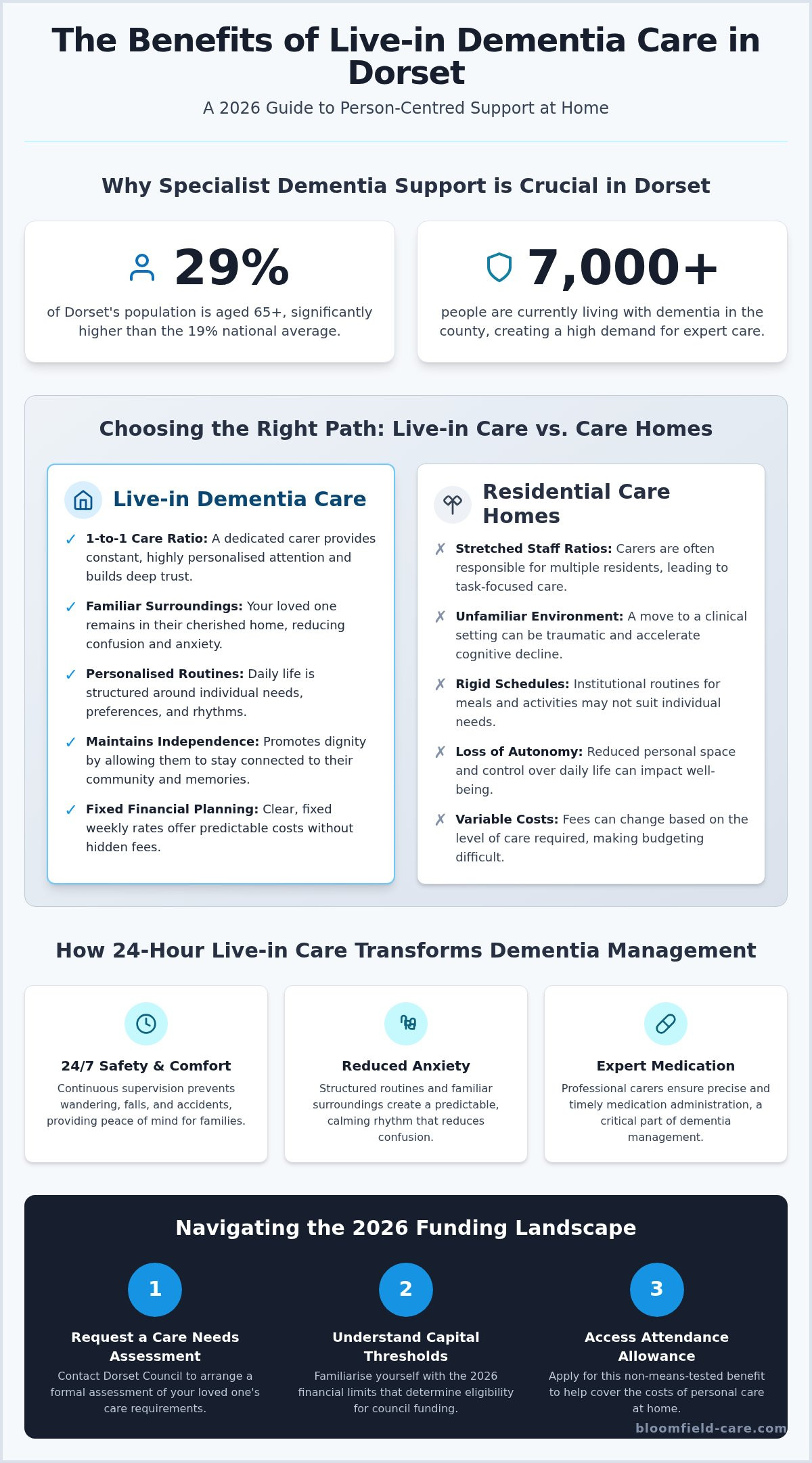
Dorset is home to a unique demographic, with 29% of the population aged 65 and older. This is significantly higher than the 19% average across England and Wales. With over 7,000 people currently living with dementia in our county, the need for specialist, local expertise has never been greater. Live-in dementia care Dorset provides a 24/7 dedicated support system where a professional carer resides within the home to offer continuous assistance. It serves as a vital bridge between preserving a person’s independence and ensuring their absolute safety.
Specialist care is particularly effective at managing “sundowning,” a distressing period of increased confusion and agitation that often occurs in the late afternoon. For a detailed look at the clinical stages of these conditions, you can consult this comprehensive guide to dementia. When a person remains in their own home, the familiarity of their surroundings acts as a natural anchor, significantly reducing the severity of these symptoms compared to a move into a clinical facility.
The Tipping Point: When Hourly Care is No Longer Enough
Many families start with visiting care, but there comes a moment when short hourly bursts are no longer sufficient. You might notice your loved one becoming increasingly agitated during the evening or perhaps they’ve started wandering at night. These are clear signs that the complexity of their needs has evolved. Visiting carers, while helpful, cannot provide the constant supervision required to manage these risks safely. By choosing a live-in arrangement, you provide a consistent presence that prevents the falls or accidents that frequently lead to hospital admissions in Dorset. It’s about moving from reactive crisis management to proactive, person-centred support.
The Stability of Familiar Surroundings in Dorset
The concept of “place memory” is incredibly powerful for those living with cognitive challenges. Whether it’s a home in Weymouth, Christchurch, or Poole, the layout of a kitchen or the view of a familiar garden provides a sense of security that no care home can replicate. Moving a person with dementia into a clinical setting can be deeply traumatic, often leading to a rapid decline in well-being. By staying at home, your loved one can maintain their local social links and enjoy the sanctuary of their own space. This continuity of environment is a cornerstone of dignity, allowing them to follow their own rhythm in the place they feel most secure.
How 24-Hour Live-in Care Transforms Dementia Management at Home
Specialist carers don’t simply “watch” a person; they actively manage the environment to promote long-term well-being. This includes precise medication administration and preparing nutritious meals that stimulate appetite, which can often decrease as dementia progresses. Following NHS guidance on dementia care and support ensures that these clinical needs are met with professional rigour while maintaining the warmth of a home setting. When you choose live-in dementia care Dorset, you’re ensuring that the complex logistics of health management are handled with grace and expertise.
A structured daily routine provides a predictable rhythm that calms the mind. Anxiety often drops when a person knows exactly what happens next in their day. Whether it’s creating memory boxes to spark long-term recollections or taking gentle walks through the quiet paths of Christchurch parks, these activities are tailored to the individual’s history. This level of Understanding Dementia Stages allows the carer to adjust the pace of the day based on the person’s current cognitive energy and emotional needs.
One-to-One Attention vs. Shared Care
In many care settings, staff are often stretched thin, leading to task-focused interactions rather than person-centred care. Live-in dementia care Dorset offers a 1:1 ratio that’s impossible to replicate in a residential home. A single, dedicated carer learns the subtle cues that signal discomfort, hunger, or joy before they escalate into distress. This continuity of care builds a foundation of deep trust, which is essential for someone who finds the world increasingly confusing. It eliminates the “revolving door” of visiting carers, providing a steady, calming presence that eventually feels like family.
Integrating with the Dorset Community
Isolation is a significant risk for those staying at home, but a specialist carer ensures the house remains a sanctuary without becoming a prison. They support safe outings to local landmarks, perhaps a stroll along the Weymouth seafront or a visit to a favourite local cafe. These outings maintain cognitive engagement and social links, which are vital for mental health. Human connection isn’t a luxury; it’s a clinical necessity that helps slow cognitive decline. If you’re looking for a partner to help maintain this quality of life, our team at Bloomfield Care can provide the dedicated support your family deserves.
Choosing Care Homes or Live-in Support in Dorset
When the time comes to decide on the future of a loved one’s care, the choice often feels like a trade-off between safety and happiness. While residential care homes in Weymouth or Poole offer a structured environment, they typically operate on a one-to-many staffing ratio. This means a single carer might be responsible for several residents at once, making it difficult to provide immediate, personalised attention. In contrast, live-in dementia care Dorset provides a dedicated 1:1 ratio. Your loved one receives the undivided attention of a specialist who knows exactly how they like their tea or when they need a quiet moment of reflection.
This personalised approach extends to lifestyle choices that are often curtailed in institutional settings. For many, the ability to keep a beloved pet is the deciding factor. Pets provide immense emotional support for those with cognitive challenges, yet most care homes cannot accommodate them. Staying at home means maintaining these vital bonds and keeping the freedom to eat, sleep, and socialise on one’s own terms. For a deeper dive into these differences, our Bloomfield Care Home or Care at Home? guide offers a comprehensive look at the 2026 landscape.
The Emotional Impact of Relocation
Moving someone with advanced Alzheimer’s can trigger what clinicians call “transfer trauma.” This is a period of intense distress, confusion, and physical decline caused by a sudden change in environment. By choosing live-in dementia care Dorset, you preserve their sense of identity and autonomy. They remain in the sanctuary where their memories were made. Family traditions, like Sunday lunches or unrestricted visiting hours for grandchildren, continue without the constraints of a facility’s schedule. This stability is often the best medicine for a mind that finds newness frightening.
Financial Considerations for Dorset Families
Many families worry about the cost, but it’s vital to look at the full picture. Care home fees in Dorset often include hidden extras and can escalate quickly as a person’s needs become more complex. Live-in care through a provider like Bloomfield uses a fixed weekly rate, which offers much-needed financial transparency for your planning. This model is especially cost-effective for couples who wish to stay together; they receive support for one price rather than paying for two separate beds in a residential home. You can find more detail on this in our guide to The Cost of Home Care in Oxfordshire and Dorset.
Navigating the Logistics: Funding and Home Preparation in Dorset
Arranging live-in dementia care Dorset begins with a formal Care Needs Assessment from Dorset Council. This is a vital first step. It identifies the specific level of support required and determines if your loved one is eligible for financial help from the local authority. In 2026, the capital thresholds remain a key factor in this decision. Those with assets over £23,250 are typically expected to self-fund their support, while those with assets below £14,250 may receive significant assistance. Even if you intend to fund the care privately, this assessment provides a professional roadmap for the journey ahead.
Financial support isn’t always means-tested. Attendance Allowance is a non-means-tested benefit for those over state pension age who need help with personal care due to a physical or mental disability. For 2026, the higher rate is £114.60 per week, and the lower rate is £76.70 per week. These funds can be used directly towards the cost of a specialist carer. Alongside financial planning, establishing a Lasting Power of Attorney (LPA) for health and welfare is a compassionate way to ensure your loved one’s preferences are respected if their capacity to make decisions changes.
Accessing Local Authority Support
Eligibility for funding often depends on whether the primary need is health-based or social. NHS Continuing Healthcare (CHC) is fully funded support for those with complex, intense, or unpredictable healthcare needs. If your loved one doesn’t qualify for CHC, Dorset Council may still offer direct payments, which give you the flexibility to choose your own provider. It’s helpful to work closely with local GPs and Admiral Nurses who understand the specific dementia support networks available in Weymouth, Poole, and the wider county. They can advocate for your family during the assessment process and help you access the right tier of support.
Creating a Dementia-Friendly Sanctuary
Preparing the family home is about balancing safety with the comfort of a familiar domestic environment. Simple, person-centred modifications can make a profound difference. Increased lighting helps reduce shadows that may cause confusion or falls, while clear signage on doors helps with navigation around the house. You’ll also need to prepare a private room for the carer. This space should be a comfortable, quiet sanctuary for them, ensuring they remain well-rested and able to provide the high-quality, 1:1 support your loved one deserves. If you’re ready to start this journey, you can contact Bloomfield Care for a personalised consultation to discuss your home’s specific needs.
Why Families Trust Bloomfield Care for Live-in Dementia Support
Choosing a provider for live-in dementia care Dorset is a decision rooted in love and the desire for the highest possible quality of life. At Bloomfield Care, we understand that we aren’t just providing a service; we’re becoming guests in your home and partners in your family’s journey. Since our founding in 2014, we’ve maintained a CQC Good rating by prioritising a person-centred philosophy that places the individual’s dignity at the heart of everything we do. Our deep roots across Dorset and Oxfordshire mean we understand the local community, from the quiet residential streets of Poole to the breezy promenades of Weymouth.
Our carers are selected through a rigorous process that prioritises emotional intelligence and specialist dementia expertise over mere checkboxes. We look for individuals who possess a genuine sense of kindness and the patience required to support someone through the complexities of memory loss. This local, family-oriented approach ensures that care plans aren’t just clinical documents but reflections of a life well-lived. You can learn more about our regional presence in our guide to Compassionate Live-in Care in Oxfordshire, Dorset, and West Berkshire.
The Bloomfield Care Planning Process
We believe that effective care is a collaborative effort. Our planning process involves the individual and their family from the very beginning, ensuring that every bespoke plan respects their history, preferences, and long-standing routines. Whether it’s ensuring a morning walk along the Christchurch coastline or keeping up with a local gardening club, we integrate the Dorset lifestyle into the daily schedule. These plans aren’t static; we conduct regular reviews to ensure the support evolves as dementia stages progress. This proactive approach empowers the individual, maintaining their autonomy for as long as possible while providing the professional safety net they need.
Starting Your Journey with Us
Taking the first step can feel overwhelming, but we’re here to guide you with grace and clarity. Your journey begins with a free care assessment in your Dorset home, where we listen more than we speak. This session allows us to understand the nuances of your loved one’s personality, their triggers, and what brings them joy. We then use this information to match the perfect carer, ensuring a harmonious fit that feels natural and supportive. If you’re ready to explore how live-in dementia care Dorset can transform your family’s daily life, please contact our Dorset team for a gentle, no-obligation conversation. We’re here to listen, advise, and provide the sanctuary your loved one deserves.
Embracing a Brighter Future for Your Family in Dorset
Choosing the right support is a journey of transition. It’s about moving from the exhaustion of solo caregiving to a partnership that honours your loved one’s history and personal identity. By opting for live-in dementia care Dorset, you ensure that safety and comfort coexist within the sanctuary of the family home. This 1:1 approach doesn’t just manage symptoms; it nurtures the individual’s spirit and maintains those vital local connections that define their quality of life.
As a trusted local Dorset provider with a CQC Good rating, Bloomfield Care offers the reassurance of specialist dementia trained carers who understand the nuances of this condition. We’re here to help you navigate the complex logistics of funding and home preparation with patience and expertise. You don’t have to face these sensitive decisions alone. Our team is dedicated to providing a bridge between independence and necessary support.
To begin exploring a person-centred path for your loved one, please Request a Free Care Needs Assessment in Dorset today. We’re ready to listen and support your family through every step of this journey toward peace of mind and lasting dignity.
Frequently Asked Questions
How much does live-in dementia care cost in Dorset?
Live-in care costs are based on a fixed weekly rate, providing essential financial transparency for your family’s planning. While costs vary based on the complexity of needs, this model is often comparable to high-quality residential homes in Weymouth or Poole. For couples, it’s frequently more cost-effective than residential care because you’re paying for one dedicated carer rather than two separate beds in a facility.
Is live-in care safer than a care home for someone with Alzheimer’s?
Safety is highly personalised when you choose live-in dementia care Dorset. In a residential setting, staff ratios mean one carer looks after many people simultaneously. With live-in support, the 1:1 ratio ensures your loved one has undivided attention. This constant presence significantly reduces the risk of falls and prevents the “transfer trauma” often caused by moving a person into a clinical, unfamiliar environment.
Can a live-in carer help with dementia-related night-time wandering?
Yes, a dedicated carer provides vital support for night-time wandering and “sundowning” agitation. Having a professional present 24/7 means someone is always there to offer gentle reassurance if your loved one wakes up disoriented. They can guide them safely back to bed or provide a calming cup of tea, preventing the distress and danger associated with unsupervised wandering in the early hours of the morning.
What happens if our live-in carer needs a break or goes on holiday?
We manage all holiday and break cover to ensure your loved one’s routine is never interrupted. Our relief carers are also specialist trained and briefed on the specific person-centred plan. We introduce relief staff carefully to maintain a sense of stability and trust. This professional management removes the burden from your family, ensuring that high-quality care continues seamlessly while your primary carer takes their rest.
Does Dorset Council provide funding for private live-in dementia care?
Dorset Council may provide funding following a Care Needs Assessment, depending on your financial circumstances and assets. In 2026, if your assets are below the upper capital limit of £23,250, you might be eligible for local authority assistance. You can often receive this funding as a “direct payment,” which gives you the autonomy to choose a private provider for live-in dementia care Dorset that fits your family’s needs.
How quickly can live-in care be arranged in Weymouth or Poole?
We work efficiently to arrange support as quickly as possible, often within a few days of your initial enquiry. The process starts with a free care assessment in your home to understand your loved one’s personality and clinical requirements. Once we’ve matched the perfect carer to your family, we can begin the transition. Our local presence in Dorset allows us to move faster than many national agencies.
Do live-in carers have specialist training in dementia support?
Every carer at Bloomfield undergoes rigorous, specialist training in dementia and Alzheimer’s support. This goes beyond basic tasks; it focuses on communication techniques, managing complex behaviours, and enhancing mental well-being. Our CQC Good rating reflects our commitment to maintaining these high standards. Our carers aren’t just staff; they’re dedicated professionals who understand how to empower individuals while managing the unique challenges that different dementia stages present.
What space does a live-in carer need in our family home?
A live-in carer requires a private, furnished bedroom to serve as their sanctuary during rest periods. This space should include a comfortable bed, storage for their belongings, and access to Wi-Fi so they can stay connected with their own support network. Providing a quiet, respectful environment for your carer ensures they remain well-rested and fully capable of delivering the compassionate, 1:1 support your loved one needs throughout the day.